


Peres: 'Nationality Law' - attempt to undermine the Declaration of Independence
As they remember Israel's first prime minister David Ben-Gurion, politicians and dignitaries lock horns over contentious bill.
Ben-Gurion supported 'Jewish democracy'
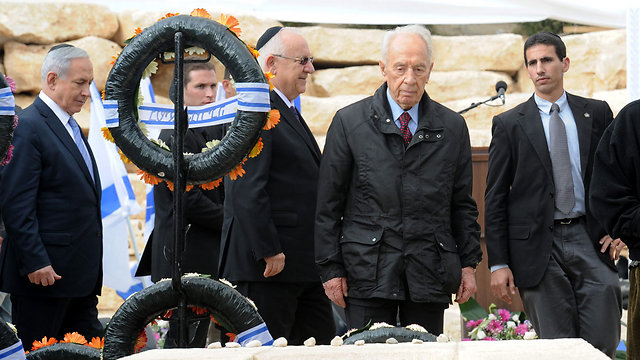
Netanyahu's speech quoted Ben-Gurion, who said in 1948 that he supported “Jewish democracy. The Western one isn’t enough. Being a Jew is not just a biological fact but also a moral and ethical one.”
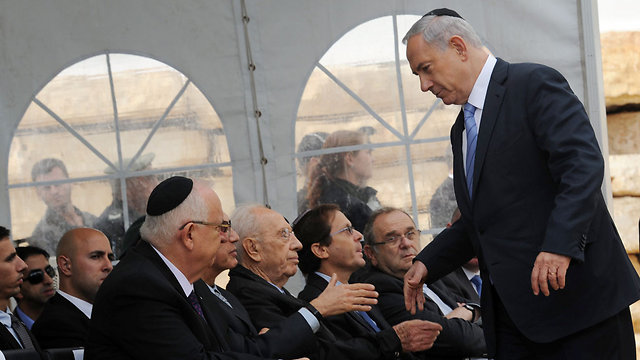
Netanyahu noted that Ben-Gurion was present when the conflict between Arabs and Jews first took root.
“He personally witnessed the Arabs’ refusal to recognize any rights over the land. Incitement and terrorism existed no less than today. His hope that Israel would be a national home for Jews was dashed time and again. But he did not lose hope.
"We want to attain peace with our neighbors, but we see the threats and the instability. And Ben-Gurion also saw them. His conclusion was unequivocal: Israel’s security must be safeguarded for the long term, based on power of deterrence. “
On Wednesday, the Knesset erupted in jeers as Netanyahu spoke about the proposed legislation to officially define Israel as a Jewish state. "The bill I will present will be based on Israel being a Jewish and democratic state,” said Netanyahu. “Israel guarantees equality of personal rights to all its citizens without discrimination based on religion, race, and gender,” he added.
"I oppose a bi-national state. Israel is the national state of the Jewish people and the Jewish people alone," continued the prime minister.
Meanwhile, President Reuven Rivlin opposed the bill. Speaking after Netanyahu at the Knesset, Rivlin noted that the Declaration of Independence emphatically determines the Jewish and democratic nature of the State of Israel.
"The formulators of the Declaration of Independence, with their infinite wisdom, insisted that the Arab communities in Israel, as well as other groups, should not feel as the Jews had felt in exile."
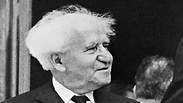
Ben-Gurion headed the government for two terms. The first was between 1948 and 1954, after which he retired to Kibbutz Sde Boker. But in early 1955, he returned to serve as defense minister in Moshe Sharet’s government, and at the end of that year he was elected prime minister for the second time – a position he continued to hold until he stepped down in 1963.
