


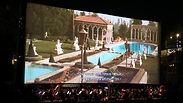
A concert you can't refuse
Live orchestra of 60 musicians plays under the baton of conductor Justin Freer in Jerusalem during a special screening of Francis Ford Coppola’s classic 'The Godfather,' replacing film's recorded soundtrack.
They had just finished watching a special screening of Francis Ford Coppola’s classic movie "The Godfather" – with a live orchestra playing the iconic score, replacing the film’s recorded soundtrack.
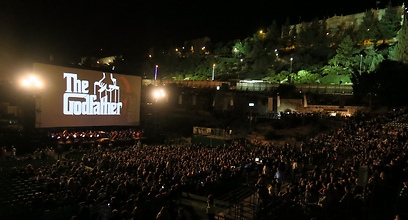
"This is the first time that a live orchestra has accompanied a movie with sound in Israel," said Shauli Baskind, the spokesman for the event. "It’s been done with silent movies before, but never with a movie that has spoken dialogue and a score."
According to Baskind, Bimot Global and Kadishson Productions contracted with Los Angeles-based CineConcerts to perform "The Godfather Live" at Jerusalem’s most impressive venue, Sultan’s Pool.
A local orchestra of 60 musicians, most affiliated with the Jerusalem Symphony Orchestra, was hired to play under the baton of CineConcert’s conductor Justin Freer, while a restored print of "The Godfather" was shown on a giant screen above the orchestra pit.
The special event was held under the auspices of the Jerusalem International Film Festival, which promoted the performance as the official closing of this summer’s festival.
It is hard to imagine a more crowd-pleasing conclusion to the cinematic festival than "The Godfather Live." The name and reputation of the movie alone would, of course, guarantee a sellout crowd of film buffs who would pack any theater in the city. But the added dimension of a live orchestra promoting the screening to the level of a concert clearly was an innovative drawing card.
When the strains of the opening bars of Nino Rota’s score faded into the opening scene with Marlon Brando, the audience was riveted; even the presence of the orchestra in the foreground was no distraction, then or thereafter. On the contrary, as the movie progressed, the musicians became an integral part of the evening. It added greatly to the anticipation of what was to come next to take note when the musicians picked up their instruments in order to continue.
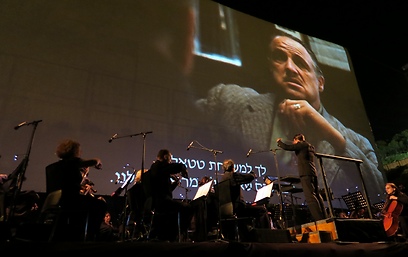
In particular, during solo interludes, the audio experience became a visual one as well: as the bow was drawn across the strings of the cello in the front row, for example, the movie audience was magically transported to a concert hall.
Even though Freer and his team were only in Israel for four days, and he'd had only three rehearsals with the orchestra, the audio combined seamlessly with the visual. The three hours of entertainment seemed to fly by.
As the music played while the final credits rolled, the audience rose to its feet – but hardly anyone made a move to leave. Still photos of the actors working with Coppola appeared on the screen, and it seemed like half the audience was filming them with their cell phones. All the while, the music played on and on; it was after 1 am, but the audience could not get enough. It was almost like a contest to see which would end first: The music or the applause.
The evening clearly left an indelible impression on everyone who attended. And, says Baskind, given the success of this festival finale, plans are afoot to stage an encore (although not necessarily with the same film) next year.
