


Life, theater, and death
Ottilie Mohr, a free-spirited, rich American, hid several Jews in her villa in France during the Holocaust, including artist Charlotte Salomon. Although Salomon herself was murdered in Auschwitz, her paintings were saved. A large exhibit of her works, entitled Life or Theater, opened at Yad Vashem
Eight year old Valerie Paige spent the summer of 1939 in the French Riviera with her mother. One day, they happened to bump into their good friend Ottilie Mohr, a rich American who owned a villa in Villefranche.
“Mohr told my mother that war had broken out the day before and that it wasn’t safe for children to remain in Europe,” Paige recalled in a telephone interview from New York. “She said that she was going back to America, and she offered to take me with her. My mother put me in her hands immediately, without any clothes or any personal items.”
Mohr drove the young girl home in her car. “I’m not Jewish, and I assume that Ottilie invited me because she knew my mother,” Paige recounted. “Eventually, there were more children, mostly orphans. I know that my mother didn’t pay for me, and I’d be very surprised if Ottilie received money for anyone.”
Several refugees were already living in a small cabin in the villa’s courtyard, including painter Charlotte Salomon, then 22, and her grandparents from Berlin. Salomon herself was killed in Auschwitz a few years later, but Mohr managed to preserve the artist’s creations.
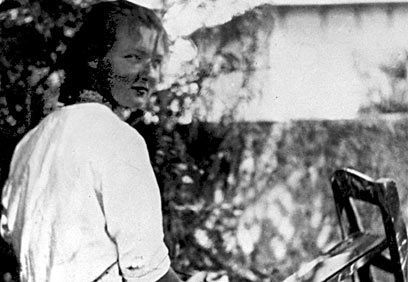
Charlotte Salomon (Photo: Charlotte Salomon Foundation)
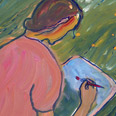
Last month a large exhibit of Salomon’s works, entitled Life or Theater, opened at Yad Vashem. On display are almost 300 canvases, on loan from the Jewish Museum in Amsterdam. In the background, visitors can discern musical selections chosen by Salomon to accompany her paintings. In addition, a newly dedicated wing contains another 23 Salomon drawings and sketches, which were only recently discovered and acquired by Yad Vashem.
“Meticulous detective work over many years allowed us to track these illustrations and bring them to Israel,” curator Yehudit Shendar, Yad Vashem’s art director, noted. The drawings, owned by Mohr’s relatives and some of the child survivors, were previously unknown.
Rich, non-Jewish heiress
Although many owe their lives to her, little has been recorded about Mohr, a rich, non-Jewish heiress whose motives remain unclear. In 1928, she relocated, together with her husband and their baby daughter, from New York to the South of France. They used her father’s money to purchase a villa in Villefranche, near Nice, but their ill-fated marriage was far from harmonious.
“After her husband either fell or jumped to his death during a particularly stormy fight, she decided to become a guardian angel and bring orphans into her home,” Salomon biographer Mary Lowenthal Felstiner reported. “She managed to find dwellings, work permits, papers and medical treatment for many Jewish families. Her relatives sent her money to pay for the children’s upkeep. Her nephew, who lived in the house, remembered the names of over 300 children that lived in the villa.”
During her European travels, Mohr befriended Ludwig and Marianne Grunwald, a wealthy, educated German-Jewish couple. After Hitler rose to power, she offered to shelter them, and a year later, they moved into a small cabin in the villa’s courtyard. The elderly couple had already suffered great tragedy. Both their daughters had committed suicide, and their nine year old granddaughter Charlotte was left behind. Charlotte, the daughter of renowned physician Dr. Albert Salomon, was told that her mother had died from influenza.
Dr. Salomon later remarried Paula Lindberg, a famous opera singer. The lively Lindberg came from a rabbinic family, and Charlotte would accompany her to the synagogue. In addition, Lindberg encouraged Charlotte’s artistic aspirations and even managed to enroll her in the prestigious Berlin Academy of Art, where Jews were no longer welcome.
“During the course of my research, I went to the Academy where Charlotte Salomon studied,” Shendar stated. “In the archives, I found a document from December, 1935, which had a family tree for every student, in order to determine how much ‘Jewish blood’ each one had. Charlotte was the only one who was listed as Jewish on all sides.”
'Life or Theater'
When Charlotte’s father felt the noose tightening, he sent her to France. She left Germany in January, 1939, two and half months before her twenty-second birthday, and went to stay with her grandparents in Villefranche, where she developed a strong friendship with Mohr. Later that same year, Charlotte’s grandmother Marianne tried to hang herself in the shower. She was discovered in time, and Ludwig finally told his granddaughter about the family’s high suicide rate.
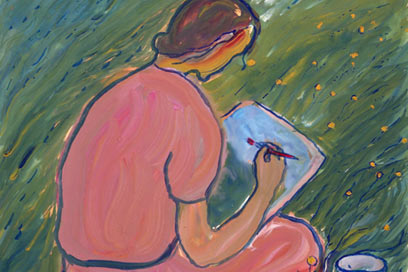
Self portrait (Photo: Charlotte Salomon Foundation)
When the Grunwalds decided to leave Mohr’s home, Charlotte reluctantly accompanied them. It was in their rented apartment in Nice that Marianne Grunwald finally managed to kill herself by jumping out of a window. Charlotte realized that she must find meaning in her own life, in order to avoid the suicidal tendencies that plagued her family.
Charlotte recreated her life in an illustrated story called “Life or Theater”. Although the characters all have fictionalized names, an astute observer can easily identify their real life counterparts. The work, which was dedicated to Mohr, included a postscript in which Charlotte discussed the reality behind the fiction.
From Nice to Auschwitz
Meanwhile, Mohr, who had been desperately trying to obtain exit visas for the orphans in her care, was granted papers for only six of them, on August 19, 1941. Defying the authorities, she took eleven children, including her daughter, her nephew and Paige, to New York, leaving several refugees behind in her villa.
Charlotte was distraught at her patroness’s departure and buried herself in her artwork. After Ludwig collapsed in the street and passed away in February, 1943, his granddaughter returned to Mohr’s villa. She grew close to Alexander Nagler, Mohr’s former lover, who eventually deposited Charlotte’s drawings with a neighbor for safekeeping until the end of the war.
On July 17, 1943, Nagler and Charlotte made a fatal mistake. The couple, who were expecting a child, applied for a marriage license, thus alerting the authorities that Jews were hiding in the villa. On September 24, they were arrested by the Gestapo and later brought to Birkenau. Charlotte, obviously pregnant, was immediately sent to the gas chambers, and Nagler was assigned to hard labor.
“We discovered the daily record from January 1, 1944,” Shendar said. “Nagler is still listed in the morning roll-call, but by the evening, he was no longer among the living.”
In 1946, Mohr returned to France and learnt that Charlotte’s father and stepmother had spent the war hiding in Holland. She presented them with a portion of their daughter’s drawings, which they subsequently donated to the Jewish Museum in Amsterdam. The rest were only recently discovered by Yad Vashem researchers.
Mohr died in 1972, at age 70. According to Paige she died poor, drunk and miserable, after loosing all of her wealth to a vicious lawyer.
