


Respecting their wishes
If a person wishes to be cremated, the law should allow him to do so
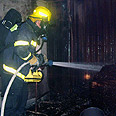
It would be appropriate if Yitzhak Cohen, the minister charged with religious affairs, would retract his declared intention to pass legislation that would define cremation as a criminal offense. In his response to the torching of the crematorium belonging to the company that offers its clientele cremation services alongside burial services, Cohen said that the heads of this company are feeding off the heritage of the annihilators of the Jewish people.
Let's hope that the harsh and justified criticism leveled at this preposterous statement will prompt the minister to consider whether to really propose a bill that would legally prohibit cremation.
Reason leads us to believe that such a proposed bill would not be accepted by the Knesset, yet if it is surprisingly passed it is highly doubtful whether it will stand the constitutional test.
Cremation, which originated in ancient times, is a common secular norm in all western democracies. Some have attempted to find proof of this in Jewish heritage as well. Key reference to this view has been found in the book of Samuel 1, 31:12–13, which records the cremation of King Saul and his sons.
The weakness of this claim stems from the continuation of the story, which says the bones were then buried under a tamarisk tree. It appears that the burning of the bodies constituted an acceptable part of the king's burial ceremony (regarding the kings of Judea.). It is unclear what exactly they burned; yet the king's body was brought for burial.
I shall assume, therefore, that the law takes the side of those who argue that Jewish tradition sanctifies the burial of the dead as an obligatory arrangement in Jewish law, whereas the burning of a body is perceived as opposing Jewish law. However, the existence of a Jewish law ban has no validity in the laws of a democratic country. As long as the ban is not adopted by law, adherence to the religious ban is subject to the conscience of the individual.
Human dignity
Although the law pertaining to Jewish religious services in Israel is in the hands of Hevra Kadisha, which implements Jewish burial customs, this rule constitutes a kind of "default" that has an exception: In the law pertaining to alternative burials passed in 1969, it was recognized that everyone has the right to chose the type of burial in "an alternative civilian cemetery."
This law called for the establishment of civilian cemeteries and placed their management in the hands of burial corporations, which were licensed to do so by the minister of religious affairs.
The only obligation that this law imposes on burial in a civilian cemetery is that the burial procedure is carried out with "dignity for the deceased." This obligation does not imply that cremation of a body in accordance with the deceased person's wishes contradicts the obligation of "dignity for the deceased."
A High Court of Justice ruling determined that "human dignity" - as implied in the basic law pertaining to the protection of "human dignity and liberty" - "is the dignity of the living and the dead." Preserving the dignity of the dead is first and foremost expressed by honoring the deceased person's will, as long as it does not harm another's rights or public regulations.
This rule, which guides law in many aspects, means that even what is done to the body of a person following his death will remain his choice. If new legislation is required, it would be legislation that would explicitly recognize this right.
The writer is a retired Supreme Court justice
