


Why can't middle class buy new car?
Tax benefits aimed at lowering car prices for consumers are instead devoured by market's heavy batters –leasing firms. Reason is tacit alliance between leasing sector, car importers. Government joins bandwagon by raising import tariffs rather than cutting them, thus affecting final prices for private customers
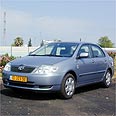
What attracts the most attention is the car's price – NIS 108,500 (about $31,700) – lower than most cars in its class in Israel, the average cost of which is NIS 120,000 ($35,055). Nonetheless, this is no special deal – it is the list price of the Nissan Note – the same car which sold for NIS 120,500 ($35,202) in 2006
Why than did the Note's price drop? Firstly, the Note was no hit on the sales charts as compared with the Mazda 3 and Toyota Corolla, and when a car performs weakly on the sales curve – importers endeavor to lower its price.
Secondly, the arrival to the local market of compact family cars such as the Hyundai Accent i25, which sells for some NIS 110,000 ($32,135), compelled Nissan to reposition its Note as an alternative to the Accent i25.
Thirdly, the Note 2011 is actually a remolded version with a cleaner engine which qualifies the importer for higher tax credits resulting in lower prices for consumers.
Does the Note indicate the shape of thing to come? It is the harbinger of a free market in which Israel's middle class will at last be able to afford a new family car? Sadly, the answer is no.
Green taxing doesn't apply to family cars
These price cuts were suppose to be the result of the new green tax-credits reform which on one hand hiked purchase taxes on new cars from 78% to 83% but on the other hand, afforded nice tax credits worth thousands of shekels which were taken off the price of clean cars. Indeed, in recent years cars are becoming cleaner thanks to new state of the art injection systems and smart gear boxes.
Nonetheless, while the Nissan Note's price dropped, other cars in its class maintained their price level. Moreover, Toyota, Mazda and Hyundai among others manufacture different cars paid for with different currencies yet their price for Israel's consumers remain unchanged.
The reason for this is that the car importers prefer to pocket the tax credits and share them with the leasing companies rather than with costumers, unlike Nissan which reflected the NIS 12,000 ($3,505) tax credit in its prices. Apparently, leasing companies avoid lowering prices on their star models in order to maintain car fleet value, which if affected, may lead to harsh measures against such importers on part of the leasing companies.
Consumer clubs also benefit from importers' pocketing the tax credits and from the lower prices and offer the various cars with considerable discounts (albeit lower than those offered to leasing companies).
Moreover, leasing firms buy the cars at a discount but the use-value paid by the holder of the linked car is based on the full official list price of the new car, thus the discount indirectly benefits those who are affiliated with the right leasing firms or consumer clubs but does not benefit private customers.
And it is not only the market forces which put a spoke in the wheels of private consumers; purchase taxes are as high as 83% from which air pollution credits are deducted.
The tax authorities know that car ownership in Israel is far from its full capacity as compared to other countries and can expect a double profit due to disparities between the center of the country and the peripheries when it comes to traffic congestion – car owners in the center of Israel will soon be subjected to new congestion levies whereas demand in the peripheries will drive sales up to about 240,000 cars in 2011 as compared with 216, 400 last year.
Tax authorities are well aware of the market's growth potential and have no reason to lower taxes as the southern peripheries prefer used cars which they buy form leasing firms which purchase them from importers.
Going small for the long term
Such barriers drive private consumer to buy small cars costing around NIS 60,000 ($17,530) where green taxing has more teeth. Car importers know that most costumers are private since leasing companies will be hard pressed to find buyers and thus roll over the green rating credit to the consumer, which keeps everyone satisfied.
Salvation, however, seems short lived. The tax authorities are gearing up for green tax reforms which aim to mitigate the gaps between pollution levels, aiming among others to extend tax credits to diesel cars as well. Private owners of small cars will bear the brunt as they are the main consumer of this class and car importers have no stake in protecting them.
The car dealership and leasing sectors know that a private family car – a common commodity all over the world – is perceived as an exorbitant dream in Israel. As long as the tax authorities, leasing firms and car importers are raking in the profits, there is no reason to change the formula just for a handful of disgruntled private consumers.
Tax authorities: Unfounded claims
Israel Vehicles Importers Association declined a response; however according to the Israel Tax Authority the objective of the green tax was to increase demand for environmentally friendlier cars regardless of who pockets the tax credit. Furthermore, claims the Authority, figures show far reaching changes in the distribution of imports by pollution levels and increasing demand for manual transmission models which are more economic and environmentally friendlier.
"Just like in any other market in which demand is price-sensitive (whether competitive or not) tax changes reach end consumers partially. Following the reforms, we see a growth in the small car segment which was not represented until then on the market.
In 2009 only a small number of small cars sold for NIS 75,000 ($21,910) whereas in 2011, the sales rate in this price range hit 6%, therefore claims that the end-consumer is not enjoying the tax credits are unfounded."
- Follow Ynetnews on Facebook
