


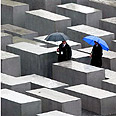
Walking through the memories
צילום: איי פי
Berlin Holocaust memorial inaugurated
Dozens of politicians attend opening ceremony of stone maze commemorating Jewish victims of Hitler
BERLIN - The German capital of Berlin witnessed the inauguration of a Holocaust memorial on Tuesday. Dozens of politicians, together with Jewish community leaders in the city, visited the memorial, erected as a maze near Brandenburg Gate.
German Chancellor Gerhard Schroeder opened the ceremony in which Bundestag President Wolfgang Thierse took part. Speaking on behalf of German parliamentarians, Thierse said that the memorial proves that the Germans are dealing with their past.
“Today we open a memorial that recalls Nazi Germany's worst, most terrible crime, the attempt to exterminate an entire people,” he said.
The American architect Peter Eisenman, who worked on the design of the memorial, said that he hopes the citizens of Berlin will pass between the slabs of the memorial as part of their daily routine.
"I like to think that people will use it for shortcuts, as an everyday experience, not as a holy place," said Eisenman.
He responded to accusations that the memorial was set up too late – 60 years after the victory over Nazi Germany: “In another 100 years, no one will ask if it was too late. For me, it’s still early.”
Controversial design
The inauguration came after years of delays and differences of opinions regarding the design of the memorial and how it was built.
Supporters of the memorial said that the large stones would stand in the midst of the daily Berlin experience, while opponents said the design was too abstract.
Another debate centered on the name, “Memorial for the Murdered Jews of Europe.” Critics said that it did not recognize the non-Jewish victims of the Holocaust, while others in the Jewish community said that the abstract design and lack of religious symbols made it non-Jewish enough.
The memorial stones stand on 19,000 square kilometers, in an area separating the former East Germany from West Germany. Visitors can easily pass through the maze as each stone has its own unique height and shape.
The stones are covered in an anti-graffiti agent in order to prevent vandalism by neo-Nazis. But even this was a matter of controversy.
Eisenman argued in the beginning that anti-Semitic graffiti would serve an educational purpose. Later it was discovered that the same company that produced the agent also supplied poison gas to the Nazi concentration camps.
