


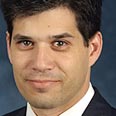
Israeli named to senior SAP post
Shai Agassi to head software development for world's largest business software maker
The world's largest business software maker, SAP, promoted Shai Agassi to head of all software development.
Some analysts say the promotion could place him next in line to head the company. Whatever the future holds, this latest move is another sign of the Israeli entrepeneur's rapid rise through the company ranks.
Indeed, the 36-year-old high-tech wiz has grown into a huge success story and is currently considered one of the world's most influential economic figures.
Those who knew him 10 years ago and were impressed by his eloquence, fluent English, sharpness, and sophistication, likely realized he was no average youngster.
He formed his first startup company, Quicksoft, at the age of 22, and at 33 sold another startup, TopTier, to SAP for more than USD 400 million.
Prior to Tuesday's announcement, Agassi served as a SAP board member, as well as its chief technologist.
Time magazine and the CNN web site chose him as one of the top 20 most influential business figures in the world.
The power of good mentors
In an earlier interview, Agassi said he was never bothered by the Israeli media's tendency to refer to him as a wunderkind. Local journalists tended to play up his youth, almost bringing him to urban legend status, he said.
"In my mind, age is something that's found in your head," he said. "I ignored it."
Agassi said living with the wunderkind label was no burden. He said he never felt responsible for other people's expectations of him, and knew he was capable of doing the things he wanted to do.
He also credits his success to being surrounded by the right people and taking advantage of advice offered by good mentors.
"I had an amazing period with my father, Reuven," Agassi said. "He was my first mentor and I got a lot from him."
Agassi also acknowledges the contribution made by SAP co-founder, Hasso Plattner. He said Plattner is the smartest man he knows and is the type of person that founds industries, not mere companies.
"It's like somebody in the auto industry getting a chance to learn from Henry Ford," he said.
Bankrolled by mom
Agassi grew up in Raanana, but moved to Argentina when his father was sent there through work. He completed his high school studies at 15 and embarked on computer science studies at Haifa's Technion.
A car accident delayed Agassi's enlistment to the IDF and allowed him to gain valuable work experience in the meantime. He later decided to join forces with his father, but not before he completed his army service in the intelligence corps.
Agassi and his father established the Quicksoft software house in 1991. Their intention was to avoid seeking unique solutions for new problems, but rather, apply existing solutions to other areas.
The two later formed TopTier, which was sold in 2001. Still, the road to success was paved with obstacles and difficult moments, Agassi said.
He said the company had to contend with a money shortage and survived only through the efforts of his mother, Paula, who was running a successful women's fashion business.
Indeed, Agassi's business career appears to be family-oriented. His father, who was his first business partner, serves as SAP Manage's CEO here, and still lives with Paula at the Raanana house that hosted "board meetings" in the early days.
"The meetings took place around the table during dinner," Agassi said.
Another high-tech bubble not in the cards
SAP was established in 1972 by five former IBM employees who wanted to start a business that provides software applications to organizations.
Today, SAP is considered the top global supplier of e-business software as well as enterprise resource planning systems, which allow companies to integrate different departments into a single computer system that serves all employees.
Currently, the company employs about 30,000 people and has about 23,000 clients in 120 countries. About 500 SAP employees reside in Israel.
Agassi says Israel is fortunate to have high-tech entrepreneurs who started companies that did not fizzle out, but rather, proved they are successful, innovative, and capable of surviving.
"These people salvaged Israel's economy," he said.
However, he said that large-scale foreign investment in technological development and in serious companies here is needed in order to facilitate genuine growth.
Despite the global recovery in the technology sector, Agassi said he does not foresee the emergence of another high-tech bubble, as painful fiascos pushed investors back to the basics, namely companies offering a genuine innovation that is in demand by clients.
"In my estimate, investments today are healthy, not crazy," he said.
