


Yasser Arafat
None
While most Palestinians saw Yasser Arafat as the father of their national aspirations, most Israelis saw him as the primary obstacle to peace. Regardless of the conflicting perceptions, there is little debate that Arafat was the central figure in the Israel-Palestinian conflict.
Arafat was born in Cairo on August 24, 1929. His father, a Palestinian merchant living in Egypt, was among the Arab soldiers who died some 20 years later while fighting Jewish forces during Israel's War of Independence.
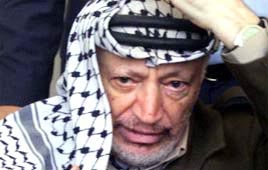
In 1958, Arafat, who was living in Kuwait at the time, founded the Fatah Movement, which was devoted to replacing Israel with a Palestinian state. Arafat became an expert in explosives and demolition, which served him well when he became head of the Fatah military wing in 1965.
Four years later, Arafat became chairman of the Palestinian Liberation Organization. The PLO was based in Jordan, but in 1970 the Hashemite Kingdom put down a Palestinian uprising in the country. The conflict became known as "Black September" and resulted in the PLO being forced to relocate its headquarters to Lebanon.
In 1974, Arafat made a dramatic appearance before the United Nations General Assembly, becoming the first non-governmental organization representative to address the international body.
From the PLO's new base of operations in Lebanon, Palestinian forces created a state within a state, which came to be known as Fatahland. From here the PLO launched attacks on Israeli targets in the north, but in 1982, after then-Defense Minister Ariel Sharon ordered the Israel Defense Forces to invade Lebanon, Arafat and the PLO leadership was forced to relocate to Tunisia.
In 1987, with the Palestinian leadership far from the territories, the first Palestinian uprising (intifada) began.
In 1991, Arafat's PLO was the lone Arab voice that expressed support for Saddam Hussein during the first Gulf War. As a result, the Palestinians became ostracized by an Arab world that cut off its financial and political aid to them.
Bankrupt and in exile, Arafat and the PLO faced the possibility of becoming irrelevant, but it was the 1993 Oslo Accords that paved the way for the Palestinian leader to return to the territories. For his role in the peace agreement, Arafat - along with Shimon Peres and Yitzhak Rabin - were awarded the Nobel Peace Prize.
In 1996, in the first Palestinian elections, Arafat was elected Chairman of the Palestinian Authority.
But in November 1997 Rabin was assassinated by right-wing extremist Yigal Amir. In the years that followed, the peace proccess slowed considerably, as terror attacks by Palestinian groups such as Hamas increased and the settlement enterprise continued in the territories.
In the summer of 2000, Arafat and Prime Minister Ehud Barak were hosted at Camp David by U.S. President Bill Clinton for peace talks, but the sides failed to reach an agreement. Israel and the U.S. blamed Arafat for taking hard-line positions on sensitive issues which made it impossible for the negotiations to succeed..
A second intifada erupted in the fall and both Israel and the U.S. called on Arafat to act to stop the violence. A new Israeli government under Prime Minister Ariel Sharon took a more aggressive stand toward the Palestinian leader, declaring Arafat an enemy of Israel in 2002.
Israel sidelined Arafat from the political process and there was even talk of expelling him from the territories. Arafat remained confined to his compound, known as the Muqata, in the West Bank city of Ramallah, out of fear that if he left the country Israel would not let him return.
In late 2004, Israel allowed an extremely ill Yasser Arafat to fly to Paris for medical treatment. He died in a Paris hospital on November 11 from an undisclosed illness.
He was survived by his wife, Suha Arafat, and a daughter.
