


So far, so good
Abbas is starting on right foot, but time will tell
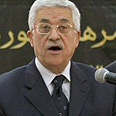
According to Palestinian President Mahmoud Abbas, both sides should use the forthcoming period to take unilateral steps.
It’s temporary, say the residents of Sderot, and the cease-fire won’t last. Any fair analysis of the interests, tendencies and personalities of those involved in the Middle East wars inevitably leads to one conclusion: fire will be resumed. It might happen a month from now, a year or perhaps even in a week. If not because of Hamas, than because of one of the esoteric terror organizations, or Iran or Hezbollah or because ties between Israel and the Palestinian Authority, as everyone estimates, will reach a dead end.
Instead of crying over spilled milk (or perhaps one should say spilled blood), we would do well to take advantage of the benefits of this lull. Israelis and Palestinians from both sides of the fence in Gaza are yearning for a period of calm, and they are not alone.
Challenge is to enjoy the break in terror
The drastic drop in terror throughout the country strongly contributes to the economy. The market is stabilizing. Tourists are returning and we are regaining the feeling of security that prevailed prior to September 2000.
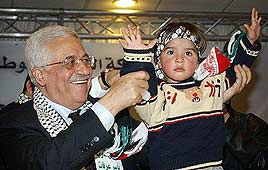
Abbas' successful campaign for Palestinian presidency is leading to time of optimism
The challenge is to enjoy this break as though it will not be followed by terror, and to prepare for the renewal of terror as though there were no cease-fire. Namely, to make an effort to accommodate Abbas’ demands: to coordinate moves, to release prisoners of all types, including 50 and 60-year-old veterans with blood on their hands.
It is emotionally straining, and has a high political toll, but it seems there is no other way.
At the same time, we should not permit the perpetrators of terror to reorganize for the next round. When Shimon Peres served as prime minister in the mid-1990s, he refused to pressure Arafat to rein in Hamas and other organizations. That was a mistake. The new Palestinian government should be dealt with cautiously. With much respect, trust and assistance. But also with a fair measure of suspicion, at least concerning the PA's determination to root out terror
Recently, Hussein Agha, a close associate of the Palestinian Authority, and Robert Malley, a former assistant to President Bill Clinton on Middle Eastern affairs wrote a complimentary article on Abbas.
Abbas steers clear of limelight
The two describe the differences between Abbas and his predecessor: Arafat attained his national status by identifying with every party, every tribe and every Palestinian. Abbas attained his position by not identifying with anyone. Arafat was up to his neck in local Palestinian politics. Abbas hovered above it. Arafat forced himself on others. Abbas steers clear of the limelight.
Abbas is a devout Muslim who adamantly opposes mixing Islam with politics. In his contacts with Hamas and Islamic Jihad, say the authors, his religious faith gives him an advantage: he is convinced he is as loyal as they are.
Many believe he will adopt tougher views
The national consensus created around him is fragile, they say. Few believe his views. Many more believe that in time they will make him adopt their views.
The ideas expressed in the next paragraph in the article are worth noting; it was probably written after several conversations with Abbas.
“Abu Mazen has very little hope in reaching a comprehensive agreement with Sharon. Too much separates them, including Sharon’s behavior during their talks, the negotiating and bargaining.
“He (Abbas) doesn’t even agree with an interim agreement that would bypass the really tough issues. According to Abbas, the forthcoming period should be used by both parties to take unilateral steps. Israel would disengage from Gaza and the West Bank, and the Palestinians would put their affairs in order. Negotiations over a comprehensive settlement would be postponed until a time when Palestinian institutions are rehabilitated and their international status strengthened. Negotiations would not be conducted by Sharon, but by his successor. The Palestinians could accelerate the choice and influence it."
Abbas is starting his reign on his right foot, there is hardly any dispute. His powers of persuasion are considerable. With regards to his prophecies, time will tell.
