


Torn between two countries
Israeli filmmaker Eran Riklis places hopes for Arab modernism in women's hands
TEL AVIV - The Syrian Bride, a film by Israeli filmmaker Eran Riklis, tells a tale that could have easily been taken from a true story.
The story unfolds in the Druze community of Majdal Shams in the Golan Heights. The community has been living there since the Six-Day War, but considers itself Syrian and refuses to accept Israeli citizenship.
When one of the family's daughters (Mona) is betrothed to be married to a Damascus-based TV star, the wedding ceremony is held at the border crossing.
Mona has never met her fiancé, but what really upsets her is that she’ll never see her family again. Once she crosses the border and trades her Israeli papers for a Syrian passport, she will not be allowed to reenter Israel.
Meanwhile, her father Hammed is on parole for an anti-Israel protest, and is barred from accompanying the wedding party to the border. Hammed’s mood doesn’t improve with the return of his eldest son, whom he’s never forgiven for marrying a Russian.
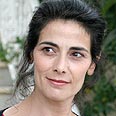
Mona slips into the background as her day wears on, and her older married sister Amal, who is played by Hiam Abbas, moves to the center. Amal deals with her own troubles as a woman who refuses to adopt the traditional women's role within the conservative Druze society.
Film brands no one as a villain
Riklis presents the border as a place where the women of the Druze community break the bonds of their own destiny.
“The Syrian Bride” is a feminist film that implies that Arab hopes for modernism and progressivism lie in the hands of women.
However, the film does not brand anyone — not Hammed, not Amal’s conservative husband, not the local Israeli commander — as a villain.
Abbas says Riklis managed to make a film about people, without judging them and without using the clichés we are accustomed to.
"Cliches are born in the minds of people who are tainted with stereotypes. They don't exist in this film," Abbas says.
For the past 15 years, Abbas has been living in Paris with her husband, actor Zinadin Swalam, where the couple has been raising their two daughters - far from the Middle East where she herself was born and raised.
Abbas, who was born in the Galilee village of Dir Hanna, says she understood from a young age that man makes his own borders and then decides to break them.
She chose art as a way of life, studied photography and joined the Al Hawakati theater troop in east Jerusalem, without ever having taken acting classes. Her life took her to Paris where she became involved in the local film industry. She was given minor roles and a lead role in the film "Red Silk," which was warmly received.
After years of living in exile by choice, Abbas returned to Israel to play the lead role in "The Syrian Bride."
Abbas talked about the making of the film with "Yedioth Ahronoth" correspondent Merav Yudilevitch.
How do you pick a script?
It has to be a script I believe in, a local film that touches on universal aspects. Films that interest me are about people, where viewers can identify with the characters. A film should take you beyond, politics, slogans and clichés. It can start with a local political conflict but it must involve emotions. Human emotions are universal; they don't belong to one people or another.
In the "Syrian Bride" you portray the image of Amal, a strong and opinionated woman who goes against the flow. She is not afraid to go against conventions and her husband's will in order to advance herself as an individual. Do you identify with the character?
Amal is full of contradictions. She was born a strong woman, and that's something that won't change. That particular day in the film when she becomes overwhelmed, is when she decides to take charge of her life. She realizes that she is the only one who can charter her life. I believe that a moment comes in everyone's life when he or she realizes that they must take charge. Amal represents that.
Amal is a character torn between her father and her brother who married a Russian woman and was removed from the community, between her desire to develop and study and what is expected of her as a wife and mother, between old traditions and modern progress. Does it remind you of your own life?
Indeed, even if the details are different. I decided to take charge of my life from a very young age; I skipped over anything that obstructed my way. When I talk of barriers I mean traditions, religion, society and political conflicts. I grew up in the village of Dir Hana in a relatively open family, but the social bonds were there. From this starting point I decided to break away, to move forward. It wasn't always easy, but I don't think it has anything to do with where I was born. Even if I were born in France into a "regular" Catholic family, judging by my character I imagine I would have found the way to fight for my independence.
The heroine's ID card says her identity is not clear; the protagonists wander back and forth between Israel and Syria, is this situation familiar to you?
Yes, and by the way the Druze are not alone. For years the Palestinians living in the Gaza Strip had no identity, and the Palestinians living in Syria still only have transit papers. I know many such stories, and I can identify with these people, because we are all human beings, and we all have the right to live where we choose. We should be able to decide our identities. I have a broad point of view when it comes to people. What I liked in the film was that although a political entity decided not to recognize a certain people or an individual, self recognition was in the hands of the individual.
But you still have an Israeli passport.
Yes, of course, that's the physical side of my identity; I need the passport in order to travel. The place I was born and raised granted me an identity I didn't choose, but I didn't refuse to take it, because it is part of me.
Giving up my Israeli citizenship would also mean giving up my historical affinity, my roots. A man must know where he came from in order to know where he is heading.
This is one of the few films about the Arab community produced by an Israeli Jew that doesn't come across as stereotyped.
It's one of the reasons I wanted to do the film. I must admit it's not easy for me to say I am part of the Israeli film industry, partly because I think the Israeli film industry is tainted with stereotypes. For me the film industry is a means for communication between people and the film producers' starting point is important to me.
Meeting Eran Riklis was educational. I came with lots of questions such as why would an Israeli film maker be interested in making a film about the Druze in the Golan Heights? I quickly realized he was a humanist with no prejudice towards Palestinians and Arabs.
