


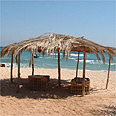
Staying at a hut on the beach is one option
צילום: גילי סופר
Sinai: Crossing the border
The complete guide to making it through the Taba crossing and into Egypt
When to cross?
The Taba border crossing is open 24 hours a day, 363 days a year (closed on Yom Kippur and on the Muslim Feast of Sacrifice, Id al-Adha.) The crossing is particularly busy from 6:30 a.m.-8:30 a.m., as midnight bus riders arrive from Tel Aviv and Jerusalem.
Crossing the border is often a quicker process during late afternoon hours, except for Jewish holiday periods, when you can find yourself stuck in a long lineup even in the middle of the night.
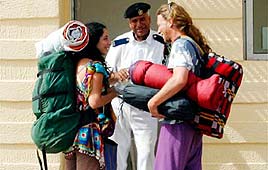
סיני מסוף גבול טאבה מצרים פסח (צילום: ג'ו קוט)
Those tips may not be too useful if you plan to stay in a hut on the beach.
The Egyptian side of the crossing is unpredictable. A group of pilgrims can grind matters to a halt, and Muslim prayer hours are also a factor. Alternately, you could encounter local officers deeply engaged in a discussion of current affairs and oblivious to the rest.
Still, matters at both sides of the crossing are usually run efficiently. On normal days, the average crossing time by foot is about an hour.
How to get there
If you plan to cross the border by foot, you can get there by bus from central Eilat, or by taxi.
If you prefer to use your own vehicle, you can leave it at a large, crowded parking lot near the border. During peak times the lot is completely clogged, so parking in Eilat is a wiser move.
Taking your vehicle into Sinai can be a smart move as well. It is easier to get around and you will avoid the exhausting ritual of bargaining with taxi drivers. At the end of the day, it could even be cheaper.
The price, however, involves participation in a lengthy, tiring and incomprehensible process. Do not attempt to understand it, just go where they tell you to go.
You must possess an international driver’s license (do not forget a passport photo), and an English translation of the vehicle permit. Note that vehicles running on diesel fuel, four-by-fours, and cars that are not registered to the driver, will not be allowed into Egypt.
Among other costs, expect to pay for translating the license to Arabic, insurance fees, and a pair of Egyptian license plates.
You will be sent from one office to the next and start a collection of little notes featuring illegible writing, which must be kept. At the end of the process go into your car, sit back, turn the air conditioner on, and start breathing again.
Some no-no’s, money matters, and white uniforms
You cannot bring weapons and ammunition, other military equipment (or anything that looks like it), pornographic materials, and illicit drugs into Egypt.
GPS systems, two-way radios, and videotapes are also forbidden. Cellular phones are allowed, but do not expect much in the way of reception.
On the Israeli side of the border, a small fee is levied (approximately $15). You can also exchange currency to Egyptian pounds at the same counter, but the exchange rate will not be the best. However, when crossing at particularly busy times, exchanging money will spare you another queue later.
Next, walk over to the Egyptian side of the crossing, where you will encounter the first Egyptian police officer.
Along the route you will repeatedly be asked to present your passport to the white uniforms, who are usually friendly. Their main function is to direct you to the next point.
The Egyptian side of the crossing is about 330 feet (100 meters) away. You will find luggage carts there, but they are hard to steer and are not recommended.
Crossing the cultural boundary

מעבר גבול טאבה (צילום: ג'ו קוט)
Somebody asked you for a “baksheesh” (bribe)? The customs officers “somehow” cannot find change for a large bill? The police officer is showing unusual interest in your daughter’s mineral water bottle? It does not mean you just encountered someone particularly corrupt, or are being deliberately screwed by the system.
This is how things work when people are in distress; a local police officer earns less than $300 a month, and mineral water is considered a foreign delicacy.
If you still wish to avoid such experiences, leave the bottled water in the car, get small change at the border, and hand over exact change. Prepare yourself to cross not only a geographic border, but to also enter a different, less developed world.
And stop whining.
Your foreign currency will buy you service, not love or subservience. Do not expect the service to be similar to what you experienced in Zurich. Then again, this is exactly why you came here, to get a taste of something else.
The new Egyptian border terminal is a large, marble structure with many service counters. Do not get overly excited, however, as most of them are not staffed.
Fill the standard form, go through a security inspection of luggage, and on to passport control. There, a 14-day visa to the Aqaba beach, Ras Nasrani, and Santa Katarina will be stamped in your passport.
If you do not wish to travel to Ras Muhammad, al-Tur, or the western Sinai, you do not need anything except for a passport valid for at least three months.
However, in order to travel to the above-mentioned areas, for a diving adventure in Ras Muhammad for example, you need a visa that can be arranged at the Egyptian embassy in Tel Aviv or at the consulate in Eilat. The process takes about two to three weeks.
If you did get the extended visa, emphasize this at the crossing. Otherwise, the officer may not notice and stamp the passport with the regular two-week, limited visa, which will take precedence.
After going through passport control you will see a bank and can exchange money there. Now you will find yourself on the Egyptian side of Taba, which is increasingly turning into a town in its own right.
Still, unless you have something to do there (eating Egyptian broad beans at Mustafa’s or shopping at the local supermarket,) all that is left to do is to arrange transportation to your destiny, pay a small fee to the Egyptian Transportation Ministry, and get on your way. Do keep the green receipt.
Expect to bump into more white uniforms at roadblocks along the way. Most of them are soldiers doing their compulsory military service who are largely concerned with limiting the movement of local residents, not yours.
