


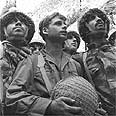
Six-Day War (1967)
None
The 1967 Six-Day War is named because of the short duration of the conflict in which Israel defeated its hostile Arab neighbors of Egypt, Jordan and Syria. The resounding victory ended with Israel capturing the West Bank, Gaza Strip, Sinai Peninsula, Golan Heights and East Jerusalem.
Prior to the outbreak of the war, tension in the region escalated when Egyptian President Gamal Nasser demanded on May 17 that UN peacekeeping forces evacuate the Sinai, and Egypt began to deploy forces on the border with Israel. About a week later, Egypt closed to Israeli ships the Straits of Tiran, Israel's main shipping route to Asia and other major trading partners, and blockaded Israel's port in Eilat.
On May 30, Egypt and Jordan signed a mutual defense treaty, and several days later Jordanian forces were put under the command of an Egyptian general.
Faced with these aggressive moves and the sense that an Arab attack was inevitable, Israel launched a pre-emptive strike on Egypt on June 5 that began the Six-Day War.
In this attack, Israel destroyed the Egyptian Air Force while it was still on the ground. This move was crucial because Egypt had the most modern of all the Arab air forces, comprised of some 385 Soviet-built modern aircraft.
Israel's last offensive of the war was completed on June 10 with Israel capturing the Golan Heights from Syria on June 10. The next day, a cease-fire was signed between Israel and the attacking countries.
With the end of the war, Israel quadrupled its size and became responsible for about one million Arabs living in the newly captured areas.
Related links:
