


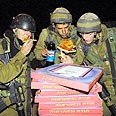
Reservists eat well, but are they properly trained?
צילום: דן בלילטי
Averting another disaster
No money to train reservists? Then don't call them up, Alex Fishman writes
We must not accept the argument that the death of IDF soldier Tsiki Eyal north of Hebron Monday night was an act of fate. it was not a case of bad luck, or a rare operational accident that could not have been predicted.
Indeed, it's surprising such tragedy didn't happen sooner, as all factors leading up to this accident have been present on the ground and are still there.
IDF regiment commanders in charge of reserve units, particularly artillery and the armored corps, have been warming, cautioning, and complaining for a long time now about the readiness level of army reservists sent for operational duties in the territories.
The operational level of those reservists, who do not hail from the infantry corps but are tasked with missions requiring decent infantry skills, is inadequate, to put it mildly.
The officer tasked with investigating Monday's tragedy should ask the reservists at the checkpoint and in the regiment how many hours they trained before being sent to perform this duty. Not how many days of training they were invited to attend, but how many hours, in practice, they actually trained.
And which scenarios did they prepare for? How many situations and responses did they practice? How many bullets did they fire, at the firing range and in other scenarios?
Since the tragedy happened at night, he may also wonder how many bullets they fired in the framework of a nighttime training session.
We can assume the answers the investigating officer will come up with will be depressing indeed.
A recipe for accidents and disasters
These soldiers are called up for duty once a year and train for it once they are called up. The shooting drills they engage in are meant to hone their previously acquired skills. However, when it comes to armored and artillery corps troops, shooting skills were never impressive to begin with.
On top of that, the training they undergo is not thorough, to say the least, leading to a situation where shooting drills are insufficient and soldiers have no confidence in the guns they receive.
Indeed, it's a recipe for improper reactions, friendly fire, accidents, and disasters.
Monday's tragedy already happened and a terrible price was paid. Yet we must not wait for the next disaster to happen.
We must again thoroughly train reservists who are not infantry fighters for operational duties. True, this entails financial costs, very high costs, but there is no other way.
If the state does not have sufficient funds to train reservists properly, it should not call them up for service and refrain from sending them to the West Bank and Gaza.
