


Out of the Box
Are Israelis ready to accept a new vocabulary in architectural design? To prevent poor planning from infecting our cities, architect Haim Dotan says Israelis—and the rest of the world—have no choice.
Since returning to Israel 13 years ago, architect Haim Dotan has designed more than one million square meters of building space and has won numerous prizes, including the Engineering and Architects Association Award for the 50th Anniversary of the State of Israel.
His Tel Aviv firm, with its innovative take on design, has helped drive the modernization of residential, office and cultural projects in Israel, predominantly in the south.
Dotan's designs are futuristic, nature-inspired forms and shapes. Ynetnews interviewed Dotan at his office in Tel Aviv to learn more about his concepts and why he thinks they must transform the way we live.
1. Your new futuristic designs contrast with some of your earlier buildings. What caused this change of focus?
I realized that it was the end of the box era in architecture. For 2,000 years, our technology allowed us to build using gravity-bearing walls, and column-and-beam construction.
Now, the computer revolution has enabled us to structurally calculate any form, and cut and weld any shape using laser tools. We can make curvilinear shapes, and buildings don't have to be geometrical or orthogonal designs.
People are used to living in boxes, but it's the most inhuman way of living. In Shanghai, Hong Kong, or even New York, boxy buildings, however attractive, create a big blur. The qualities of an individual masterpiece are lost while attempting to house millions of people in many buildings.
2. How can we change urban design to avoid these boxes?
My vision is landscape urbanism, with buildings designed as organic forms like hills and mountains, which harmoniously integrate into green spaces, parks and more.
In the next 20 years there will be billions more people on the planet. How do you house them? On a recent visit to China, I saw 20-story buildings in rows, which together look like atrocious walled cities. We have a disease that people don't realize. It's like AIDS: If we don't attack the urban issue of where to house people, we will have an end-of-the-world environment.
3. Your vision seems to have inspired your design of the Shamoon College of Engineering buildings in Beer Sheva.
In Beer Sheva, we began with a dilapidated neighborhood, where there was drug use and prostitution. By bringing inspiring architecture and students, we've revitalized the whole area.
Architecture can bring culture. It can mean new horizons and hope. The Andre Minkoff Auditorium "spaceship" is now an icon of Beer Sheva. Hundreds of people also saw the construction process, which itself was invigorating.
We also elevated the buildings from the ground. This way, they serve as a bridge, leaving public space for people in the park below.
4. Your new Ashdod Concert Hall is also designed as an icon for a growing city. What inspired its dramatic form?
Originally, a Japanese architect had won the design competition for the project. It was estimated at NIS 130,000 million (about USD 30 million), which the city could not afford financially. So they suggested that I give them a new proposal - within 10 days.
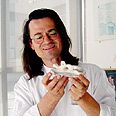
I went for a walk on Gordon Beach in Tel Aviv, and I stepped on some shells. I picked them up, and I loved their forms. They were about musical dynamics and a sense of the sea, which worked for the Ashdod project, a concert hall in a city on the sea.
Ultimately, through effective design, this signature building is being built for less than half of the original proposed price. It has become a symbol of excellence for the community.
5. The design for the Academic Campus of Ashdod looks more like sculpture than shells.
Yes, but my architecture is not about sculpture, it's more like rocks dropped in a Zen garden. It's about pursuing the humane and dealing with the problems of the city using shapes that will adapt to and learn from nature, rather than about living in rigid boxes.
A rock garden is simplicity. The buildings are adaptable, so they can accommodate alterations while staying true to their forms.
Unlike many university campuses, the Ashdod campus will not be of boxes with courtyards. The project creates relationships between organic forms. It is designed near a sand dune, where children play, and so the rock garden has a dune-like green park in the middle. I'm not trying to recreate the sand dune, but I'm trying to bring nature onto the campus.
6. What makes your designs distinctively Israeli?
Until now, Israeli architecture has been architecture of immigration and migration, with styles from the British, the Turks, the Bauhaus era and more.
But we need to draw inspiration from the soil, to assimilate the architecture into the land and vice versa.
For example, my design for the Rehovot Concert Hall is a big flowering rock in the park. It not only reflects the desert region around Rehovot, but it is also practical. The building is covered with stone, which ages well and requires minimal maintenance. Its connection to the unchanging natural environment of Israel gives it an enduring quality.
I'm not designing for myself, but for two generations from now.
7. Do you think the move to more futuristic forms will be too hard to handle for the average Israeli?
The move to more organic forms is already happening: in cars, plastic bottles, clothing and industrial design. Architecture will follow.
We also must be open to futuristic building materials. Many composite materials improve on the old ones. We have plastic floors that are patterned like wood yet are more durable. We have ceramic tiles that are formed like stone and are lighter. It's hard to distinguish between the original and a top-quality modern version, and if the modern version creates the atmosphere you desire, and is cheaper or easier to maintain, there's no reason not to use it.
My ideas are very futuristic and I doubt I will realize them all. I express my ideas in the icon buildings I design. Yet, when I design a building of this type, I don’t act as if the client has an open checkbook, like many of the icon-builders do. My new buildings are being built for a quarter of what Frank Gehry designs. In Israel, as in many countries, no one can afford USD 5,000-per-square-meter buildings. Consequently, I see building economical icons as a challenge.
I didn't publicize myself early in my career. I felt it was premature. Now I've matured, and I've developed my style and my message. I have a mission and a purpose. I talk to high school kids and they get very enthusiastic about my work. I'd rather give them icons in pastoral cities that emit positive energy than images of violence, gangs and crime.
