


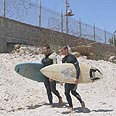
Sun setting on surfing settlers
Gaza's surfers wonder where the next big wave will come from after disengagement
GUSH KATIF - With baggy shorts, a deep tan and a gleaming white surfboard, Lior Barda looks like any laid-back surfer dude as he scans the Mediterranean for the perfect wave.
But the 21-year-old Israeli is no ordinary beach bum. He is part of a subculture of surfing settlers watching the sun setting on their idyllic lifestyle in the occupied Gaza Strip.
The Israeli government intends to evict Barda and his surfer friends when it removes all 8,500 Jewish settlers from the coastal territory starting in August under Prime Minister Ariel Sharon's disengagement plan.
"We're losing the best waves on this entire coastline," Barda lamented as he sat strumming his guitar atop a lifeguard tower at the main beach at Gush Katif, Gaza's largest settlement bloc, where he works part-time.
Beach-lover's paradise
Gazing out at the sparkling sea and pristine sands, it seems like a beach lover's paradise. Youths stroll past with wave boards under their arms. A teenaged couple roars by on a beach buggy. A sport fisherman stands thigh-deep in the shallows.

Only a few meters down the beach is the decaying Palm Beach Hotel, abandoned at the start of a Palestinian uprising in 2000, until a handful of diehard surfers and cash-strapped settler youths began squatting there.
In recent weeks, their carefree existence has been strained. Far-right Israelis who see Gaza as theirs by biblical birthright have taken over many of the white-stucco bungalows, creating a stronghold of support for settlers vowing to resist evacuation.
If protests against the pullout turn violent, Barda and his fellow surfers, mostly secular Jews, won't join in. They oppose Sharon's plan but are resigned to leaving.
Surfers' loss, Palestinians' gain
Barda has lived most of his life in nearby Pe'at Sadeh, where most of the 20 settler families have decided to relocate en masse to a new community inside Israel just north of Gaza.
"This is our last summer in Gush Katif," Barda said.
The settlers' loss will be the Palestinians' gain.
Settlers account for less than 1 percent of the population of the Gaza Strip, densely populated and home to 1.3 million Palestinians, but they control at least 15 percent of the land, much of it seafront property.
Once the settlers are gone, Palestinians in the nearby town of Khan Younis, whose path to the beach has been blocked by the army since the start of the uprising, will again have an escape from the summer heat of their crowded cinder block slums.
Fishermen struggling to survive after being barred from settlement shores will have a wider berth to cast their nets.
"They have kept us imprisoned," said Umm Mohammad, an elderly resident of Khan Younis. "Now I hope this will end."
Some Palestinians even dream of someday turning part of the newly acquired coastline into an international tourist resort.
For his part, Barda does not begrudge ordinary Palestinians the chance to enjoy Gush Katif's scenic beaches, complete with showers and sun shades, where he first surfed at the age of 9.
Pain while surfing
Unlike hardline settlers, his family moved to Gaza not for religion or ideology but because of incentives offered by the government - tax breaks, loans and a better quality of life.
He says at the time his parents gave no thought to the risk of establishing a homestead on land that Israel captured in the 1967 Middle East war and might someday cede to the Palestinians.
"We've never felt like occupiers," he said referring to the Palestinian view of settlers as usurpers of Arab land.
While serving in the army in 2003, Barda was shot in the leg when a gunman attacked his post at a West Bank settlement. Two comrades were killed, and he spent five months in the hospital.
Even now, when he paddles out on his Star of David-adorned surfboard, his prize from a surfing championship, he sometimes feels pain.
"I have no desire for revenge," he said. "I just hope what Sharon is doing brings peace, not more terror."
