


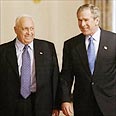
Why Bush is voting Sharon
President has been obvious in supporting PM, with no hint of respect for Israel's political system
For years, American presidents and Israeli prime ministers have become used to meddling in the affairs of one another, each in turn trying to support, weaken, pressure, or change the current policies of the other.
This phenomenon exists, will continue to exist, and it is completely irrelevant whether or not it is legitimate.
One can hardly forget the efforts of former President George Bush, father of the current president, to topple former Prime Minister Yitzhak Shamir in favor of Yitzhak Rabin (the same Rabin who said in 1972 that Israel hoped Richard Nixon would be re-elected).
Bill Clinton tried to help Shimon Peres win the 1996 election, and did little to hide his efforts to portray Benjamin Netanyahu as someone unfit to conduct U.S.-Israel relations (a program checked with studies and proved to be very important to Israeli voters when it comes to respecting a prime minister).
Netanyahu, for his part, built strong ties with the Republican majority in Congress, and even tried to topple Clinton during the Monica Lewinsky affair by meeting Clinton's arch-foe, televangelist Jerry Falwell, during a 1998 visit to Washington.
A year later, Clinton returned the favor, campaigning for Ehud Barak to unseat Netanyahu.
There is a tendency in Israel to confuse political interference with support for a certain policy, all under the general headline "American pressure" (examples include withdrawing from the Golan Heights, evacuating illegal settlement outposts, negotiations with the Palestinians, and others).
Global consequences
But the notion that Israel must accept Washington's intervention as a small price to pay for the "special relationship" is not really true. President Harry S. Truman tried to help Winston Churchill's re-election campaign in 1945; the U.S. did all it could to topple unfriendly governments in Latin America throughout the 1970s and 80s; European leaders who support financial integration have openly tried to influence elections in other European countries.
Overall, international politics is moving farther and farther away from the idea that countries should stay out of the domestic affairs of other countries. Instead, there is a new tendency towards less sovereignty and more cross-border involvement.
The relationship between building and stability of a political establishment, personal relations and chemistry between leaders and foreign policy is a strong one as the global village continues to shrink, and as the domestic policies of one country have increasing implications for others.
For instance, Germany's recent elections will have direct consequences for French farmers and the government subsidies they currently receive, and for Turkey's chances to join the European Union. Why, then, should Paris and Ankara refrain from trying to influence the outcome?
If elections in Japan will have direct consequences on America's debt bond market, how could Washington justify not supporting Prime Minister Junichiro Koizumi?
How could Netanyahu criticize?
If so, why must Netanyahu run to America to stigmatize President Bush's support for Prime Minister Sharon on the eve of an important political decision that is not only an internal Israeli issue, but even an internal party issue?
If it's true that Sharon's relationship with Bush and the impressive level of coordination with Washington is a great strategic investment, built with great effort, of course the president's support helps his standing.
And in general, how can Netanyahu criticize Bush after sending his own representatives to Capitol Hill in order to warn the United States against having President Clinton support Israel-Syria negotiations, and having threatened – according to reports – to "ignite" Washington by playing Congress against the White House?
No respect
The issue is that this time, Netanyahu is 100 percent correct. Clinton's support for Barak was sophisticated, but Bush has been blatant and obvious in supporting Sharon, with no hint of respect for the political system of another country.
If he was truly interested, he would surely have asked why the Prime Minister has ignored the decisions of his party, and even more so, of the votes he himself initiated.
But Bush hasn't asked, because Bush knows all about the differences between Sharon and Netanyahu.
Sharon is more that an ally in the global war against terror. He is also committed to a political process that helps Bush show there is more to his policy than long-term involvement in Iraq.
A Netanyahu-led government, whether it is a majority of 61 Knesset members who oust Sharon or a coalition government that comes out of elections, will be a radical right-wing/ ultra-orthodox government with limited outlook, even if Netanyhu really wants a political process - or at least the appearance of one.
Alon Pinkas is the former Consul-General in New York
