


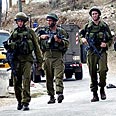
IDF troops in action (Archive photo)
צילום: איי פי
Am I my brother's investigator?
Does Israel need a civilian body to investigate IDF abuse?
Many years ago I had a driver, a capable but strange guy, who liked to wander around the streets of Jerusalem at night. It was his way of calming down.
Those were the happy days of long ago, as the rot set in after the occupation, and there was a misleading and intoxicating wind of "co-existence" in the air.
One night he walked by Damascus Gate, where he aroused the ire of some cops. Why? Just because. Who knows what angers men in power? They proceeded to beat him up.
Two days later, when he was released from hospital, he turned to several friends in the media, who created a storm over the issue. The city's police chief immediately found the perpetrators and brought them to justice.
Three days later, my friend appeared on a television talk show, where he was asked, "So, do you think the officers learned anything from this incident?"
"Of course," he said. "They learned not to beat up people with friends in the media."
Nothing changes
This past Sunday, a thug in uniform attacked a television cameraman, and pointed his cocked weapon at a reporter. Footage from the incident showed a man crazed with hate and violence, wearing a large, black kippa and sporting a wispy beard.
Readers are kindly asked to spare me their pious lectures about the fact that I mentioned the soldier's religious symbols. I may be a relic, but I can't quite let go of my old-fashioned custom to expect a little bit more from people with kippot on their heads.
I have yet to get used to the fact that during these years of insanity, too often a kippa and beard are little more than a smokescreen for thugs seeking an outlet for their violent instincts and the lordship.
The same day, the officer's commanders were all summoned - all the way up to the IDF spokesman, the chief of staff, defense minister, the media… and that very day the thug was put in jail for a month.
There he will have plenty of time on his hands to internalize the message mentioned above: Don't hit people with media connections.
Back in the field
Next month, the soldier will return to active duty. Is it really that tough to imagine how he'll act towards people who lack the good fortune to come armed with a TV camera?
Is it really that complicated to understand just where he acquired his habits, his crudity, his absolute certainty that anything and everything is permitted?
And how should he resist the pressures of active duty?
And how naive, or foolish, or blind, must a person be to believe that this guy was a "bad apple", or that only journalists and TV cameras drive him nuts?
Every day, angry kids beat up other people. Every day, out there on "active duty," things happen that would make Sunday's incident look small and insignificant.
Only one-in-a-thousand of these cases ever make their way to the public eye. And only one-in-a-thousand of those cases are actually investigated, and one-in-a-thousand of these investigations actually lead to some sort of punishment.
Let the public investigate
It's not only that the army also learned a long time ago that it's not such a good idea to beat up people with friends in the media, but also because the army, like the police, is entrusted to investigate itself.
And during the week when we finally put an end to the bluff called "Police Investigation Unit" and made it a truly separate unit of the police (rather than a body in which all investigators are borrowed from police ranks), we must consider establishing a civilian body to investigate violations by IDF soldiers.
Perhaps then, violent soldiers, or thugs in uniform, will get their just deserts, even when their victims have no friends in the media.
B. Michael is a columnist for Israel’s leading newspaper Yedioth Ahronoth
