


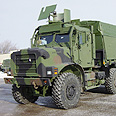
Israeli armor to protect Marines
Kibbutz-owned company wins contract to provide armor for American military vehicles
Israeli companies are renowned worldwide for their expertise in providing armor for military vehicles. Now, kibbutz-owned Plasan Sasa, which specializes in manufacturing armor protection kits for military vehicles, aircraft and naval systems, has won a deal to provide USD 100 million worth of equipment to the U.S. Marine Corps.
The company is owned by kibbutz Sasa in the northern Galilee region.
Plasan Sasa will serve as a sub-contractor for Armor Holdings, which won an American Defense Department tender to provide armor for the Marines' vehicles.
The company will provide the corps with modular armoring to protect vehicles against improvised explosive charges, land mines, and various other terror threats. The add-on armors will be installed on 930 light trucks.
The contract constitutes part of the Marines' plan to equip its fleet of tactical trucks, MTVR, with advanced armor.
Plasan Sasa CEO Danny Ziv said the company succeeded in meeting the high technological and operational demands presented by the American navy.
"We proved that our solution substantially reduces damage and represents the most effective armor for tactic vehicles in today's modern battlefield," he added.
"This contract illustrates the Marine Corps' satisfaction with Plasan's sophisticated armor solutions, since it constitutes a renewal of an identical deal between Plasen and the U.S. Navy signed the previous year," he said.
Sources at Plasan explained that the company's solutions will not only provide protection for the vehicles, but would also enable easy and fast installment and dismantling of the add-on armors, to suit the changing needs of the forces.
Founded in 1985, Plasan Sasa has specialized in the manufacturing of add-on armor since 1987.
Plasan provides its solutions to the IDF, as well as to military forces around the globe. The company currently employs about 400 workers and is expected to gross a total 150 million in revenues in 2005, compared to only USD 45 million in 2004.
