


7 impressions from Tunisia
Ynet reporter joins Foreign Minister Shalom's entourage to Tunisia; visits house where Fatah founder Abu-Jihad was assassinated, fascinated by local Jews, gets into trouble with Iranian stand security guard
(Video)
1. House where Abu-Jihad was assassinated
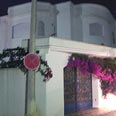
It's a very short distance, only a few hundred meters from the beach. You drive up the main road of the Sidi bou Said neighborhood, the northern suburb of the capital Tunis, and turn tight into the al-Qasim al-Shabi street.
After a few meters, there is it, closed and sealed. It seems like no one has lived in it for years. It stands alone with no sign or signal to reveal what took place there a number of years ago. This is what one of the most famous houses in the Israeli security experience looks like: the house where Fatah founder Khalil al-Wazir, known as Abu-Jihad, lived and was assassinated in April 1988 by a special force (an IDF force, according to foreign publications).
I want to get out of the car and take pictures. The taxi driver hesitates and eventually agrees. Suddenly he understands. "What are you doing here?" he asks my colleague and me.
He finds it strange to see tourists taking photographs of this particular house in the middle of the night.
"Don’t worry, we are journalists. If the police come – we're responsible. We gave you the address and brought you here," we answer.
Silvan Shalom's visit to Tunisia (Footage: Roee Nahmias)
He doesn’t seem to calm down and after a few seconds we are forced to leave the place.
When one sees how close the power centers are to one another, one cannot not be impressed by the assassination operation: Abu-Jihad's house is not far from the fancy residence of Tunisian President Zine El Abidine Ben Ali. Suha Arafat lives not far away in a house which belonged to her late husband, former Palestinian Authority chairman Yasser Arafat.
"This is a real humiliation for the Tunisian regime, to come and hit them at their home and leave. You don’t understand what a dramatic change one has to go through between this humiliation and the invitation of an Israeli foreign minister here. You can't comprehend it," a colleague from an Arab newspaper explains to me.
2. Djerba Jews also read Ynet
The first visit was moving and filled with unusual sights, to put it mildly. The procession that broke threw the dusty desert road from the Djerba airport drove a short distance until the neighborhoods of the Jewish community.
"Tunis is the capital of the world," read a sign in Arabic not far from the airport. Who would believe?
The Jews are warmhearted, friendly, and a bit shy. They speak beautiful, surprising Hebrew, and a short tour reveals that the "Cheder" (Jewish elementary school) still preserved in the area from ancient days has something to do with it.
However, one could not ignore the relative poverty and modesty of the Djerba area, as if the central regime has not much interest in it. Some of the residents work their land. Some ride bicycles with an aiding engine, which is a relatively popular means of transportation.
A quick glance reveals a considerable difference in development between the Djerba area and the capital of Tunis. Due to this poverty, one might understand the astonishment when hearing what some of the Jews had to say.
"You are from Ynet? I read you on the Internet?" Chai Hamus Mazuz, a distant relative of Attorney General Menachem Mazuz, said. Mazuz makes his living as a goldsmith.
Simon Vasanah, 17, and others also showed their proficiency in Israeli media, including Ynet.
The discussion was interrupted when Foreign Minister Silvan Shalom entered the neighborhood. He hurried to the local, ancient synagogue, where he was presented with an as ancient Scroll of the Law.
The excited youths hurried to take pictures of him with their third-generation cellular phones. Tunisia is a country of differences and contradictions.
3. The frightened prince
The official purpose of the trip to Tunisia was to attend the U.N.-sponsored World Summit on the Information Society (WSIS), in Tunis, the capital. The summit was not a big one, but the Tunisians planned for it as if it were the Olympic Games; no less. Tunisian flags, posters of the hosting president and greeting signs in Arabic were hung everywhere, and fresh palm trees were planted on the roads leading to the WSIS venue.
Security was tight: You could see a security officer on almost every street corner and hotel entrance, not to mention the security inspections of all those entering the local hotels – which were thorough even by Israeli standards.
The impressive Israeli stand at the summit was the sight of several interesting meetings.
“We did some good business; more than expected, but there were a few failures as well” Noah Bell from “Babylon” says.
“The prince of the United Arab Emirates showed a great deal of interest in our technology, but after his technician realized I was leading him to the Israeli stand, the prince turned pale and stopped in his tracks.”
The Iranian stand is placed only a few feet from the Israeli one. Iran is offering its own internet projects. I managed to take a few photos of the stand before the security guard said “Halas (stop)!”
4. The local Shas education system
The Israeli delegation cannot ignore the upcoming elections. Minister Shalom and Shas Chairman Eli Yishai leave the synagogue and enter a nearby “Cheder” (religious elementary school) to hear the local children read out loud in Hebrew.
“This is exactly the same learning method as “El Hama’ayan” (Shas’ religious education system). The system hasn’t changed in years; if we would adhere to Shinu’s values and methods, there would be no Jews left,” Yishai tells me.
Apparently, a Cheder in Djerba serves as a good stage for relaying messages to Israel.
5. Silvan’s admirer
An excited young woman who had met Shalom in Djerba makes her way to the ministers’ hometown of Gabes. She holds a photo of her and Shalom that was taken two days ago, but is embarrassed to ask her idol to sign it. Shalom sign the photo like a well-polished pop star. The woman is overjoyed, as are all the other locals who were photographed with the minister.
6. Tunisian Jews and the Jews from Israel
The behavior of the Tunisian Jews is in stark contradiction to that of the Jews who came from Israel.
“They told me they do not want to make aliyah for fear they would be ‘damaged,’ Yishai says.
I am not certain this is the reason, but their charm is undeniable.
One of the most colorful markets in Tunis is located in the city center.
“Shalom. Welcome,” one of the store vendors says to me.
It turns out that he picked up a little Hebrew from the tourists who used to frequent the market. He says he hopes the Israelis will return.
A few minutes later a few members of the Israeli delegation arrive.
“What is this market? The Old City in Jerusalem is better,” one of them says; the difference between the old-style Tunisian Jews and the Israeli Jews is clear.
“A little humility wouldn’t hurt them,” an Arab journalist tells me.
“If they think it’s so bad, they do not have to come.”
7. ‘No lighting at the airport’
The Israeli delegation lands in Gabes, where Silvan Shalom was born. Two young ladies greet the Israelis with flowers.
“This will be a very short visit,” Shalom’s spokesperson says. “By 4:30 p.m. everybody has to board the plane because there is no lighting at the airport, so we will not be able to take off after sundown.”
The convoy hurries to the local synagogue, where many Jews who made the trip from Djerba await the minister. From there the delegation continues to the home in which the minister was born.
The locals are stunned. They are all confined to their homes or held up at police checkpoints. When we tried to ask one of them if he knows who is visiting, he refuses to answer and sends us to the police officer. The residents look on curiously from the windows.
We reached the house, where a Muslim family is waiting with gifts; but we find out that this is not the house in which Shalom was born, but one that was owned by his family. The Muslim family members are left with the gifts in hand.
We reach the barren plot where the house in which Shalom was born once stood.
“I am not disappointed. I am glad I was able to come here with my mother,” the minister says, and the convoy races off.
