


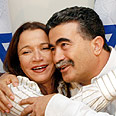
Poor female representation in Knesset
Despite important contributions by women in Knesset, Israel is 59th in female parliamentary representation
Defense news, massive business transactions and social trends fill the headlines. "Secondary" issues, such as corruption, health issues and violence, will just have to wait for April, after the elections. But they will eventually be dealt with.
But one minor issue has been swallowed up, and stands alone for the moment – but it cannot wait: Female representation in the Knesset.
Many dogs have barked about the lack of women in Israeli politics, but the caravan continues to move forward. The outgoing 16th Knesset scored an impressive achievement, when 15 percent of Knesset members were women. But in absolute terms, that’s just 18 parliamentarians, and everyone knows what
their true proportion in society is.
59th in the world
Global numbers make a mockery out of us: Israel is 59th in the word for women's parliamentary representation. Rwanda is far ahead of us; 49 percent of its lawmakers are women, and even countries as Nepal and Trinidad and Tobago are not waiting for feminist salvation.
The enlightened United States is stuck with about the same percentages as Israel, but the story there is a little bit different: Hilary Clinton and Condoleezza Rice are making great strides towards the White House.
Even in Syria, God have mercy, Assma al-Assad, the president's wife, opens her mouth and speaks out about the skewed government. In all, more than 80 countries have passed or are considering legislation to build a more equitable political infrastructure.
Three claims
Some say the fact that women are underrepresented in the jungle of politics causes them to continue to be weak. But I don't think Limor Livnat's delicate (but powerful) hands, or Dalia Itzik's quest for the coveted chair – they stain our image.
If we brush away some of the dust on the well-worn declarations calling for equality, we find three things that stand in the way of women's attempts to gain equality in politics: women aren't wanted in politics, women are afraid of politics, and women cause each other to fail in politics.
As for political parties themselves, most of them have adopted the absurd concept of "corrective discrimination," but don't really do anything about it.
This idea still serves as a fig leaf for continued discrimination, whereas in practice, it wants "favors" and addresses the under representation of women as some sort of happenstance, and not because of some ongoing phenomenon.
And so it turns out that placing women in realistic spot on Knesset election slates in order to present the party as a bit more egalitarian and win a few more seats – in practice this is just about the only weapon that works in favor of women.
Rabbis and rebbitzens
Despite groundbreaking achievements in high tech and on the international business field, primitivism and closure rule the Knesset in the 21st century: ultra-Orthodox MKs refuse to sit with women on halachic (Jewish law) grounds, and on this balance, as always, the rabbi wins out over the rebbitzen (rabbi's wife).
The Arab parties have never saved a Knesset seat for a woman candidate; paradoxically, Tamar Gozanski was the only woman to sneak through the conservative filter into the 15th Knesset as a representative of the Hadash party – and she's Israeli.
In the same Knesset Hussniya Jabara, an Arab Israeli woman, managed to make it to as part of the Meretz Party. Even Shinui has no spot reserved for women on its Knesset list.
Train didn't wait for Yechimovitz
In recent weeks have born witness to the wheeling-and-dealing between parties striving for the crown. A university president, retired senior police officers and a wide variety of artists have been enlisted to join the quest for the political top.
When the hunting season is over, they'll seek out a few women – they're always easy to sign up. If Prof. Braverman caved in to a swath of intense pressure, Shelly Yechimovitz jumped in straight from the interviewer's chair.
She claims she would have preferred a cooling off period, but it wasn't possible. Of course not. The train never waits more than a couple of minutes for women.
The strident, uncompromising Yechimovitz tore apart her own ideology. This fact can explain what women's role is in public and political life, in a world where generals are parachuted straight into key positions in government.
Even though this right will not be taken away by Israel's women voters, for their own good, women in the 16th Knesset have the requirement and parliamentary activity, clear for all to see and out of all proportion to that of their male counterparts.
Long road to the top
Some people will claim that the fact that it’s a long struggle to get to the top, even more so for women, ensures better women MKs, as if they are expected to gird their loins and struggle for their craft.
As proof, from an examination I carried out about the activities of female MKs, I found women in the Knesset, who account for just a fifth of their male counterparts, work twice as hard as the men in the struggle against spiraling social violence.
All the more so, cooperation between female MKs crosses party lines and has become a tradition passed from one Knesset to the next. Such cooperation is simply not found amongst the male power brokers.
The different demands and initiatives over the years to advance women's representation have encountered difficulties and hurdles, including the smearing of "feminism," as if it were somehow a dirty word.
But voters will testify beyond any doubt that the public wants to see more women in the Knesset. Women are perceived as more trustworthy, less corrupt and are considered to be more involved with and more responsible to their constituencies.
Maybe, just maybe, the power of the social maelstrom that will happen here in March will change long-standing grasps on power and society.
Erela Golan is a member of Knesset for the Shinui party
