


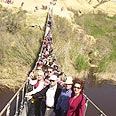
Habesor stream after a flood
צילום: ארכיון קק"ל
The flood channel
Last week's onset of winter has awakened a special breed of travelers from their summer hibernation - flood hunters. Did someone mention rain? They are always the first ones to run to the Negev and Judean Deserts in order to get a good seat for the show
When Ya'ala Konda heard the weather forecast predicted heavy rains last weekend, she didn't cancel her travel plans. She packed up a warm coat and binoculars and raced as quickly as possible to the Negev. Ya'ala is, as known amongst nature enthusiasts, a "flood hunter," part of a growing group of travelers that have traded in the traffic jams of the Galilee and Golan Heights for the flashfloods of the south.
Flashfloods in the Negev and Judean deserts have gotten a bad name in recent years, due mostly to the irresponsible behavior of tourists. It is clearly not advisable to watch a flood from within, but if you find a good observation point on a cliff or on the side of the road, you see the entire desert below fill with water all at once. It is truly an unforgettable experience.
"It is an amazing and unique experience," says Ya'ala. "At first you hear a quiet noise that quickly gets louder until, all of a sudden, everything is flooded. The flow of the water is amazing and the contrast between (the water) and the surrounding desert is beautiful."
Effy Perry, the manager of the Mt. Negev Field School, says he looks forward to that first wave of a flashflood: "It is an incredible sight when the river suddenly starts to flow in front of your eyes. There's a big wave full of foam, and a huge noise. You need a lot of luck to catch that moment."
Even you don't make it on time to see the beginning of the flood, the duration is no less interesting. The amount of water that flows through the Faran River, in the south, during a serious flood, is greater than the amount of water flowing through the Jordan River in an entire month. "True the Faran River is only a seasonal river," explains Perry, "but its drainage basin is larger that that of the Jordan (river). Therefore, when the water comes, it is the largest river in Israel."
Where and How?
The best observation points in the Faran River area are the bridge south of the Moshav Faran in the Arava desert (route 90), or on route 40 between Mitzpe Ramon and the Tzichor Junction. On this part of route 40 you can also see floods in the Ramon, Neqarot and Tzichor rivers. In the Negev, near the Arava Junction, you can see flashfloods in the Tzafit and Tamar rivers and in the Yerouham Spring.
If there are flashfloods in the Tzin River, the best observation points are on route 40, between Sde-Boker and Mitzpe Ramon. According to Perry, the best spot is the upper lookout point in the Ein Ovdat National Park, near Sde-Boker.
There is a fantastic view of the entire northern section of the Ramon Crater from the Mt. Negev Field School that is located on the edge of the cliff. Incidentally, older residents of the area swear that every few years the region has even seen snow.
In the Judean Desert one can see flashfloods all along the Dead Sea Road. The most outstanding rivers in the area are the Dargot, Arugot, Hever and Tzeelim rivers. It is important to pay attention to strength of the floods on the Dead Sea Road in order to avoid getting stuck between two flowing rivers.
To find two especially beautiful lookout points in the Judean Desert one has to travel on a dirt road until the Mashash River (you go up towards Metzoke Dragot and continue on the path marked in green for three kilometers) and to the Tzfira pools (via a dirt road that comes off of the Arad-Masada Road).
If you want to see a flashflood but don't want to listen to the radio all day hoping for a rainy forecast, the Society for the Protection of Nature ([email protected]) operates an email list about floods, and provides up-to-the-minute telephone information about floods at (03) 638 8688. The organization also offers flood watching tours, but many people prefer independent flood searching.
Rules of the game
Flood hunting is not dangerous - as long as one follows the rules. "It is forbidden under any circumstances to enter riverbeds when floods are possible," warns Effy Perry. "To watch a flood from above is one thing, but from inside you are risking your life. Even if the riverbed looks sunny, you cannot know for sure that water will not appear out of nowhere in the middle of the trail. It could raining a few kilometers away and a flood could be approaching you even though you don't see any sign of it."
An obvious recommendation is to avoid trying cross a flood either on foot or by car. If the water is higher than half a meter (1.5 ft), don't risk it, even in a car. Even if the water level is relatively low, it can hide boulders and pits that can damage a car.
