


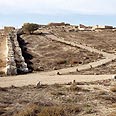
Tel Arad
צילום: עדי אדר, החברה הכלכלית ערד
A land of milk and honey
From the Negev Desert to the Galilee, the Land of Israel is a wealth of living Biblical history. As the Pesach holiday season approaches, there is virtually no end to he possibilities of getting out and bringing the Torah to life. Ynetnews presents a selection of museums and tourist attractions not to be missed
Our journey took us all over the world, and at each stop we examined the influences on Israel.
Now, finally back at home, we are on a quest for the most authentic expression (if there is such a thing) of the land of Israel, the one thing that in large measure is at the foundation of our presence here and in our culture – the Bible. And, believe it or not, there is a Biblical Israel in the 21st century.
Mounts and more mounts
Archeological artifacts from Biblical times that let us discover how and what exactly life was like here back in the day. Here are a couple of selected mounts, for your pleasure:
Impressive remnants still remain from the major historic city of Tel Arad. The lower city was inhabited only during the ancient Canaanian period (2200 – 3150 B.C.E.), and was one of the biggest cities in the land. It was surrounded by a sturdy wall, and its streets and homes were meticulously planned. Residences were built according to a unified plan in the “Aradi” style.
The upper section of the city is known as the Mount of Fortresses, dating to approximately 1200 B.C.E.). Over the years, several fortresses were built on location, one on top of its predecessor’s ruins. A shrine was discovered at the fortress’s yard, a smaller version of Solomon’s Temple in Jerusalem. It included a large palace and a small hall which served as the holy of holies.
Where is it? Two kilometers due north from Tel Arad Junction (Route 2808). Admission: NIS 12 per adult, NIS 6 per child.
Mount Hazor
The largest of Israel’s ancient mounts is Mount Hazor. Hazor was the most important city in Canaan and southern Syria, and King Solomon built it as a major center in his kingdom. Also here – there is a lower city and an upper city. On the mount, one can find a large temple in which were Basalt lion statues, a structure which probably served as a palace for the kings of Canaanian Hazor, a large fortress from the times of the kingdom of Israel and an impressive water facility from the times of King Ahab, which includes a deep shaft which drops to a quarried tunnel ending in a pool.
Many artifacts are currently on display at the Israel Museum in Jerusalem, and copies can be seen at the Hazor Museum in Kibbutz Ayelet Hashahar.
Where is it? In front of Kibbutz Ayelet Hashahar, next to Road 90. Admission: NIS 18 per adult, NIS 8 per child. Telephone: 04-6937290.
Archeology at the museum
Another way to see artifacts from the Biblical period is to visit archeological museums. The Akron Museum, for instance, houses artifacts from Mount Mikne, which was discovered when Kibbutz Revadim was founded.
Archeological digs on site revealed evidence suggesting the locale is Philistine Akron. The museum displays pottery, houseware items, jewelry, an ancient olive press and much more. There is a reconstructed Philistine street outside the museum, including production facilities that existed in the city.
Akron Museum, Kibbutz Revadim, Telephone: 08-8588913.
At the House of Miriam, an archeological museum located on a cliff at Palmahim Beach, there are remnants which shine a light on the settlement of diverse populations in the area, from the Stone Age to our times. The museum offers also different activities to familiarize visitors with the history of writing, burial and coin making, alongside activities focused on maritime archeology.
House of Miriam, Palmahim, Telephone: 03-9538281.
Active Restoration
If you want to become acquainted with life during Biblical times – the Biblical Garden in Yad Hashmonah, established by non-Jewish Finnish volunteers who believe in the Bible, reenacts the experience and technology of life on the Judean Mountains, during the period between the First Temple and the Second Temple. The garden includes vines, figs and olive trees, and a road snaking between the trees and the ancient agricultural facilities leads to a hospitable shelter in a Bedouin style.
Yad Hashmonah,Telephone: 02-5343956.
At the amazing panorama of the Michmanim (not far from Carmiel), Roni and Rocky fulfilled their life’s dream and established an ecological garden which reenacts an agricultural village from Biblical times. On location there are an ancient olive oil press, a granary for threshing wheat, a wine press, a welcoming tent, a stone Han (ancient hostel) and an animal petting site.
“Through the Bible to Nature”, Michmanim, Telephone: 04-9881337.
Neot Kdumim, near the Ben Shemen Forest, is a wildlife reserve in which time seems to have stood still. On display are the nature and agriculture of Israel, as they were weaved and threaded in the Bible and early rabbinic sources.
The “nature” on location was planted by the founders of the site, relying on written sources, and the reserve includes walking trails and guide notebooks. Most trails are also suitable for wheelchairs and baby carriages, and pass through flower gardens, trees and water pools, as well as facilities and stations that allow visitors to experience the labor of our ancient forefathers.
Where is it? Route 443, about three kilometers from the Modi’in Junction. Admission: NIS 25. Telephone: 08-9770777.
Peace and environment
Peace and environmental protection are focus of “Pinat Shorashim”, (Roots Corner), the educational park at Kibbutz Gezer. About 20 attractions are dispersed throughout typical Israeli vegetation, and center around subjects from the ancient scriptures – the Exodus, paradise, the Song of Songs, etc. The attractions combine different visual displays and texts. Tours and guides for all ages in diverse topics are available on site, including the possibility to have a biblical meal.
“Pinat Shorashim,” Kibbutz Gezer, Telephone: 08-9270694.
The ancient sources and creativity
Another way to be impressed with the stories of the Bible and walk alongside personalities from the Book of Genesis is though pictures – at the Israel Bible Museum, in Tzfat.
The museum is a project of artist Phillip Ratner. Statues and paintings describe more than 300 scenes from the Bible, as well as a Biblical exhibition as portrayed in children’s paintings. The museum, established in 1984, is located in an ancient stone structure at the Garden of a Crusader’s Fortress.
The Israel Bible Museum Hativat Yiftah 1, Safed. Telephone: 04-6999972. Admission is free of charge.
At the home of Meir Dizengoff, the place where David Ben-Gurion declared the establishment of the State of Israel, resides (next to the Declaration Museum) the Bible Museum displays hundreds of paintings, drawings, statues and models which describe the stories and heroes of the Bible, as well as coins, stamps and holy books in more than 350 languages.
Dizengoff House, 16 Rothschild Avenue, Tel Aviv. Telephone: 03-5173942.
A collection of antiques and artworks from the pre-historic period to the Talmud period are on display at the Bible Lands Museum in Jerusalem. The museum includes one of the most important collections in the art world of the ancient East which shine a light on the Bible. Guided tours, at no charge, take place every day.
Bible Lands Museum Jerusalem, 25 Neve Granot, Museums Avenue, Givat Ram. Telephone: 02-5611066.
For those unsatisfied with pictures and statues, the first Hebrew-speaking theme park – Kings City Eilat offers multimedia and four-dimensional attractions, including a magnificent “palace” based on biblical stories.
The four main attractions offered are the Bible Cave (featuring dramatic scenes such as Noah’s ark, the binding of Isaac and the exodus from Egypt), Solomon’s Waterfalls (a boat tour through major landmarks in Solomon’s life), Journey to the Past (a multi-sensory film about the Pharaohs and ancient Egypt), and the Cave of Illusions (a kind of science museum).
Kings City is located at Eastern Lagoon , Northern Shore, Eilat. Telephone: *3044, 08-6304444. Admission: NIS 118 per adult, NIS 95 per child.
Jerusalem of gold
Special mention is reserved, of course, for Jerusalem. The Tower of David Museum at Jaffa Gate, features a permanent exhibit following the story of the city's 3,000 year history. Each display room is dedicated to a different period in the city’s history.
For example, at the space reserved for the period of the First Temple, Jerusalem rises to greatness with the conquering of Yevus by King David and becomes a thriving economic superpower during the days of King Solomon.
Tower of David Museum, Jaffa Gate, Jerusalem. Telephone: 02-6265333. Admission: NIS 30 per person over five years old.
The “Time Elevator” will also take you through 3,000 years of Jerusalem’s history, and will do it in a multi-sensory manner, with many special effects. Haim Topol portrays the role of Shalem, a historic tour guide, who leads the visitors to the historical depth of the city. While they sit on movable chairs, the visitors “pass” through the city’s tunnels, escape following Zidkiyahu, watch Titus’s armies break through the city walls, stopping at the times of Hordus, Jesus, the Byzantines, the Crusaders and landing all the way at the Six-Day War.
Time Elevator, Agron House, 37 Hillel, Jerusalem. Telephone: 02-6248381. Admission: NIS 40-50 per person over five years old.
The Ariel Institute is owned by “Yad Ben Zvi”, and recounts the history of Jerusalem during the First Temple period.
The museum's permanent exhibits include “Like a Bird in a Café,” which details the story of the Assyrian siege of Jerusalem in 701 B.C.E., and an exhibition which documents the daily life in Jerusalem using models, as well as various copies of archeological artifacts. The museum also includes an audiovisual display projected on a topographical model of Jerusalem, as well as activities for the entire family, like writing in ancient Hebrew.
Ariel Institute, Bonei Hahoma Street, Jerusalem. Telephone: 02-6286288. Admission: NIS 40 per adult.
When King David chose to make Jerusalem the capital of the Kingdom of Israel, he strengthened and fortified it, and built a fortress on the ruins of a Jebusite fortress. At the City of David , which skirts a small area on a hill south of the Old City, there is a visitor’s center and an archeological garden with remnants from ancient periods of the city.
Another site which is open for visitors is the Warren Shaft, an underground water facility which operated during the First Temple period. Not far from there are also Hezkiyahu's Aqueduct and the Shiloah Pool.
The City of David, Kfar Shiloah, Jerusalem. Telephone: 02-6262341, 1800-252423.
