


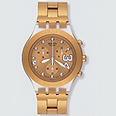
Swatch founder: Only God can stop me
In first interview to Israeli newspaper, Nicolas Hayek tells Yedioth Ahronoth why time plays no role for him
An example could be seen in the annual international Basel World watch exhibition held in Switzerland at the beginning of April. Some 2,200 manufacturers took part in the exhibition, which was attended by 90,000 people and where million-dollar deals were signed on an hourly basis.
Wandering among the stands was a vigorous man, wearing two watches on each of his wrists. Although he is 78-year-old, Nicholas Hayek, founder and chairman of the Swatch Group, is still energetic and active, and sounds like an enthusiastic youth when talking about watches.
"What do you mean who needs a wristwatch?" he wonders. "Human beings love to have vision, to have jewels, and this is a jewel that we sell. We sell beauty. Why do you have at your home a Picasso or a Monet, or why do you listen to Mozart piano concerto? Everybody has all the electronics you need, but you still love this. It's beauty that we sell and not cold equipment and electronics."
Who is your target audience?
"We sell to everybody. We are not like some of the competitors, who say, 'we talk to you only if you have 1 million in the bank.' You can buy a watch from us, a Flik Flak for USD 25 and a swatch for USD 40 and a Tissot for USD 100, and you can go up to USD 800,000 a piece."
And indeed, a limited edition Blancpain watch was sold in the exhibition to an Israeli businessman for USD 770,000. Hayek reveals that one of Israel's former prime ministers is among the regular clients of prestige watches.
How do you see the watch industry in 10-20 years?
"We have three legs in the watch business. The first is the leg of art and fashion. The second is high-tech and electronics. For example, using nanotechnology we made watches for Airbus and Microsoft. And the third part of it is a real measuring instrument. We make, for example, an atom watch, and Omega was with the astronauts on the moon. In the high electronics we have to keep developing. We have many laboratories and development engineers that work on this, and this will grow very fast."
Was there a stage in which you thought about leaving the field?
"When I started my first company I was 25 years old, and many of my colleagues promised me to give me contracts. And then I started myself, and the same day all the people who promised to give me contracts said, 'oh, sorry, our board decided to not to give it to you, because you are too young.' And I had tears in my eyes. I thought, 'oh, my God, I have two children and a wife, and now I am starting a company and I counted on these people and they didn’t give me a contract.' And I was very unhappy about it and I slept one night, and the next day when I woke up I was fighting again.
"When we started with Swatch we failed for a whole year. We made a mistake to try to launch it in Texas and with people who were only bankers and put only money. It didn’t succeed at all."
How do you maintain your precedence in a competitive field like the watch industry, which is subject to fluctuations?
"There are two main keys. First, never underestimate your competitors. They are all great competitors. And the other key to remain number one is not to have any managers in your company at the top places. You can have them, but not at the top. At the key positions have entrepreneurs."
What is the secret of your success?
"One of the most important parameters in every business is selecting the managers and the team to lead the company. You have to look for someone who is an entrepreneur rather than a manager. What is the difference? Picasso for me was an entrepreneur, because Picasso created things, he did them, he communicated it to the public. He created new wealth, because what he did was worth money, and he created new jobs because many people worked for him.
"A manager is a guy who goes to Harvard, to business school, and thinks that if he gets a diploma of a Master in business administration he can run a company and he can take safely take a train from Bern to Zurich, but he doesn’t do anything else. An entrepreneur is somebody who can overcome obstacles, who is a fighter, who is a creative guy, who doesn’t say at the first obstacle that it's impossible. The only things that are impossible for me are to avoid death and to avoid paying taxes.
"Entrepreneurs in my eyes are people like Picasso, Monet, Bach, Hitchcock – people who understood the difference between creativity and between what we can give society to create new worlds, because we need new worlds, otherwise we have only jobless people. The problem in our world today is that we have very few real entrepreneur artists who are powerful enough to push the people to do things."
The Swatch Group employs more than 20,000 workers worldwide. How do you cause workers to remain loyal and motivated over time?
"With pleasure. If you are happy in life, you do it with pleasure. When you ask me how many hours he works per day, and some people say between 14-16 hours, I will answer the following: I never worked one single hour in my life. I always amuse myself. I have a lot of fun. And if you ask the people working with me, they will tell you, 'it's enormous fun to work with him.'
"We create things, we run things, we are number one. Everybody wants to work with us. You get excited if you are successful. If you work in a company where you have to stamp every day and do the same thing, you don’t care. Then you're really working. You can get the people to get excited, to communicate why are we doing these things, how can we do it better. And if you talk to the people around, they will all tell you it's a very exciting place to work at."
Hayek is considered one of Switzerland's 10 wealthiest people, and is ranked 292 among Forbes' list of the world's richest people, with a fortune worth USD 2.5 billion. Although he has already crossed the age of retiring, it appears he has no plans to stop working.
Are you still active in the company? Do you even think about retiring?
"My son heads the firm today. I am only chairman of the board and the main shareholder. I own 51 percent of the company. Have you ever heard of Picasso going on pension or on a retreat? Artists never stop. Look, (former Prime Minister Ariel) Sharon didn’t stop, and he was the same age as I am. But maybe I will be stopped by God, who knows?"
Story first published by Israel's leading newspaper Yedioth Ahronoth
