


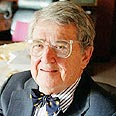
Ex-NY Times Editor Rosenthal dies
A.M. Rosenthal, demanding editor who lifted New York Times from economic doldrums in 1970s, molded it into journalistic juggernaut known for distinguished reporting of national and world affairs, dies Wednesday at 84
He died of complications from a stroke he suffered two weeks ago, the Times said.
Rosenthal, known as Abe, spent virtually all of his working life at the Times, beginning as a lowly campus stringer in 1943. He rose to police reporter, foreign correspondent, managing editor and finally to the exalted office of executive editor, a post he held for nine years beginning in 1977.
"Abe was a giant among journalists,'' retired Times publisher Arthur Ochs Sulzberger said in a statement. "He was a great editor with extraordinary loyalty to his troops.''
Rosenthal had a special interest in Israeli security. He visited Israel regularly and wrote articles on the issue until 2004. He thoroughly dealt with Jewish issue and anti-Semitism.
On Rosenthal's watch, the Times published the "Pentagon Papers,'' a history of America's secret involvement in Vietnam, which won the paper one of its many Pulitzer Prizes in 1972. But the paper started slowly on Watergate and never caught up with the rival Washington Post on the seminal story that brought down a president.
In 1986, facing mandatory retirement, Rosenthal stepped down as editor to assume a new role as a twice-weekly columnist. Thirteen years later, he was abruptly dismissed, with no explanation, he said, other than a comment by Times publisher Arthur Sulzberger Jr. that "it's time.''
The Canadian-born Rosenthal was a naturalized US citizen and fervent disciple of American democracy, with an abiding interest in international affairs nurtured by a decade of working abroad.
'Devoted to quality journalism'
He covered the United Nations for eight years from its inception in 1946 and later reported from India, Switzerland, Poland and Japan. His tough coverage of Warsaw's communist regime in the late 1950s earned him expulsion from the country - and journalism awards: the 1960 Pulitzer Prize for international reporting and the first of two Polk awards.
In an editorial marking his departure, the Times said Rosenthal's "devotion to quality journalism made him one of the principal architects of the modern New York Times.''
Though he was acknowledged as a brilliant and incisive editor, Rosenthal's temperament was less admired. To some detractors he was an overbearing tyrant, whose autocratic behavior could, and sometimes did, derail a promising career.
Rosenthal stepped down as executive editor in 1986 at age 64, a year short of the paper's mandatory retirement age, and began a twice-weekly op-ed column called "On My Mind.''
Rosenthal was 4 when his parents, Harry and Sarah, moved the family from Canada to the United States. He grew up in the Bronx and began his newspaper career in 1943 as a $12-a-week campus stringer while attending City College of New York.
Graduating with a bachelor of science degree, he joined the Times as a full-time staffer in 1944 and spent two years as a police beat and general assignment reporter before a plum assignment in 1946 to cover the then-new United Nations.
Eight years there led to a series of foreign assignments. After returning to New York, Rosenthal was named Times metropolitan editor, beginning a 14-year climb to the pinnacle of newsroom power.
Rosenthal is survived by his wife, Shirley Lord, and three sons from his first marriage, Jonathan, Daniel and Andrew, who is the deputy editorial page editor of the Times. Other survivors include a sister and his first wife, Ann Marie Burke.
Yitzhak Benhorin contributed to the report
