


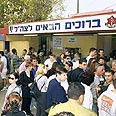
Tel Hashomer 2006
צילום: אבי אוחיון, לע"מ
The lost city of Tel Hashomer
It supposed to be a prestigious neighborhood near Tel Aviv, but World War II threw a spanner into the plan and destroyed the dream
A small street in Tel Hashomer, today’s city of Ramat Gan, is the last remnant of the garden city that was planned for the outskirts of Tel Aviv. The only thing left of that dream is a sign: "Litvinsky Brothers Street, Founders of Tel Litvinsky, Tel Hashomer and its pioneers."
The Dutch-styled street is lined with some 40 rubber plants that are more than 60 years old, as are the two dozen or so remaining houses. The entire surrounding area - Tel Hashomer Hospital, an army base in the name of the first Chief of Staff Yaakov Dori, the IDF archives, Kiryat Krinitzky neighborhood, Habroshim Street, and some as yet undeveloped areas - all this was supposed to be a community of large homes, of schools, sports facilities, cinemas and a theatre.
World War II threw a spanner into the plan and destroyed the dream. Most of the land earmarked for the city of the future was confiscated by the British. Tel Litvinsky, the city that was supposed to bear the name of the family head, millionaire Yaakov Elhanan Litvinsky, remained in a planning office portfolio. The name was changed to Tel Hashomer, in honor of the first guarding units established in pre-Israel Palestine. Today it is mostly a military and hospital complex.
In the center of the only street that Tel Litvinsky succeeded in establishing is number 13, belonging to the youngest of the brothers, Raymond or Reuven, a confirmed bachelor who does not spend much time there. Eldest brother Maurice or Moshe lives at 44 Mandes Street, near Brothers Street, and there is Emile or Emmanuel’s home at number 51.
The Litvinskys staked out their claim in the land of Israel in 1886. Yaakov Elchanan Litvinsky, an immigrant from Odessa, bought land wherever he could: in Rishon L'Tzion, in Gaza where he set up a steam=driven flour mill, a soap factory in Jaffa, land in the Sharon where the kibbutzim Gaash and Shfayim now stand. He was one of the founders of Tel Aviv, the oldest and richest of them, and lived at Achad Ha’am 22, one of the city’s first homes.
Rich brothers' return
In 1916, at the height of the First World War, Litvinsky passed away and his huge inheritance was divided among his three sons. The youngest, Raymond, moved to Paris. Morris and Emile continued their father’s business and even added to his fortune. It is said that during the war they took up residence in Egypt and were the main suppliers of the British military in the Middle East.
At the end of the war, the brothers returned Tel Aviv as agents of Britain’s Shell fuel company. Emile specialized in real estate and continued to acquire property east of Jaffa where the garden city was supposed to have been built. The architect promised homes full of light and sun and demanded that the design of the homes be maintained. A number of those who bought homes were able to design their own.
The city was divided into 2000 lots, some intended as summer cottages, as restaurants, hotels and small farming parcels. In the first four years, 24 homes were built and purchased by immigrants from Germany, but they found it difficult to make a living in their new land. The concept did not catch on and in addition, the area became one of the fronts for riots of 1936 to 1939, when the Arab uprising demanded an end to the Jewish settlement of the land of Israel.
Only ten families, mostly from Germany, settled in the area. They were older academics. The small community was surrounded by Arab villages - 20,000 residents in an arc surrounding it from the north and the east. At a certain point, the question arose as to whether to retaliate to the Arab violence or to simply relocate to Tel Aviv.
The British confiscation
In the meantime, World War II broke out and the Litvinsky's garden city got even smaller, on paper as well. The British confiscated a large parcel and set up a military base called Tel Litvinsky.
The British cleared out in mid-April of 1948 when the 33rd Brigade of the Alexandrine Division infiltrated the base and following a house to house battle, managed to occupy most of the camp. Three men fell in the battles. The southern part of the camp was taken two weeks later during 'Operation Hametz’. The British Hospital that was in the camp was taken over by the IDF medical corps and used as a military hospital until 1953. Sometime in 1948, the camp’s name was changed by Tel Litvinsky to Tel Hashomer.
That was the end of the garden city and today all that remains is the one little street, Litvinsky Brothers. Haim Litvinsky, son of Morris, a retired judge and attorney, told researcher Karen Ben Or-Dadon of Bar Ilan University that he failed in his battle to reinstate the original name - Tel Litvinsky. Ramat Gan Mayor Tzvi Bar ordered the one street on which the garden city homes still stand to be named for the family and a public park has also been named in their memory. These are the only remnants of a dream that disappeared.
