


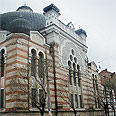
Synagogue, Sophia, Bulgaria (Archive Photo)
צילום: יוסף ג'קסון
Many reform temples, few reform Jews
A response to Paul Arberman and Dalia Sara Marx
Growing up in Southern California, my parents – and cousins and uncles and every other "Reform" Jewish family we knew - had no relation to the ideals of Reform Judaism. At all. My parents were totally assimilated American Jews who wanted "a little something" for my sister and I, and so they joined a Reform temple where they knew they would get a touchy-feely "service" on Rosh Hashana (first day only) and Yom Kippur but where neither rabbi or congregation had any expectation of any further commitment to Judaism.
By the numbers, in other words, Reform is indeed the largest "movement" in American Judaism (it isn't the largest group, however; that "distinction" belongs to Jews who are unaffiliated with any Jewish organization), but Reform temples are hardly filled with Reform Jews. On the few occasions they are filled they are filled with assimilated Jews, many, many of whom have wholly or partly severed their connections with Judaism, and are simply looking for "a little something." In short, the oft-cited statistic of "1.5 million Reform Jews in America" is misleading and incorrect. Similar statements could accurately be made about Conservative synagogues.
I mention this story because several articles detailing the trials and tribulations of non-Orthodox Jews in Israel have appeared several times on this channel in recent weeks. For instance, last week, Conservative representative Paul Arberman pleaded LINK http://www.ynetnews.com/articles/0,7340,L-3272064,00.html for "respect" from Israel's President Moshe Katsav, who doesn't want to address men and women who reject fundamental beliefs of traditional Judaism with the exalted title "rabbi."
Unfair request
Although he doesn't wear a kippa in public, Katsav comes from an observant family, and is said to consider himself an Orthodox Jew. I've never spoken with the president about his personal religious beliefs, but most people who choose to identify with traditional Judaism would reject the legitimacy of belief systems that reject the basic fundamentals of the Torah and/or of rabbinic tradition.
Presumably Mr. Arberman would not ask President Katsav to refer to a leader of Jews for Jesus as "rabbi," because the idea that Jesus is the son of God stands in contrast to traditional Jewish teaching. How, then, can he demand such respect for Conservative leaders who preach ideas that stand in contrast to traditional Jewish teaching?
Never enough
Furthermore, President Katsav DOES treat Reform and Conservative leaders with dignity and respect, even though his personal beliefs prevent him from calling them "rabbi." conservative leader Jerome Epstein and Reform representative Eric Yoffie have been granted an open door to Beit Hanassi, and Katsav has made clear that he – and Israel – values the contributions of non-Orthodox Jews have made to Israel over the years. He has even agreed to call them "Reform Rabbi Yoffie" or "Conservative Rabbi Epstein" when speaking in English, but says he cannot use the Hebrew phrase "rav", which obviously strikes a deeper chord.
But none of this good enough for Arberman. It seems Katsav is trying to find a middle ground with non-Orthodox clergy, but rather than praising Katsav for taking a principled stand and agreeing to focus on the many areas of agreement Katsav shares with non-Orthodox Jews (and agreeing to disagree on theology), Arberman blasts the president and says he feels "the president acts as if he would prefer that we, too, not pass through."
Diatribe
Then there is Dalia Sara Marx, whose diatribe against traditional Judaism drips with venom from the very first word. Marx displays not only a stunning failure to understand the reality of Reform Judaism in America, but also the reasons Reform has never caught on here.
Dr. Marx outlined what Reform Israelis must consider the worst thing of all: Kibbutz Degania, the founding father of the kibbutz movement and a bastion of stubborn, committed anti-religious secularism for nearly a century finally built a synagogue, but when – horror!!! – kibbutz members decided their synagogue would adhere to the requirements of Jewish law, Marx could only conclude they'd never heard of "progressive" Judaism.
That's unlikely. Reform has been around in Israel since 1958, there are more than two dozen Reform congregations around the country. According to sources at the World Union for Progressive Judaism, the organization has an annual budget of tens of millions of dollars to try and interest Israelis in their theology. And news about Reform and Conservative court cases and issues receives wide media coverage. Sorry, but I don't believe Kibbutz Degania is so insular that members don’t read the news, have never traveled, and have never heard other ideas about Judaism and about Torah.
Critical function
One could argue that overseas, Reform and Conservative serve a crucial function as today's Diaspora Judaism hemorrhages people at a frightening pace. Though inherently contradictory and largely devoid of spiritual engagement, the twice-yearly visit to Reform services serves as a last tie to the Jewish people for many people.
But what, exactly, does Reform have to offer Israel? More importantly, what does Reform have to offer Israelis? Spirituality? For that, Israelis go to India or Tibet. Judaism? Sorry, but Israelis aren't buying it. They already feel Jewish, celebrate the holidays, etc.
So perhaps, Dr. Marx, this is the explanation to Kibbutz Degania's choice: After nearly 100 years of staunch secularism, of ham sandwiches on Yom Kippur and bread rolls at the Pesach "seder", could it be, just maybe, that the members of Israel's first kibbutz were looking for something just a little bit more authentic?
Andrew Friedman is opinion editor of Ynetnews
