


A tour between the wars
Golden sand dunes separate Tel Aviv from Gaza. The entire area was a raging furnace as the young state struggled for its existence
Hulikat outpost, Hill 113, Hill 69, Kartiya – are all names replete with the sound of shelling and the blood of the wounded and dead. The combatants came from the divisions of Givati, Shuali, Shimshon, the armored corps 8th division and the Alexandroni division. The tales of heroics and comradeship can still be found in the pages of history and in the memories of war veterans.
The first Hebrew hold on the golden sands was recorded in 1935, at a remote agricultural farm surrounded by hostile Arab settlements. The farm, known as Kfar Menachem (named after Menachem Ussishkin) survived until the Arab revolt in 1936. It was rebuilt overnight in 1937 and Negba, Israel's southernmost kibbutz was founded two years later.
When the Egyptian army invaded Israel during the War of Independence, the settlers at Negba found themselves positioned at the front. With the IDF's help, they built bunkers, firing posts and communication trenches. Today Negba is an open museum that tells the story of that war.
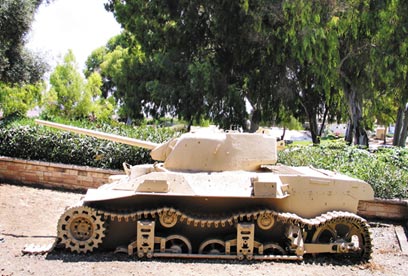
Egyptian tank (Photo: Ronit Svirsky)
Memories are aroused at the very entrance to the kibbutz. The tower and the hut have been reconstructed in a special area. When going through the electronic gate, visitors can see Egyptian tanks positioned on both sides of the road, they can climb atop and peep inside. And then there's the first tractor that ploughed the earth. In the heart of the eucalyptus forest lays the cemetery where 37 fallen soldiers lie. Towering above is an impressive bronze statue of the fighters, designed by Natan Rapaport.
Meir Mindel, a member of the Kibbutz, is also a musician who combines modern day music with Hebrew song concerts that are accompanied by a string quartet. Performances are held either at the cultural hall or out in the open. Mindel takes visitors on a tour through the kibbutz and stops besides a small building known as the "Nukta." This used to be the first guard post where armes were stored. Next, they reach the historic water tower, pierced with bullet holes and shelling. Mindel tells the heroic tale of the observation guard killed while on duty, and how his body was recovered under fire.
Additional tours are conducted to the outposts and battle sites. A two-hour tour for a group of up to 10 people costs NIS 100 for the entire group. To book a tour please call: 050-5560554
A monster on the hill
The Yoav Fortress, which has become the memorial site for the Givati Division, served the British police prior to the founding of the state – it was known as "Iraq Suedan," taken from the name of a nearby Arab village. When the British left the country the building was handed to the Arabs. During the War of Independence the fortress became known as the "Monster on the Hill."
It was conquered after seven failed attempts on the 9th November 1948 by the armored corps 8th division, headed by Yitzhak Sadeh and assisted by the Givati division. With its new name it perpetuates the memory of Yitzhak Dubno, Negba's dead commander whose nickname in the Haganah Jewish Resistance Movement was Yoav.
Just a few years ago the restoration of the impressive building was completed, and it became a museum and a memorial site for the Givati division. Maps, certificates, documents and photographs documenting the events during 1848-1956 are displayed on the first floor. Recently an interactive multimedia display covering the history of the Givati division since 1983 - after it was reestablished - was added to the fortress.
The Yoav Fortress and Givati Museum are open from Sunday-Thursday 9:00-15:00, open to groups Fridays and Saturdays with advance booking. Entrance fee: NIS 18 for adults, NIS 10 for children. Tel: 08-6611315
In life and death
Loss and bereavement befell Kibbutz Negba on February 4th 1997 yet again. Hagit and Yoav Keidar, second generation kibbutz members, lost their youngest son Tomer in the helicopter tragedy in Shaar Yeshuv. Yoav who could find no consolation for his pain toured the hills surrounding Negba until he found the right hill on which to commemorate his son, his best friend and the remaining 71 soldiers who lost their lives in the tragedy.
Yoav chose to do this out in the open, out of his great love for the country. He only planted Eretz Israel plants in the park, which changes from one season to the next. During winter, the garden blossoms and blooms and during summer it becomes arid with Sabra plants abounding with fruit and shady acacia trees.
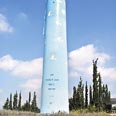
At the heart of the site rises a blue electric pole that has become a work of art. It is painted in pale blue with 73 doves hovering above it. Below the words from a poem by Natan Yonatan are engraved.
The garden is crisscrossed with narrow paths, passing through trees and headstones bearing quotations from the bible and from Hebrew songs. Two stone circles were erected beneath the shade of the acacia trees. One circle is dedicated to the plants of the Land of Israel, while the other is a monument in memory of Tom and Tomer, who studied together, enlisted together and fell together. The site is open to the public everyday and is free of charge. There is a small contribution box at the entrance.
How to get there: You pass through the entrance to Kibbutz Negba and continue for two km following the sign Tom and Tomer's Hill. Guided tours are available on advance booking. Tel: 050-5773324
