


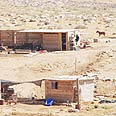
Peace Now: Outposts expanded during war
Report says construction of West Bank outposts expanded during war in Lebanon; Peace Now director-general: This government is a huge disappointment; not only is there no evacuation of outposts, but the expansion of settlements and violation of law continues
Peace Now Director General Yariv Oppenheimer said “In regards to everything that is settlement-related, this government is a huge disappointment; not only is there no evacuation of outposts, but the expansion and violation of the law is continuing.
“The data show that the settlers are not letting up and reinforcing settlements and outposts,” he said.
According to the report, the expansion took place from April until August. So far, this year’s tenders have been issued for the construction of 952 housing units in settlements, compared to tenders for 235 housing units that were issued by last August. Most of the tenders issued focused on Betar Ilit, Maale Adumim and Alfe Menashe.
Continued building
The report said the Construction and Housing Ministry was responsible for issuing the majority of tenders, adding that the ministry is currently working toward building and marketing 3,661 housing units in the settlements.According to the Central Bureau of Statistics, the construction of some 413 housing units began throughout the West Bank in the first quarter of 2006. Last May the head of the Northern Command signed a decree expanding the jurisdiction of four settlements: Givat Zeev, Oranit, Betar Ilit and Maskiyot.
The Peace Now report said active expansion works are being conducted in 31 settlements, while permanent housing units are being built in 12 settlements. In 2006 only one unmanned outpost has been dismantled (Yitav), the report said, but 101 remain.
The report enumerates the outposts in which expansion works have been undertaken: three trailers were added in Derech Avot in Hebron; in Gilad Farm and Yair Farm in Samaria, two more were added. One trailer each was added in Gush Etzion, Bat-Ein, Nofei Nahamia (near Tapuah Junction), Neveh Daniel and Point 468 (north of Jerusalem).
Expansion works and road construction
According to the report, land is being prepared for building near the Itamar settlement, and in Nofei Nahamia, Givat Harel and Lehavat Itzhar.
Permanent structures are being built in Hill 782 near Itamar, the settlements of Givat Olam, Tekoa B and C, Kiryat Arba, Bnei Kedem, and Zeit Raanan, as well as in the outposts of Mitzpeh Kramit, in Plagei Meim, Givat Harel, Hersha and Bruchim.
In the north Jordan valley - in Givat Seliat - building of an encompassing road has been renewed. There is also road construction in Tekoa B and C. A new road is being constructed in Sde Bar, near Tekoa, and in Tzur Shalem in Gush Etzion.
According to Peace Now, the number one perpetrator of outpost expansion is the Binyamin Regional Council, led by Pinchas Wallerstein, where 39 percent of the changes are taking place.
It is tailed by the Samaria Regional Council, then by Gush Etzion. A relatively small amount of work is being undertaken by the regional councils of the Jordan Valley and Mount Hebron.
Pursuant to these statistics, Peace Now claims that during the summer of 2006, while public attention was focused on the war in the north, settlers continued to expand and strengthen their hold and their building.
War sidetracks evacuation efforts
According to the organization, settlers took advantage of the war in order to expand outposts, pave streets and build permanent infrastructure in outposts. "The war sidetracked efforts to clear out outposts, including those where violence against Palestinians was instigated," they said.
Prior to the outbreak of the war, the government intended to evacuate three outposts: Hill 833 (Maon Farm), Point 792 (Sculley's farm) and the Sneh Yaakov outpost (the farm of Ronen Arusi).
Peace Now's report further stated that work has been renewed on paving two streets in the West Bank: the Tekoa-Jerusalem route and the Maale Adumim-Jericho route (in the area west of Kfar Adumim).
Likewise, the government approved building of a Samaria peripheral road, at a cost of some million NIS. Work is anticipated to take place for three years and, all the while, building continues on a police station in the E1 area.
In response to the Peace Now report, Binyamin Regional Council Head Pinchas Wallerstein told Ynet: "I'm glad that Peace Now redeemed all their transgressions and have time to begin accumulating new transgressions. If it wouldn't cause a rift in Israeli society, I would laugh at it report."
According to Wallerstein, "the report refers to necessary building, such as renovations of a kindergarten classroom. The debate regarding outposts could be solved immediately – if the government would decide to acknowledge the existing outposts."
