


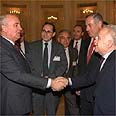
In Madrid
צילום: יעקב סער, לע"מ
Go back to Madrid
Renewed Madrid peace process would align peace-seeking countries against fundamental Islam
The 15th anniversary of the Madrid Conference (October 30-November 1, 1991) should be a day of reckoning. When the peace process in the Middle East is in a quagmire, in abeyance with no light in sight, it is imperative to resort to the only proven, solid, promising process there is: The Madrid Process.
The Madrid process came into being after years of futile political activities. Then-US Secretary of State James Baker brought a great deal of enthusiasm and determination only to encounter dogmatic entrenched positions lacking imagination, true belief, and a sense of profound change in the respective attitude of the parties toward the process.
It was a time when position clung to the procedure, in order to elude and postpone the substantial – since the substantial required decisions that bolster the process and pull out the dragging coach closer to the target at a faster pace.
I had the privilege of being one – according to Secretary Baker’s testimony – who felt that time to act, time for a new departure - not to immerse in the small letters, not to engage in the realm of the procedural that ultimately brought the Israeli Government to say “No” to a formula presented by Baker and resign.
The time had come to embark on a new initiative toward new all encompassing horizons.
Two tracks
Thus it was suggested to Secretary Baker to take a new course – dual track: The Palestinian-Jordanian track and the Arab-Israeli track. The idea being that one track should feed progress into the other. It was inconceivable, we maintained, that we might reach an agreement on the Palestinian issue at a time when Israel’s relations with the Arab countries close and distant remained hostile.
The two tracks of Madrid were to be enhanced and supported with a third track-the multilateral track-that was based on the vision of regional development and endeavors to find solutions and accommodations for the weighty problems of water, environment, refugees, arms control that were hovering over the peace process and might affect the attainment of the peace agreements.
In retrospect, the Madrid process is the only prevailing peace process. The Oslo accords reached a deadlock once they produced a Palestinian regime, through democratically held elections, which negates the very essence of Oslo.
The last “move,” namely the disengagement from Gaza, failed as well. The ill fated move ended up with continuous shelling of the city of Sderot and the Israeli Army back in the recently evacuated territory.
The Madrid way
Therefore there is a process remaining - the Madrid process that brought the region to real and tangible achievements with a minimum of ups and downs. This is the truly credible, solid, gradual and comprehensive process that holds hopes and promises.
When the Madrid process was at work we witnessed a glimpse of a “new” Middle East that engages in discussion on regional developments on a large regional scale and other mutual challenges.
The Madrid process ought to be reactivated – in order to reconfirm its basic tenets: Tolerance, reconciliation, people to people dialogues and above all a mutually agreed compromise. The renewed Madrid process will by virtue of its revival become the alliance of peace-seeking countries who fight openly and candidly the fundamental Islam that threatens the entire world.
A newly launched “Madrid” will re-ignite the peace process and implement an outline of agreements, arrangements, diffusion of tension, mitigating conflicts. If properly prepared, taking into account what has been achieved, mend what has to be corrected, it will pave the way for a comprehensive regional peace in the Middle East.
This is a process that awaits resourceful and imaginative diplomacy. It is a process for the believers and not for the agnostics. It is a process that presents hope, yearning, proven track, effectiveness, vision of a new Middle East to be attained nevertheless and against all odds.
It is hope and determination to move ahead versus despair and plunging into helplessness. It is up to Israel, the moderate Arab countries, the United States, Russia, Britain and France to measure up to the potential of the Madrid process so that the prospects of peace may be enhanced until arrived at.
Eytan Bentsur is the former director-general of the Foreign Ministry
