


Out and about in Palestine
Alternative Tourism Group publishes first Palestinian guidebook for those who want to know more about Palestine its culture and history
Rami Kasis and Juad Mosala from Beit Sahour near Bethlehem are graduates of Israeli law enforcement. During the days of the first intifada some 10 years ago, the two who were young boys at the time, participated in riots taking in the Territories and quickly found themselves in Israeli jails. Mosala (36), who suffered a wound to his leg from IDF fire, served more than a two year prison sentence, Kasis a little less.
Perhaps it was the sojourn in a small cell that led the two to the tourist industry, where they founded the Alternative Tourism Group (ATG). This center specializes in organizing tours and excursions while taking a look at Palestinian history, culture, politics and its affiliation with Israel.
The idea for setting up the center was born somewhere around the time when the word "partner" could still be heard in the Middle East when relating to the peace process. In 1995, the founding generation thought it was high time to expose tourists not only to sacred sites but also to Palestinian culture.
"We are proposing something different," said Kasis. "People come to visit sacred sites. They meet a driver and a guide, perhaps the hotel staff as well, and that's it. They have no contact with the local population; they take no real interest in social and cultural aspects. This is our organization's objective, to prompt social and political movements to want to know more."
It was apparently a good idea because the little house in Beit Sahour picked up momentum. Although renewal of the Israel-Palestinian conflict in 2000 wasn't good for business, today the travel agency handles some 180 groups a year, primarily from the west.
"We discovered that there are no Palestinian guidebooks anywhere, such a book that could assist us and be sold to tourists," Kasis said. "All we found was international or Israeli publications. Even Palestinians have a right to publish a tour guide of their own, especially for those who are interested in coming here. There is a market. Some people have visited Israel several times, and now wish to learn about other aspects in the region. Besides, we are setting the infrastructure for future independent tourism."
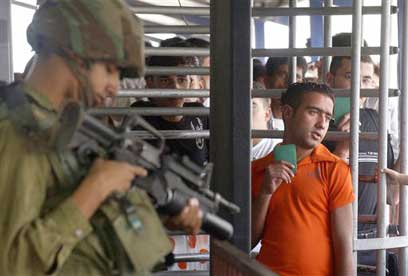
IDF checkpoint (Photo: AP)
A beginner's guide to the territories
The first edition of the guide "Palestinians and Palestine" was published two years ago. The original was written by a Frenchman married to a Palestinian living in Jerusalem. Last year the guide was translated into English by Angela Godfrey-Goldstein (56) a left wing activist, and was distributed in the US and Europe. Some 7,500 copies have been printed so far at the Ramallah printing house.
Hawara checkpoint
Significant sums of money were invested in the revolutionary guidebook, the majority of which was donated by European organizations. The 448 chromo pages present a summary of Palestinian history, culture, sites and prominent Palestinian figures.
The first chapter presents a beginner's guide to the Territories accompanied by images of stern-faced, armed Israeli soldiers and children throwing stones – as well as how to get about, both inside and out. The book also recommends Gazan restaurants and Hebron coffee houses.
Since reaching the bookshops, say editors, some 6,000 copies have been sold, however the guide is not easily available in Israel. The only stores carrying the guide book within the Green Line are in Jaffa and at the Alternative Information Center in West Jerusalem. Copies can also be found in the east of the city such as at the American Colony, or at the online souvenir store www.palestineinlinestore
For the time being the tour guide is not available at the Stimatski book chain. "And do you know why?" asked Kasis. "Let's say you get an order for 10 copies from Haifa. How would you send the books? The taxi alone would cost me more with all the checkpoints and permits. It's easier sending them abroad. They arrive within three days and it's cheap." But this is not the only reason. Editors of the guidebook say it was clear to them that those who live on the other side of the separation fence would not really take an interest in the guidebook. Sale of the new guidebook to Palestinian supporters overseas is much easier.
Who wants to visit a checkpoint?
"Look, this isn't an ordinary guidebook," explains Kasis. It's a book aimed at those who wish to learn more about the history and culture of the Palestinian people in this country. I know a lot of people who have bought this book but who are not planning to visit.
"The guidebook is also suitable for those who are afraid to come to Palestine," Angela says, "they can sit in their armchairs at home and read it. It has a lot of information."
The guidebook on Palestine is divided into several geographical areas: Jerusalem, the West Bank, the Gaza Strip and the "1948 territories. The last chapter is dedicated the "occupied Syrian Golan Heights."
The introduction to the chapter on "1948 Territories" includes a poem written by Tawfik Ziad in 1966. While the chapter on Jaffa fills nine pages, editors dedicated just half a page to the neighboring city of Tel Aviv, saying that Tel Aviv is not part of the Palestinian State. "We created a Palestinian guidebook, if we mention all the Israeli sites, then we wouldn't have achieved anything."
Some people make their way to Jaffa by smell, when the scent of Abulafia's fresh pita bread fills their nostrils, they know they have arrived. "The Abulafia bakery has been active since 1879," the guidebook notes. The neighboring Israeli establishments are not mentioned in the guide.
