


Israeli wines, at home and abroad
Sagi Cooper talks about Israeli wines like Shiraz, small boutique wineries, and ends with a quick trip abroad
Shiraz: Carmel vs. Recanati
Carmel is producing a new 2005 Shiraz as part of its Private Collection series. The wine, thick and dark, reflects Carmel’s efforts to improve the quality of its supreme wines. It is aromatic, smooth, and clean, and while it’s better than some Shiraz wines, even from Australia, it’s worse than others.
Recanati’s new 2004 Shiraz costs NIS 59 (about USD 14) a bottle. It gives you more for your money than Carmel, and is more enjoyable. According to Recanati, the wine is suited to grilled meat or rich stew, but I think that’s a bit grandiose.
This is a good wine, but it best suited to food that isn’t too heavy, not to food that is wintry and heavily spiced. The fruit aromas are good, and the fact that the wine is smooth and full of life makes it pleasant to drink and worth the money. Recanati’s 2003 Shiraz, its first, was better.
Meet Avidan Winery
I mentioned the Avidan Winery following Israwine Expo, held here several months ago. I liked some of their very original wines. Since then owners Tsina, Shlomo, and Shira Avidan have produced several new wines, and this is an excellent opportunity to become better acquainted with them.
Avidan is a small winery, not just in terms of its output, but physically as well. The Avidan family began making wine in 2000, but their love of wine began in Tsina’s parents’ home in France. Today, with a bit more experience, they produce about 10,000 bottles a year, and dream of expanding and having their own vineyards.
Tsina is the vintner, and is assisted by the other family members. Shira, the daughter, who has worked in restaurants, is responsible for the winery’s image as well as marketing and sales. Avidan wines are sold in many restaurants.
The price of wine in restaurants around the world is a sensitive, painful topic, and things aren’t too different in Israel. Today more and more restaurants, even the small and simple ones, are beginning to vary their wine menu, providing a more logical selection that is better suited to the menu, but the main problem is still the price.
Avidan’s wine is exactly what you need for a pleasant restaurant meal: It doesn’t overpower the food, it’s suitable for a wide range of foods, and mostly it’s priced logically and appropriately.
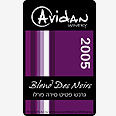
Blend de Noir 2005 comes in two varieties: an equal mixture of Grenache, Petite Sirah, and merlot, and merlot, cabernet sauvignon, and Shiraz. The winery also makes white wines and red dessert wine.
Let’s start with the newest offering, Blend de Noir 2005 with Grenache, Petit Sirah, and merlot. This wine is suited to a not-overly-heavy lunch, or to a wintry sunny day (or a sunny wintry day, if you wish). I believe it would go well with light Spanish food, seafood, or Mediterranean pasta on a balcony overlooking the ocean.
Its main strength is in the nose: It has good, pleasing aromas that extend from sweet flowers and fruits to gently animalistic. It’s a bit light in the mouth, which is disappointing, but “rooming” it (bringing it to room temperature) is useful, and balances it. It is 13.5 percent alcohol, and costs NIS 60 (about USD 14) a bottle. The Grenache comes from the vineyards of the Latrun Winery.
Blend de Noir 2005 with merlot, Cabernet Sauvignon, and Shiraz is the brother of Grenache-Petit Sirah-merlot. A very nice wine, well built and balanced. A deep-red color, clear, and rich in red fruits such as raspberry. Good bodied, medium plus. A wine that goes down easily, and its tannins are good and smooth.
As for the wood - one barrel out of six was new, while the others were from another vintage—it can be felt in the aftertaste. This wine is also 13.5 percent alcohol, and the price is similar to the other Blend de Noir.
The grapes from Shiraz Reserve 2005 and Cabernet Sauvignon Reserve are from the same harvest, and the winery is considering bottling next February. The Shiraz demonstrates typical aromas, and you can easily make out aromas of chocolate and mocha that come out first. It also has flowers along with good, stable tannins, and a good, interesting aftertaste. A happy wine.
The Cabernet Sauvignon is very uniform and clear, with a deep red color. It is still closed, but you can distinguish a light background of green aromas that complete the wine and do not make it heavier. The aftertaste is seasoned and full of fruit, which I hope will continue to characterize Avidan’s wines. The two wines are expected to cost NIS 99 (about USD 23) a bottle.
A bit of satisfaction
Yoav Yehuda’s boutique wineries - there are about two dozen in the Jerusalem and Shfela areas - are doing quite a bit to promote regional wines. Four of these wineries -Agur, Ben Hannah, Castel, and Bravdo - held a sort of “road show” this month, a sales trip to Washington and New York. Agur and Ben Hannah organized the show, Castel joined them and Bravdo sent wine.
The results, say tour organizers Shuki Yishuv and Shlomi Tzadok, were good. They met with some important wine reporters, restaurant representatives, and buyers, and the result was two grape harvests sold to two wineries.
The quantities are small in American terms, but when a winery sells its entire output that’s a major achievement no matter what the amount. This also shows that with enough effort, things move.
