


Exhibit: War and peace games
Suicide bombers, smart bombs, anti-war messages and slapping Nasrallah in the face - you can find all this at 'Forbidden Games' exhibit
The President of the United States, George Bush, presented his new world order after the attacks of September 11: “You are either with us or you are with the terrorists”.
This simple worldview that divides the world into good and bad, where there are no shades of gray, no neutrality and definitely not a more complex view of the world, is expressed in the titles produced by the Western games industry in the years that followed.
In these strategy and action games that are popular in the west, and on the web, the hero is American/European/Israeli, usually a member of some defense organization, whose goal is to defeat the “bad guys” who threaten the free world. The Rainbow Six series, based on the best selling Tom Clancy books of the same name - is a good example.
The Forbidden Games exhibition, which opened in the Center for Digital Arts in Holon, challenges this view which is also embedded in Israeli society. At the exhibition there are computer and video games that have been created apart (for the most part) from the digital entertainment industry, that today brings in more money than the movie industry.
At the exhibition there are two types of games: Shooter games, action games in first or third person where the player has to “shoot anything that moves.” The second types are web games, built on flash technology. Individuals, activist groups, academics and ideologues create the games, as a tool to deal with political and social issues. All deal with our region: The Israeli-Palestinian conflict and the war in Iraq.
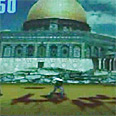
Assault on Iran
One of the more interesting displays at the exhibit is the game (t)ERROR. It is a game that takes place in physical space, where the player chooses who he wants to be: George Bush, Tony Blair or Osama Bin Laden. Without any connection to which he chose, he is asked to collect vast amounts of dollars and oil resources, to kill civilians, and destroy houses. The player jumps, runs and bends with his entire body and becomes an active participant in this controversial game.
Another interesting display is Kuma. It's a war game series, based on real events that give the player the opportunity to experience some of the more difficult battles in the Iraq war. “Assault on the Police Station in Fallujah”, “Capturing Uday and Qusay (Saddam Hussein’s sons)” and “Anaconda Mission” are just some of the mission names.
In the spirit of realism, the game’s creator added a new mission; “Assault on Iran” - a mission intended to stop the Iranian nuclear project. The Iranians, incidentally, are also planning their own “response game”. Kuma was developed in conjunction with the History channel.
An anti-war Flash game that has an original idea is “September 12”. In this game the player marks “smart bomb” targets in the market, the purpose being to harm terrorists situated among the civilian population - but in this game there are no winners: Each “smart bomb” destroys a building and kills civilians that then become terrorists. The message is clear.
Among the other displays you can find an interesting Palestinian mod to Counter Strike, the game “Global Conflict” where a Danish reporter tries to file his report on the conflict, a game created by Hizbullah, and a game that deals with a Palestinian family living under curfew.
The exhibition “Forbidden Games” is on display at the Center for Digital Arts in Holon, and is a part of the third biennial for video-art. The exhibition will be on display until January 27 and is free of charge to the general public.
