


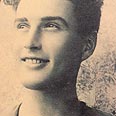
Alexander Penn
New rabbi: Grandson of Alexander Penn
Grandson of poet Alexander Penn, novelist Dr. Yonatan Fein, was ordained as a Conservative Rabbi by Schechter Institute of Jewish Studies
Yonatan Fein (48), son of the poet Zerubavela Fein, the eldest daughter of Alexander Penn, was born in Tel Aviv in 1958, and was educated in the spirit of secular labor Zionism. Uri Zohar, his uncle, was married for a short while to his aunt Ilana Rovina (Alexander Penn’s daughter from the romance with Hannah Rovina).
Regarding his ordination as a Conservative Rabbi he says “My grandfather, the avowed Communist poet, knew and understood the Bible in its entirety, much better than any Israeli university student today. Many words found their way from the Psalms straight to his poetry. Penn spent a year learning Hebrew with Bialik, in exchange for boxing lessons… so what is the surprise?”
Yonatan is a third generation writer in his family. He began writing at age 40 and published three books, “Mario Ratz Rachok” (1991), “Vehagdolah Shebahem Hi Haahavah” (2003), and “Shlosha Gesharim (2005).
His literary writing touches the collective Israeli existence, and examines, among other things, the definition of Israeli identification and the changes that it undergoes as it is influenced by the wars of Israel. In his opinion, the scenes from the Second Lebanon War were an eerie déjà vu to 1982.
Yonatan integrates with great pleasure the three main components of his life: The Rabbinate, the political-strategic sphere, and literature. In the past Yonatan served as a political-strategic advisor to the defense ministry, and today lectures at The Institute for Counter Terrorism at The Interdisciplinary Center, and he helps with Israel’s public relations efforts in Europe and the United States on the subject of international terror and the Jewish-Arab conflict.
His knowledge in this field combined with his mastery of Jewish subjects helps him in his public relations efforts. Yonatan is very worried about Israel’s image abroad and claims that the state of Israel does not do enough in this area, and does not take advantage of the reservoir of experts and wonderful lecturers that it has.
What about Abed Al-Khader Al-Husseini?
For example, once when he was lecturing on Islamic fundamentalist terror on an American campus, a Palestinian student accused Israel of massacres, starting from Dir Yassin and ending with Sabra and Shatila.
Yonatan did not get flustered and asked the Palestinian student about the series of massacres committed by Abed al-Khader al-Husseini’s gangs on the convoy of the Harel brigade during the battles for Jerusalem in 1948.
He listed names of the gang leaders, specific locations, and even the name of the Palestinian photographer who photographed the defaced bodies of the Palmach men, and he described how the Palestinians turned those pictures into postcards in order to raise the morale of the Arab villages.
The Palestinian was dumbfounded by the abundance of details. What finally silenced him was the mention of the address of the photo shop of that same Palestinian, which today is managed by another family in East Jerusalem…
Judaism path
The long and complex romance that he has with Judaism began when he was a counselor in a Reform summer camp, after he was released from the IDF in 1980.
“I was amazed to find out “, confessed Yonatan, “that a group of children from Beverly Hills and Bel Aire (including the son of actor Dustin Hoffman) knew more about Judaism than I did. This began a process that continues to this day. At that moment I understood what the Israeli education system did not give me, and a hole opened wide”.
He came out of the Lebanon war (1982) with painful memories, and with literary inspiration, that finally led him to begin studying Judaism with the Conservative movement.
“It is also what drew me away from Orthodoxy, not to mention the phenomenon of fundamentalist Islamic terror that in his opinion reflects all that could be monstrous in religious belief if it is not conducted with pleasantness."
Yonatan does not see any contradiction between the three main components in his life: The Rabbinate, the political-strategic sphere, and literature.
“The opposite is correct, this way I feel more at peace with myself”. Yet here there is something greater than self-contentment: Yonatan whole-heartedly believes that a modern Rabbi has to be as knowledgeable in international affairs and current events as he is in Gemara or the weekly Torah portion.
Yonatan is a staunch believer in the need to institutionalize an alternative leadership to the Orthodox monopoly in Jewish education in Israel.
"“The greatest tragedy of the secular community in Israel is the fact that they were never given a real opportunity to see alternatives to what the Orthodox offer, and this unsown field has to be cultivated”, he summarizes.
