


Gaza bloodshed affected Mecca talks, Haniyeh says
(VIDEO) Palestinian prime minister returns to Gaza, says government’s speedy resignation necessary to start process of forming new unity coalition; however, PA officials say previous deal breakers, such as control over security forces, have yet to be resolved
VIDEO - “Palestinian blood spilled during the Hamas-Fatah clashes greatly affected the negotiations in Mecca and pressured us to reach a deal on the formation of a unity government,” Palestinian Prime Minister Ismail Haniyeh said upon his return to Gaza Monday afternoon.
Haniyeh said his Hamas-led government would step down in the coming days as the first stage of the process of forming the new coalition.

“We are convinced of the necessity of a hasty resignation - possibly by Wednesday, Thursday or Friday,” Haniyeh told reporters at the Egypt-Gaza border crossing.
When Haniyeh arrived home, fireworks exploded from the roof and women ululated. He was surrounded by armed guards from the Hamas militia, but the crowd of reporters prevented him from exiting his car.
Haniyeh’s political advisor Ahmed Yusef said the government would submit its resignation as early as Tuesday.
Senior Palestinian officials acknowledged that previous deal breakers, such as control over the security forces and the fate of Hamas’ militia, have still not been resolved.
Under the power-sharing deal reached last week in Saudi Arabia, the Hamas-led Cabinet is to step down and make way for a coalition government with the rival Fatah movement of Palestinian President Mahmoud Abbas.
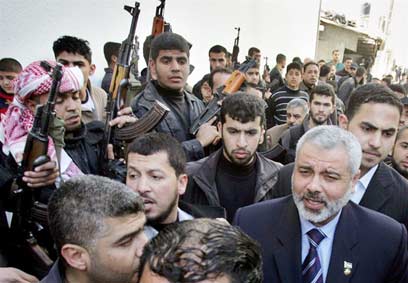
Haniyeh upon his return to Gaza on Monday (photo: AP)
The two sides agreed to a division of Cabinet posts, but have not yet reached agreement on the names of most of the government ministers. One unresolved issue is who will be interior minister and thus exert considerable control over the security forces. Wrangling over such control helped spark deadly Hamas-Fatah clashes in Gaza in recent months.
The deal also did not settle the fate of Hamas’ 5,600-strong militia, which was formed last year over Abbas’ objections. Under one proposal, the force would be dismantled and its members assigned to various security branches, as part of an overall reform of the security, who are mainly loyal to Abbas.
Under the Mecca deal, Hamas is to propose candidates for interior minister, and Abbas has the right to choose one of them. Haniyeh said Monday that Hamas has proposed two candidates, but hasn’t heard back from Abbas yet. Haniyeh, who has five weeks to put together a government, is to meet with Abbas on Thursday.
Two key portfolios, foreign and finance, have already been assigned to independents. Once the Hamas government resigns, Abbas would send a formal letter appointing Haniyeh to set up a new government, said Abbas aide Rafiq Husseini. Abbas wants to move quickly and hopes to issue the letter within days, Husseini said.
'A test for Abbas'
Abbas is also trying to win international support for the coalition deal, even though it falls short of demands that any Palestinian government recognize Israel and renounce violence. The Mecca deal says the coalition would “respect” all agreements signed by the PLO, including those with Israel, but does not specifically recognize Israel’s right to exist.
The agreement moves in the direction of the international community’s demands, Husseini said. “We hope the international community will look at the agreement from a positive side,” he added.
Palestinian officials hoped the deal would lead to a lifting of international sanctions that were slapped on the government after Hamas’ election last year. But foreign governments said they would wait to study the agreement and to see if the new government had the will - or ability - to prevent ongoing attacks on Israel, including rocket attacks from the Gaza Strip.
On Monday, Gaza militants launched four rockets into Israel, causing no injuries, the army said.
During a meeting with the Israeli parliament’s Foreign Affairs and Defense Committee, Prime Minister Ehud Olmert said he would reserve judgment on the new Palestinian government until it is formed, participants said.
Olmert said this is a test for Abbas. Up to now, he said, Abbas has been an opponent of Hamas. If the new government makes the same “inflated” demands of Israel, Olmert was quoted as saying, “It will show that (Abbas) has moved from his previous position, toward Hamas.”
Olmert rejected calls to cancel a summit next week with Abbas and US Secretary of State Condoleezza Rice, saying he wants to hear more from the Palestinian leader, said Yuval Steinitz, a committee member. In Washington, State Department spokesman Tom, Casey said Rice’s trip is still on.
He said the Palestinians have not yet fleshed out the details of their new government, and Rice would talk with Abbas and “See what shape and scope this agreement has taken.”
On Tuesday, Abbas is meeting in Jordan with Russian President Vladmir Putin. Russia is one of the members of the so-called Quartet of Mideast mediators, along with the US, Europe and the UN.
