


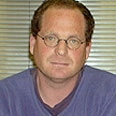
Outside the fold
Peace Now’s Dror Etkes knows that his political opinions are far from popular, but he continues undeterred
“The words of Amos, who was among the herdsmen of Tekoa, which he saw concerning Israel,’” he reads. “Where else in the world can you read a book that describes what happened here 2,700 years ago? This is what moves me.”
He found the Bible in an abandoned outpost. “I redeemed it, as they say,” he said with a grin, referring to the settlers living near the Biblical Tekoa who view Etkes and his activities with extreme disfavor.
Without god
Etkes was born in Jerusalem to a religious-Zionist family. His father, Emanuel Etkes, is a Jewish philosophy professor at Hebrew University.
“I grew up in a relatively open home,” the younger Etkes recalls. “It was okay to ask questions and have doubts about the religious education system, but not about the Zionist ethos.”
He’s unable to identify the precise moment when he became disillusioned. “I served in the army during the first intifada.
“I remember that one Shabbat, I came home and told my father that Israel is applying state-sanctioned terror in the territories. The expression caused a great deal of commotion in the house.”
After the army, Etkes removed his kippah. “I understood that I would have to find a way to feel my Jewish identity without God.”
Outside the camp
Etkes spends most of his day on the road. His jeep - outfitted with military-like tools, including binoculars, maps and telephones – serves him well as he drives around on the other side of the Green Line, tracking Israeli construction, in the hope of somehow stopping it.
Most days, he is forced to concede defeat.
“Traitor”; “informer”; “fifth column”. These are some of the milder names tossed at Etkes as he makes his self-designated rounds.
Over the past few years, members of the Left have become well-aware that their chosen political home is far outside the mainstream. Israeli public opinion about those who oppose what they refer to as the “occupation” (or more precisely, those who even use the word “occupation”) veers from impatience to outright hatred.
Jewish identity
Etkes doesn’t mince words when it comes to his political opinions.
“A few thousand settlers will have a 15-minute shorter drive to Jerusalem each morning,” he observes sardonically, as he notes that a new road has recently been paved from Tekoa and Nokdim to Jerusalem. “Who cares if we thereby make the lives of tens of thousands of Palestinians miserable?”
On a drive from one construction site to another, Etkes proffers his take on Jewish identity. “One can’t choose to belong to the tribe,” he begins.
“It’s my most basic layer of identity. I was circumcised. In other words, my tribe is etched into my flesh. In a situation of ‘us against them’, a person will prefer his own group.
“You’ll always identity more with the pain and hopes of those whose language and customs you understand. There’s no intelligent explanation. That’s just how it is.
“But the trick is to know how to transcend these base impulses, and that’s what Israeli society is unable to do. We continue ignoring the needs and desires of the ‘Other’, and we refer to the collective Jewish interest as the only legitimate interest.
“Our collective identity is based on a negative, which is that ‘we’re not Arabs.’ The State reminds me of a child riding on a bike, when his legs don’t reach the ground. We no longer know why we’re doing what we’re doing, but we’re unable to stop.”
Search for new content
But Etkes believes that he can construct a deeper and more complex identity for himself.
“I feel a lot more Jewish than Israeli,” he insists. “My culture is Jewish; my language is Jewish; even my sense of humor is Jewish.
“I realize that this is an artificial delineation,” Etkes continues. “But according to my worldview, Judaism is less aggressive than ‘Israeliness’.
“In my Judaism, there’s no element whatsoever of choice or being chosen.
“On the other hand, it’s clear that Judaism was designed based on the assumption that God exists. So, I’m certainly faced with the challenge of providing it with new content.”
70 million years old
Etkes does not deny that he feels a strong connection to the Land of Israel. “With a different political situation, I would be happy to live here,” he says about the open spaces near Tekoa.
“Each stone here is more than 70 million years old. So who dares speak in terms of ownership? This applies to both the Israelis and the Palestinians. Come on; have some humility.”
But then he adds, almost as an afterthought, “It’s more complicated. It’s not just love. I also feel hatred towards this land.
“Actually, ‘hatred’ is a bit exaggerated. It would be more correct to say ‘pain.’
