


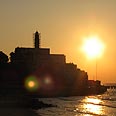
Jaffa: Look at them, see us
Liberation or occupation? Independence or nakba? Yigal Tzur, a good Jaffa boy himself, embarks on a Zionist-Palestinian tour of his childhood city and discovers that even historical facts have two sides
Two sides of a coin
You can find regular tours of Jaffa in any guidebook. The question is what will be the final result. Sami and Uri present two pictures of Jaffa: different, familiar and unfamiliar, you can say it is two tours in one shot, even though they take me to three Jaffa locations: the port, Raziel Street and a small plaza before Kikar Kedumim across from the old Saraya building.Uri Rotlevi, and I begin with him because it is easier to begin with the Jewish Zionist, is working on a doctorate in philosophy, specializing in Walter Benjamin, one of the important philosophers of the twentieth century. Sami Abu Shehade, a resident of Jaffa, is working on a doctorate on the history of Jaffa as an Arab cultural center during the Mandate, and its connection with other Arab cultural centers in the Middle East.
What is the purpose of the tour?
Uri: The point is to show that there is something not right with both of these stories. We are standing on the same points of the street, while each one of us tells his side’s story, and each listener sees something else entirely.
Sami: In addition, in Israel you do not hear the Palestinian narrative. It has no place. You have to see the audience’s anger after they listen to me.
The two laugh. The Arabs get angry with Uri, for his presentation of solid historical facts, as if they were true. The Jews get angry at Sami, who emotionally presents his side, for describing every day life in those times as if it was the truth.
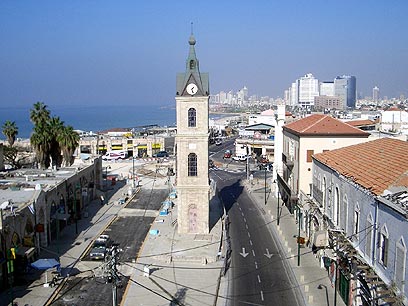
Jaffa's clock square. In the background: Tel aviv (Photo: Yigal Tzur)
How did the idea of the tour begin?
Uri: The idea began with the “Chalonot” (windows) organization which brings together teens from Tel Aviv and Jaffa. Afterwards it continued under the initiative of the Tel Aviv municipality and other educators.
We walk from Yafa in the direction of the Jaffa port. Sami tells me that he is the one who begins the tour, and that he always begins by speaking in Arabic. Meaning, if Ynet was a bi-lingual site the text would be written in Arabic.
You first
Uri: How were most people introduced to Jaffa? From the movie “Kazablan”. The first pictures of fishing boats with lamps entering the port of Jaffa. Here Uri quotes one of the scenes from the movie, and immediately presents the Jewish point of view. The port of Jaffa was mentioned in the Bible. King Solomon sent tree logs from Lebanon to the port. During the time of the Maccabees it was important to capture Jaffa so that the port would be in Jewish hands. This was the point of entry for many of the conquerors of the land. At the end of the nineteenth century Russian pilgrims arrived here, joined by the first wave of immigrants.
Sami sees a different side.
Sami: The port of Jaffa is one of the oldest in the world. Five to six thousand years ago our Arab forefathers settled here. I interrupt him: Sami, which Arabs? Mohammed was born in the sixth century.
Sami (ignoring me): Jaffa, until the mid-nineteenth century, was the old city on the hill. The land around Jaffa was fertile, and it was possible to live off agriculture, fishing, the port and commerce. Jaffa was always an important place, the gate of entry to Palestine. Therefore, Jaffa was captured more than thirty times in its history. There were Arab, Crusader, Ottoman and British occupations. Now it is the turn of the Zionist occupation.
"Jaffa has known better and worse days", Sami continues fervently, "In the Thirties, for example, there was incredible cultural and economic development here. The local population became wealthy and even had to bring in foreign workers to supply the demand. Until the nakba in 1948, Jaffa was the most important cultural and economic center in Mandatory Palestine.
Nakba? Explain.
Sami: Patience. Wait until the third station.
But he adds because he cannot restrain himself.
Sami: The port is neglected today because it has no Jewish history so the state did not preserve it.
YT: As a resident of Jaffa I know that you are right. The entire time that Arabs and a few fishermen were here it did not interest anyone. Look what Cheech did to Jaffa. He changed its shape. He took down all the amazing tall buildings. Only today is a change beginning, I hope not only because of greedy developers, but maybe also there is a little understanding and preservation.
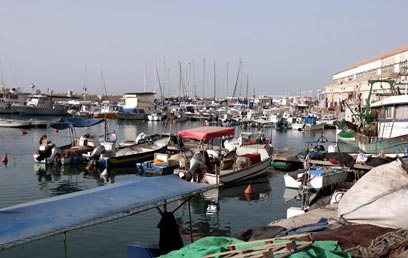
Jaffa's port (Photo: Michael Kramer)
The Jewish Raziel
We walk to Raziel Street, one of the nicer streets in Jaffa, which is suffering from gross neglect. Maybe the Tel Aviv municipality will find a way to connect it between Jaffa and the project of the old station. We stand next to house number 15.
Uri: The second stop on our tour, Raziel Street - that in the past was called the Jewish street - because it held great importance to the Zionist enterprise. The concentration here was great: justice, education, tourism, and assistance to immigrants.
We stand in front of a building with an impressive sign with three inscriptions. The bottom inscription reads "Chevalier A Howard", the sign on top of it says "Shalom Al Yisrael" (Peace to Israel), and the tops sign says "Salaam al Ibrahim" (in Arabic). The street, which leads from the port to the train station to Jerusalem, is called "Alexander Howard"- after Iskander Awad, a Lebanese Arab who westernized his name. The offices of Meir Dizengoff and the great contractor, Chloushe, who built Neve Tzedek, were in the Howard building.
The Kaminetz hotel, which hosted Herzl on his visit to Israel in 1898, is on the same street. House number 17 (which was irresponsibly ruined recently-YT) was the headquarters for the central committee of Hovvei Tzion. In 1908 Arthur Rupin lived in this building, and later the Gymnasia Hertzliya began its activities here as well as the activities of the first Hebrew court house, whose secretary was none other than SY Agnon.
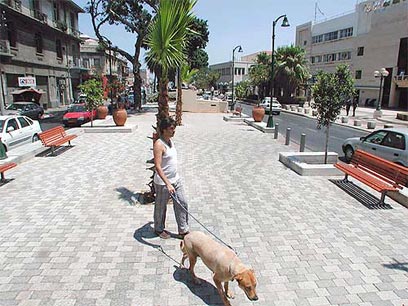
Jerusalem Boulevard
The Arab Raziel
Sami: Let's go down to the beginning of the street. Pay attention to the size of the street and the quality of the buildings.We stop next to number 4 Raziel. It is an impressive building which houses a nursing home. There is a neglected sign that no one has bothered to clean in a while. Sami asks me to read it. "In the pogroms of May 1, 1921, Arab rioters destroyed the Jewish stores on this part of Raziel Street, which was then called Boustrous Street"
Sami: The two streets on which we have walked, Howard Street and its continuation Boustrous Street, are the first modern streets of Jaffa, which lead from the port and market to the train station. Jaffa had the first train to Jerusalem. Iskander Awad and Najeeb Boustrous were two Maronite merchants who arrived here from Lebanon at the end of the nineteenth century. They settled on this street and built large plazas and luxury buildings overlooking the sea.
In this period the Arab world was open in a cultural and economic sense. People from Jaffa studied in Cairo and Beirut, and people came from other places to invest in Jaffa: there was a Di-Roma bank , and a movie theater that played western films. There were stores that sewed clothes out of English-Indian cotton. This street is a symbol of the connection between Jaffa and the Arab world.
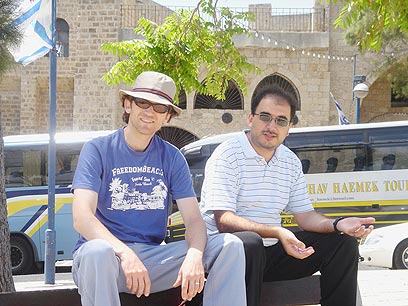
Sami (L) and Uri. (Photo: Yigal Tzur)
We go up to the third and last stop on our tour. Mifratz Shlomo Street. On the way we pass another street that leads to the port called "Second Aliyah Pier". We sit on a bench across from the old Saraya building, across from the view of Tel Aviv. The Ottoman building is behind us.
Sami: Who should begin?
Uri: Me
Sami: As usual. You always begin.
The liberation of Jaffa
Uri: We are at the third and final station. Here you can see the microcosm of relations between Tel Aviv and Jaffa. In front of us are the red tiled roofs of Neve Tzedek, the first Jewish neighborhood that arose out of Jaffa. New immigrants arrived in Jaffa and integrated with the local community. It was crowded. They wanted to establish a new Jewish neighborhood. In 1886 they established Neve Tzedek; in 1890 Neve Shalom; and in 1909 Tel Aviv, a real Hebrew city. The relations with Jaffa were close. People worked in Jaffa.
But in 1929 the trust and coexistence cracked, if not collapsed entirely. A series of riots against the Jews began. The Arabs sent groups of kids to beat up the Jews and then the men would arrive to maim and kill. The riots continued: 1929, 1936, all the Tel Aviv neighborhoods on the border of Jaffa were hit. In 1947 the confrontations were renewed. Tel Aviv was in self-defense mode.
According to the Partition Plan, Jaffa was supposed to remain an Arab enclave. It was clear to everyone that the Egyptian navy could arrive at Jaffa and take over the state. Etzel decided to capture Jaffa and remove the threat to the burgeoning state. At the end of April 1948 they began the operation to capture Jaffa.
Uri reads aloud Menachem Begins' speech as it appears in Chaim Lazar's (Litai) book "The Conquest of Jaffa": Soldiers, we are going to capture Jaffa. We are embarking on one of the most decisive battles in the war for Israel’s independence…shoot well…do not show mercy in battle…have mercy on the women and children”.
The Jewish forces encountered fierce resistance. Sniper fire from the Menashiya neighborhood caused many casualties. The next day they tried again. They took care of one house after the other in Menashiya, and wiped out all the snipers. While they were bombing the city center, the population of Jaffa escaped through the port. Jaffa was in the hands of Etzel. Jaffa becomes a neighborhood in Tel Aviv.
The occupation of Jaffa
Sami: This part is not easy for me. I do not say this to the audience. I am telling you. Here I speak about the nakba of Jaffa. The meaning of the word nakba in Arabic is catastrophe. We use this word when there is a natural disaster or a terrible family disaster. The person who coined this term was a Lebanese philosopher named Constantine Zuryk, a lecturer at the American University in Beirut, who in 1949 tried to describe what happened in Palestine. He wrote a book “Man’a a-Nakba”- the meaning of the catastrophe and convinced the Arab world that what took place in Jaffa was a nakba, a terrible disaster.
Jaffa was the most important economic and cultural center in Palestine before the nakba, and before the Partition Plan. What was the Partition Plan? To give something that does not belong to you to those who do not deserve it. Who did not even know where Palestine was on a map.
In 1947-48 Jaffa was a city under siege. Tel Aviv was to the north, to the south were Holon, Rishon Letzion, and part of Bat Yam, on the way to Jerusalem were hostile Zionist settlements and the sea was to the west. We, the Palestinians, were not able to establish an army and the Zionists had many organized gangs with weapons and ammunition and it was clear that they intended to capture additional areas in Palestine. Jaffa suffered nonstop harassment from the Zionist gangs all along the seam line.
Twenty tons of explosives fell on the city over the course of three days. They shelled the school, and the market. Then the massacre occurred. The gangs of Yitzhak Shamir, who would one day be prime minister of the Zionist state, arrived. They brought trucks of explosives in order to blow up the offices of Al Majda, the resistance committee, which resided in the market. Afterwards they placed the trucks next to the new Saraya, in the clock square, where there was an orphanage. It was a great miracle that many orphans did not arrive that day. My grandfather worked in a nearby garage. He ran to help after the explosion but the sights were so difficult that he fainted.
When the Palestinian residents saw that the Jews had no heart and were willing to blow up an orphanage they began to be afraid. After an additional massacre in Tel Arish (The licensing authority junction in Holon-YT) the residents began to flee.
YT: How many Arab residents were there in Jaffa?
Sami: 120,000 in Jaffa and another 5,000-6,000 in Menashiya (from around the Hassan Bek mosque to the Etzel museum). After a short while less than 4,000 remained. If that is not an expulsion then I do not know what is.
Sami: After this. Jaffa was annexed to Tel Aviv. The most important city in Palestine became a city of poverty and crime within the Jewish city that arose from it. The residents remained under military rule and they were all put into the Ajami neighborhood, they put barbed wire around it and the Jews call it the “ghetto”.
“My thesis”, says Sami, “is very simple”: In 1948 we lost everything. Our nationality. Our flag. In 1949 the Absentee Property Law was enacted and we lost our economic basis. Anyone who had property outside of Ajami lost it. In 1951 they put in new immigrants, Bulgarians for example, into rooms and houses in Ajami. The Arab male population fell into a depression, and from there the road to alcohol, drugs and gambling is a short one.
We were not criminals before 1948. We were the center. The occupation turned us into criminals. If there had not been a nakba, today Jaffa would be a city of half a million residents.
YT: I live in Jaffa, with Jews, Arabs, Armenians, and Christians from all walks of life. Maybe the message of coexistence will arise from Jaffa. Maybe?
To book a tour - click here
