


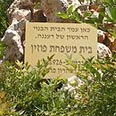
The Posen family memorial
צילום: מיכל בן ארי
America of the Sharon
Ra'anana was established in the heart of the wilderness in the image of an American town. Over the years it has changed beyond recognition, yet it still retains its rural character and its Anglo-Saxon flavor. In the exhibit “Same woman, different cloak” you can decide for yourself which Ra'anana you prefer
Who does not recognize the bustling Ahuza Street in Ra'anana? Now imagine a sandy, narrow two-lane road lined with lone huts along its length. This was how the street appeared in the 1920s and '30s.
In April 1922, two wagons left Tel Aviv with four members of the Ahuza Aleph New York, a group of American Jews who purchased land in Israel. They brought with them three workers and two guards. When they arrived, Yeshayahu Yerche, one of the members, pulled out a bottle of wine and declared, “Here we will pitch our tents and here the community will be established.” And thus, in the heart of the wilderness, Ra'anana was established.

"Here the community will be established" (Photo: Courtesy of Ra'anana's municipal archive)
The community was built like the American towns in the Midwest - a long, straight boulevard that was intended to reach Sidney Ali Beach. In actual fact, the boulevard reaches from Ra'anana Circle (Ra'anana Center Junction) until the left turn to Herzliya. Huts were built along the boulevard followed by single-storey buildings. Alongside the huts they planted tobacco groves and orchards, and Ra'anana became known as an agricultural community that insisted on using Jewish labor.
The boulevard, which is now Ahuza Street, has changed beyond recognition since the 1930s. The sandy road is now a six-lane street and the early houses have made way for shopping centers. However, you may dare say that there is something aesthetic and well-kept about the street. A little like Ra'anana itself, which tries, despite its massive growth, to preserve its green and rural character.
A harmony of accents
The first house built in Ra'anana belonged to the Posen family at 120 Ahuza Street. Today, only a monument remains testifying to the history of the place. A shopping center named for the Posens stands where the house used to be. My disappointment at the fact that the house was not preserved was allayed by a visit to two attractive stores at the shopping plaza.
The Prachim B’Cafe Ushtuyot Bamitz and Elinor Matanot stores, that sell gifts and ornaments, and carry a selection of products in the style of America in late nineteenth and early twentieth century, recreate the atmosphere of Ra'anana’s earliest days. Ra'anana was nicknamed “Americaya” (Little America) by the surrounding Arabs.
Apropos little America, even though Ahuza Street is the main street of Ra'anana and is filled with all types of stores and businesses, it still maintains its pleasant Anglo-Saxon atmosphere. From every corner of the street there are echoes of the Anglo-Saxon accents of elderly Americans or religious, young South African couples. These voices are in harmony with the sounds of South American and French accents who have also made aliyah to the city in recent years.
In the midst of all the commotion of Ahuza Street, a small museum is quietly hidden called The Founders' Museum, which immortalizes the work of the first settlers. The museum recreates local life between the years 1912-1936 and presents Ahuza Street during those years in a visual and sensory manner - the first huts, Beit Ha’am (the community center), the synagogue, the first café, schools and kindergartens, and more. (“Yad Labanim,” 147 Ahuza Street, 09-7610551)
Same woman, different cloak
Whoever feels hungry or thirsty after their tiring journey from New York to Israel has a French option at the nearby La Trattoria restaurant. Yes, the name and restaurant are Italian, but the restaurant owners, Yoel and Paula, are an immigrant couple from France and are doctors by training. Paula is a doctor who specializes in nutrition and is careful to only choose healthy ingredients for the restaurant’s menu. My recommendation - the thin pizza baked in a brick oven (Ben Gurion 5a, 09-7713505).If the visit to the museum interested you, you are invited to walk a few blocks westward to the municipal plaza of Ra'anana, the former community center, which was established in 1927. During renovations to the building, the original bricks were uncovered underneath the plaster. Behind the building proudly stands Ra'anana’s first public rest room which was built in an eastern style and served the public that came to the community center.
The Meged School is located nearby, the first school to be established in Ra'anana in the 1930s, and it still functions today, and its symbol is an orange. Around the municipality, on Ahuza Street and on nearby Hagalil and Chenkin Streets, a few of the old houses remain untouched. Some are Bauhaus jewels waiting to be preserved, such as Chenkin 1. The houses were charted by aerial photography in 1944, in the framework of a city survey to preserve the sites, and today the possibility for their preservation is being explored by making Hagalil Street into a promenade in the style of Zichron Ya'acov.
The organizers of the study, Naava Mei-Tal, director of The Founders' Museum and grandchild of the original founders, and Rachel Reinstein, director of the city’s archives, are also the creators of the exhibition “Same Woman Different Cloak,” the real reason why we came here today.
Exciting reproductions and a sweet finish
The fascinating exhibition presents 25 historical photos that were culled from the archives, and 25 contemporary pictures of the exact same place (or what exists today in that place), which were photographed by Rachel Reinstein. The attempt to be as exact as possible in the angle of the photo brought her to interesting situations such as photographing from a second floor balcony of an old house (the original picture was evidently taken from the roof of a building).
Penikol Cafe then and today
The result is impressive and emotional. As a café enthusiast, I was excited to discover photographed proof of a lively life in Ra'anana of yore. For example, there was the popular Penikol café, which was frequented by British officers and had an international style. In its place today stands an ugly events hall. (The Music Building: Hapalmach 2a, 09-7464036)
By the way, if you want to look at additional archival material, you can visit the municipal archives of Ra'anana. The archives have a collection of different work tools such as: carpentry tools, cobbler tools, sewing, and more. In addition, they also display the collection of Ostrovsky, the first mayor of Ra'anana. In his collection, you will find personal items, furniture, documents, and books from that period, and many pictures that describe the development of Ra'anana. (Municipal Archives: Eliezer Yaffe 14, 09-7414110)
After the exhibit, it is time to finish up with some coffee. Despite the fact that you can find countless cafes and restaurants on Ahuza Street and in the industrial area, I wanted to get away from the bustle to a quiet and calm place. I chose Patisserie, which is in walking distance from the exhibit. The café has a pleasant décor, and the three old radios, which sit on the café’s windowsill, matched the nostalgic feeling that enveloped me. The Mediterranean breakfast was tasty, and the pecan pie started off wonderfully but ended up too sweet. (Borochov 88, 09-7442203)
