


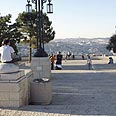
Here lives the Jebusi family
Abraham and Isaac made their way from Armon Hanatziv to Mount Moriah on their forlorn journey to sacrifice Isaac. A man from the tribe of Levi and his concubine walked a similar path in the story of “The concubine of Giva.” Reuven Gafni, a researcher at the Yad Ben Tzvi Institute, puts together a Jerusalem tour in the footsteps of these biblical figures
The Land of Moriah
Genesis 22:4 describes the forlorn journey of Abraham and Isaac: “On the third day Abraham lifted up his eyes, and saw the place afar off.” The two made their way from Beersheba, on the old “mountain pass” to the Land of Moriah - where Abraham was commanded to sacrifice his son. During the first three days of the journey, the land of Moriah remained a place that they would possibly not reach. However when the father and son walked on the ridge where we are standing now, they saw, as we are, the area of Mount Moriah (the Temple Mount of today, according to tradition).
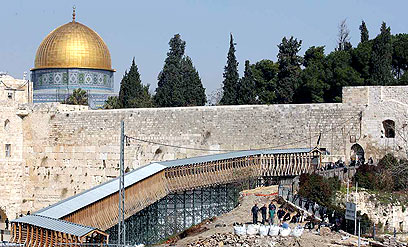
Temple Mount. 3,000 years later (Photo: Haim Tzah)
Abraham, as we know, was not deterred and continued on his way. However we will stop for a moment and overlook the Old City of today. A little below it (from the south) you can see a triangular site - “The City of David”- which was the settlement that King David turned into the capital of his united kingdom 3,000 years ago.
Indeed the city was not established by David, but rather was inhabited by the Jebusite nation: “David captured the stronghold of Zion; it is now the City of David. And David said…those who attack the Jebusites shall reach the water channel” (Samuel II, 5:7-8).
There are those who claim that the name of Jerusalem was hinted at beforehand, in the days of Abraham. When he finished fighting the war with the five kings, Abraham was honorably received by “Malchitzedek the king of Shalem”, who came out to greet him with bread and wine (Genesis 14:18).
As can be seen, in ancient times Jerusalem resided in a valley, on the western side of the Kidron stream, and under the Mount of Olives - far from the main road that crossed the land of Canaan from north to south. It was also not considered a central city.
Keeping this in mind will help us understand an additional biblical story, “the concubine of Giva,” one of the most violent in the Bible. A man from the tribe of Levi and his concubine were making their way from Bethlehem to Mount Ephraim, and stopped close to where we are standing.
They debated whether they should stop for the night in the small Jebusite city or continue a few kilometers north to Giva, a Jewish city located on the horizon spread in front of us.
The two decided not to deviate from their path, and continued towards Giva, where a horrible tragedy occurred. Men from the tribe of Benjamin raped the concubine. In revenge, the Levite summons representatives of the rest of the Children of Israel and, in revenge, they wipe out almost the whole the tribe of Benjamin.
To allow the surviving males from the tribe of Benjamin to marry and restore the tribe, and because no one would voluntarily allow their daughters to marry into the tribe, the Children of Israel allow the Benjamites to kidnap the dancing girls of Shiloh during a vineyard festival. There are those that think that this incident occurred on Tu B’av (the 15th day of Av).
Death beds
To continue the tour: Return to Derech Hebron, turn right until the Cinemateque. Park there and go up until the Begin Heritage Center. Hidden between the Begin Center and the Scottish Church are burial grounds from the time of the Bible. These grounds served the elite, and they do a good job demonstrating the family style burial of the time: the first step was to lay the body in a type of death bed, which even included a place etched in the rock to lay the head - as can be seen. The second step, when all the beds were full, was to gather the bones of the dead and put them into a central pit, where the entire family would end up.
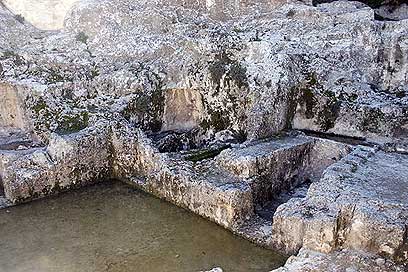
Burial grounds for the rich and famous (Photo: Ron Peled)
Who is buried in these caves? It is difficult to determine, but it is clear that they were wealthy people who could afford to quarry the stone. Some people have raised the possibility that Uziyah the king of Judah was buried here. Since he was a leper he was not buried with the rest of his family in the City of David.
Either way, different items have been found here showing that the family members were buried with notable people, such as small, round silver signs with the wording of the priestly blessing that is still known to us today. The signs are dated to around 7 BCE, and they are the oldest evidence of a known text from the Bible - they were written hundreds of years before the hidden scrolls that were found at the Dead Sea.
Who is buried here?
To continue the tour: Go down the road that descends and crosses the valley of Hinnom, and go up to Mount Zion, which rises in front of us with the Dormition Abbey on top that can be seen from afar. Stop after the church, at the site which, according to tradition, is the burial place of King David.
We just crossed the valley of Hinnom, which in the past was infamous as the place where pagans sacrificed men and children to Molech, the god of the Ammonites, as is described: “He also defiled the Topheth, which is in the valley of Ben-hinnom, so that one might consign his son or daughter to the fire of Molech” (Kings II, 23:10). Today there is no trace of Molech, but the place has become the name of the worst possible fate - Gehinnom (Hell).
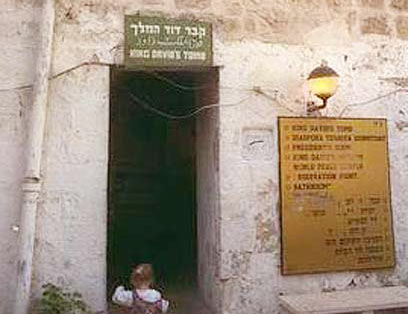
King David's grave (Photo: LAM)
We will try to discover if King David is actually buried at the site where we are standing. The answer, apparently, is no: “So David slept with his fathers and was buried in the City of David” (Kings I, 2:10). We are not in the City of David, so it appears that the identification of this place as the burial place of King David is not accurate. Some claim that the later kings from the house of David are buried here, as the name of their burial place was called “Gan Uza.”
But for the past hundreds of years, Jews, Christians and Moslems alike have treated this place as the tomb of King David, who first made Jerusalem his capital. For many generations, Jews have poured out their prayers and supplications here, and relied on the merit of David to sustain them.
Therefore, we must enter and be impressed by the site of the grave today. Climb onto the roof of the building to see the view of the Temple Mount and the President’s Room (Yitzchak Ben Tzvi), and look eastward to the slopes of Mount Zion and the Mount of Olives, the place of the biblical City of David, and the true burial place, apparently, of the kings of the house of David.
Previously on "Traveling with the Bible:"
The writer is a researcher and tour guide at the Yad Ben Tzvi Institute
