


Everyone’s a cab driver
Local taxi driver complains of passengers with gripes, and of dentists who have taken over the taxi workforce in Gaza; A glimpse into Gaza’s taxi culture
Whoever said Palestinians were behind on environmental issues? Whereas only few Israelis drive natural gas powered cars, many Gazans have been using the new environmentally friendly mode of transport for quite some time.
It is almost impossible to find a Gazan cab that runs on petrol these days, and more and more private car owners in the city have been adapting their engines to run on natural-gas, at the cost of NIS 1,300 ($304) – a move that quickly pays off by saving car owners hundreds of shekels a month.

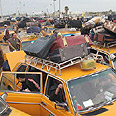
Taxi station in Gaza (Archive Photo: AP)
According to Abu Mohamed, a taxi driver from the northern Gaza Strip town of Beit Lahiya, the money being saved thanks to the new fuel is the only good thing to happen to Gazans - and cab drivers in particular - in a long time.
“From morning to night, all you hear is complaints. This one curses Hamas, that one curses Abbas, the vast majority curses them both. All you hear is cursing and complaints about the political situation, and particularly the financial situation,” Abu Mohamed says.
“I drive hundreds, sometimes thousands of passengers each month, and I get the feeling they are all the same person because they all have the same complaints,” he added.
'Nothing to laugh about'
“Even if there are one or two passengers out of a hundred that want to change the mood, there is always that introductory sentence: ‘Enough depressing stuff, let’s have us a laugh’, then they start talking about things on television or from the past, since there is nothing to laugh about these days,” Abu Mohamed said.Abu Mohamed explained that in addition to the headache brought on by complaining passengers, Gazan cab drivers have recently had to deal with another kind of headache, one much more detrimental to their livelihood.
“Since Hamas’ takeover of the Strip, everyone has been talking about deteriorating situation. Us taxi drivers are probably most affected by it. Since the takeover, thousands of police officers and security officials have joined the taxi workforce, after being ordered by Ramallah’s government not to return to their positions.
“What does it take? Nothing. All you need is a car, and you can start picking up passengers. I see a passenger flagging for a cab and think ‘There’s another ride’. But then some bastard cuts in front of me and picks up the passenger, and he’s not even a real cab driver.
“Once, not long ago, about a year or two, me and another taxi driver were the only two who worked a certain route. Now, that same route is served by over 100 drivers.”
Dentist turned cab driver
But the out-of-work policemen are not the only ones getting on Abu Mohamed’s nerves. He explains how recently, upon arriving at a busy taxi stop, a friend of his pointed out a new taxi driver on the route.“’Who?’ I asked, and he tells me it’s a dentist from the neighborhood who began working the route because he had no work. ‘What do you mean no work?’ I asked. And my friend tells me the dentist said Gazans now prefer washing their mouths out with salt and water to dull their pains in order to save some money, instead of going to a dentist,” he said.
Abu Mohamed also commented on the “annoying” demands that passengers have been making recently.
He explained that since other vehicles joined the taxi force, some belonging to business men and merchants who rent out their cars due to business being slow, passengers have begun to demand air-conditioned rides.
“A sour-faced passenger gets in and asks ‘What, don’t you have air-conditioning?’ For a one or two shekel ride the man wants air-conditioning? How low have we come? People aren’t ashamed of demanding air-conditioning because they see there are more vehicles available, some with air-conditioning.”
The combination of complaining passengers, demands for air-conditioned rides, and the need to compete with dentists and policemen who have recently taken up a new career path, led to Abu Mohamed trying his luck in the construction field.
He started his new job in July, and said that things went well for a while. “It is a little more tiring, but it puts a few more shekels in the bank each day. But then, cement was not allowed entry into the Strip for a while, and prices skyrocketed.
“From NIS 400 ($93) for a ton of cement, prices jumped to NIS 1,400 ($327) per ton. Anyone thinking of building put a hold on everything, and that’s how I came back to the passengers, their complaints, and their exaggerated demands.”
More articles in this series:
