


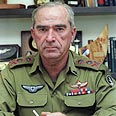
Refael (Raful) Eitan as Chief of Staff
צילום: דובר צה"ל
Raful’s rations
A glass of olive oil to start the day and several slices of bread for dessert – decorated war-hero Rafael Eitan’s food habits were certainly unique
Like any well-trained soldier, Rafael (“Raful”) Eitan knew how to capture a woman’s heart. “He said to me: ‘let’s go eat falafel,’” reminisces his widow Ofra Meirson. “And that was our first date.”
“Of course, it was strange at our advanced age, especially since we’re talking about someone who was the Chief of Staff and a member of Knesset. But apparently, he hypnotized me with his eating.
“He didn’t miss a drop of tehina. He licked from his stomach, his fingers. It was a culinary experience. I didn’t eat. I just watched him like that, entranced. I realized that the way to this man’s heart was through his stomach.”
Raful and Meirson had two large refrigerators in their apartment, but Eitan wasn’t daunted by the oversized appliances. Every evening, on his way home from work, he would stop off at the supermarket and come home laden with groceries. The refrigerators were practically bursting with food.
He was also a frequent patron of a nearby bakery. Like clockwork, he would regularly buy himself a hot, fresh bagel, dipped in salt.
“And I didn’t understand,” Meirson recounts. “We would sit together and watch a movie on television, and always – but always – at the most suspenseful part, he would suddenly get up and go over to the refrigerator.
“And I look and see that the refrigerator remains closed. He never opened it, but he looked like he was busy. When he would return to his place to continue watching the most suspenseful part of the movie, he always seemed kind of calm and relaxed.
“Until one day, I got up to check what was going on.” To her amazement, Meirson discovered an entire stash behind the refrigerator. “There was leftover bread and bagels. Some of them were so dried out that it was impossible to touch them.
“It was his secret hiding place. Like any wife, I would also tell him to watch his potbelly. So the bread that he enjoyed so much, he preferred to eat clandestinely, so I wouldn’t bother him.”
Carbohydrates were Raful’s best friends. At the end of every meal – even the most elegant banquets – he would grasp several slices of bread in his hands. He would eat several of them on the spot and take the rest for the journey home.
“We were once hosted by Gita Sherover,” Meirson recalls. “She really loved Raful. And then the waitress arrived with a small plate, with an even smaller portion of food. At that meal, Raful simply finished all the bread that was on the table.”
Afterwards, Sherover whispered to Meirson, “Listen, I didn’t plan it like that. It looks like I should’ve prepared a giant steak.”
Foreign food
As minister of agriculture during the late 1990’s, Eitan visited South Korea. Thinking that his hosts had placed all the appetizers on the table just for him, Raful emptied the plate and then, as usual, had some bread for dessert.
“I remember that it was outrageously spicy,” Meirson reports. “But as someone who would pour Tabasco sauce on everything, he liked the way it tasted. Yet the next morning, he had an upset stomach and had to rest in his room for half a day until he felt better.”
On one of his trips abroad, Eitan went out for breakfast with some friends. “Raful asked the waitress for a hard-boiled egg,” recollects his good friend Efraim (“Pichotka”) Hiram. “But he spoke English like we all did: a bit of Hebrew, a bit of English, and a lot of hand motions. So, he asked for a ‘difficult egg.’ We never forgot that.”
Raful would start his day with a glass of olive oil. As if it was fine wine, he would continue to sip it throughout the day. “And despite his large paunch, his cholesterol was normal,” Meirson reveals.
He produced the olive oil at his press in Tel Adashim. At first it was merely a hobby, but eventually, he managed to earn a profit off of his well-received oil.
In July 1989, he told Yedioth Ahronoth, “My mother would say that whoever wants to be strong should go to sleep early and wake up early. And I want to add that whoever wants to feel good all day should sip every morning, on an empty stomach, a small glass of olive oil.
“Then a sip of apple vinegar and finally, a teaspoon of honey. With this, it’s possible today to live until 120as long as you don’t get caught in a traffic accident.”
“He also knew how to prepare alcoholic beverages, especially Slivovitz,” Pichotka asserts. “It was incredibly fiery, but he would always insist that we taste it. And we would pucker up from the pungency. One small glass would simply burn us up.
“Even for my wedding, he prepared a bottle like that for me inside a straw basket. It was part of our way of life. Even at our last meal together – and we had many feasts in our lifetimes – three days before he drowned in the sea, I prepared cholent, which he really loved.
“I asked him: ‘What it’ll be? Wine or vodka?’ And he replied: ‘Both of them!’”
'Spam' schnitzel
Rafael Eitan had a long and illustrious military career. He was awarded the Medal of Courage and eventually became the IDF’s eleventh chief of staff.
“You’d think that someone who left the army wouldn’t want to see any more ‘loof’ (Spam, the canned, processed meat once found in IDF rations). But apparently, it was something else. For him, it was a treat,” Meirson declares.
“I once surprised him for his birthday with several cans of loof that I had found,” she adds. “It was a big celebration. You could’ve bought him with loof. He made schnitzels out of it and ate it with bread, of course.”
During the Six Day War, Eitan and his soldiers fought on the Southern Front. By the time they reached El-Arish in the Sinai Desert, they were starving. Carrying bags of money, the Israelis approached the local ruler and asked for food.
He directed them to the town’s small delicatessen, where they found a selection of French delicacies. As the soldiers exited the store, they bumped into their division commander, Major-General Avraham Yoffe, who was known to be a true carnivore.
“Raful felt that Yoffe owed him one from their childhood,” Meirson explains. “His mother had sent him out to catch pigeons with a sling so she would have what to cook, and the teenaged Yoffe, who had come to them for a visit, finished all the food.”
But, to their astonishment, when the general observed Raful and his soldiers, he shouted at them with a smile, “Go away from here, quickly!” He didn’t even ask for a taste.
Ingredients:
I can of ‘loof’ (processed meat)
2 eggs
Olive oil for frying
Directions:
1. Slice the meat into slabs and dredge in the egg.
2. Heat the olive oil and fry the meat slices on both sides, until golden brown.
Note: This schnitzel is best accompanied by several slices of bread to absorb the oil.
Raful’s candies
“The amounts of garlic he ate at night were immense,” Meirson relates. “In bed, I felt as if I was in a field of garlic.”
Plain garlic was Raful’s favorite snack; he would eat it like candy.
Ingredients:
Several cloves of garlic
A bit of olive oil
Directions:
1. Cut the garlic cloves in half and lightly sprinkle with olive oil.
2. Microwave for five minutes.
More famous recipes:
