


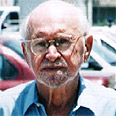
Marcus Klingberg
צילום: דייגו מיטלברג
They'll always have Paris
Traitors also have rights. It's Klingberg's right to sit in Paris and tell stories. At the age of 89 he knows nobody can be bothered dealing with him. But it's a different matter for his lawyers
Marcus Klingberg is not a spy. According to my latest dictionary, a spy is a "secret agent, sent to a foreign country to collect intelligence and secret information about it". Klingberg was not sent here by a foreign country. He is an Israeli citizen who decided, freely and of his own will, to betray his people and country.
The difference between these two activities is not a matter of semantics. It is a moral issue. Espionage is a desirable profession, heroic, often with a romantic character, and one that rewards its outstanding performers with fame. Treachery is a despicable activity, which is necessary but brings no honor, neither to the country which gains from the treason nor the country that suffers by the traitor's actions.
For 20 and more years, Klingberg passed on the secrets of the Institute of Biological Research in Ness Ziona to the Soviet Union. During a large part of these years, the Soviet government openly treated Israel as an enemy: Soviet arms were supplied in plenty to Egypt and Syria, and Russian experts trained their armies. Many Israelis, who had admired the Soviet Union's role in the war against Nazism and the establishment of the state, slowly learnt to be more cautious. An Israeli who supported the Russians at the beginning of the '50s was naïve. An Israeli who supplied them with secrets in the '60s and '70s was a scoundrel.
Ideological aspect
Klingberg was sentenced to 20 years imprisonment. He sat in jail for 16 of them. After a well thought-out public campaign, organized by his lawyer Avigdor Feldman and daughter Sylvia, he was released to house arrest. The claim was that he was seriously ill and about to die. Feldman spoke of humanitarian considerations, of mercy. That's what lawyers do. Feldman is not to blame for the fact that his client suddenly made an amazing recovery.
But Feldman, and his assistant and former legal partner, Michael Sfard, did not end their involvement there. Feldman traveled to Paris so as to be with Klingberg for his recent television news interview with Israel's Channel 2. Sfard has done even more, and wrote a book with Klingberg in which Klingberg boasts about himself and his treachery. This is a bit over the top for any lawyer, and particularly for two lawyers who like to present themselves as leading the fight in Israel for human rights.
Traitors do have rights. It is Klingberg's right to sit in Paris and tell stories. In his book, among other things, he hints that he knew other traitors working for the Soviet Union. There are no names, no facts, just broad hints concerning people who are now dead and no longer among us.
He knows that age of 89, in distant Paris, no one can be bothered to deal with him. Feldman and Sfard are another matter.
Sfard is a lawyer for a number of non-profit organizations, most prominently Yesh Din, which fights for Palestinians injured in clashes with the IDF or settlers. He also represents foreign groups in their legal battles against the IDF's actions in the territories. Unlike lawyers who represent criminals, Sfard's campaigns, as well as providing him with a living, also have an ideological aspect. He genuinely believes in the struggle for human rights.
Klingberg acts in a totally opposite fashion: the book he co-authored with Sfard crudely goes against all that Feldman and Sfard have been preaching for years: humanitarian consideration; respect for the other person; human rights. Klingberg and his co-author can despise Israel as much as they like. But what do they want from the dead.
