


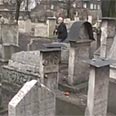
Cemetery in Poland (AArchive photo)
צילום: מירי חסון
Jewish cemetery rebuilds records burned by Nazis
Offices, files of sprawling 19th century burial site in Warsaw burned in 1943; cemetery director takes on monumental task of reconstructing records of estimated 250,000 graves: ' You never know what beautiful gravestone you may find'
WARSAW, Poland - Cemetery director Przemyslaw Isroel Szpilman walks among the moss-covered and crumbling gravestones of the Warsaw Jewish cemetery, painstakingly jotting details in his notebook.
The Nazis burned the offices and files of the sprawling 19th century burial site in 1943 and Szpilman is taking on the monumental task of reconstructing the cemetery's records of its estimated 250,000 graves.
"When I became director ... many people from around the world would come every day and ask about the graves of their ancestors," said Szpilman, who has run the cemetery since 2002.
"Each time I had to explain why I cannot help them," he said. "I decided that, as a director, I must help them, so I started to make records of the graves."
As of last week, Szpilman has completed some 60,000 records - about the quarter-way mark after five years of work.
But he has had help for the past year, with four Jewish students supported by a philanthropist from Chicago taking notes and pictures, and setting up a Web site, www.cemetery.jewish.org.pl.
If all goes well, he hopes to be done with the task by 2012.
The cemetery was founded by members of Warsaw's vibrant Jewish community in 1806. The first burial took place in 1807.
'This is history'
During World War II, the Polish capital's Jewish community of some 350,000 was all but wiped out by the Nazis. The cemetery survived, minus the records.
The site fell into neglect during the postwar communist era, as the few aging Holocaust survivors struggled to care for it.
Szpilman has to fit in his chronicling with other tasks at the cemetery, including some 20 burials a year and maintaining the site, where tree roots and falling branches crack and break the sandstone markers that have been weakened by wind, rain, moss and frost.
The job Szpilman began in 2003 is incredibly labor intensive: He goes through the 83-acre cemetery on Okopowa Street gravestone by gravestone, and reads the Yiddish, Hebrew and Polish inscriptions.
He meticulously records the details in a notebook, including the deceased's full name, father's name and date of death according to the Hebrew calendar.
Then there's the work of entering the data, and the grave's location, into his computer.
"It is a very involving and fascinating job," he said. "You never know what beautiful gravestone you may find, or whose burial site."
Already he's found one important figure in Polish Jewish history - the 1823 tombstone of Tzvie Hirsh Dantziger, the grandfather of Jechiel Dantziger, who was the first tzadik, or spiritual leader, of the town of Aleksandrow Lodzki.
There is a personal motivation for the 36-year-old. His own great-grandfather, Jankiel Szpilman, was buried in the cemetery in the 1930s, but has not yet been located. His grandfather has a claim to fame as a distant relative of the late Wladyslaw Szpilman, whose story of survival was told in the Oscar-winning movie "The Pianist" by Roman Polanski.
Though the cemetery is a place of death, Szpilman also discovered that it was used to preserve life. He uncovered a large hole in the ground, covered with gravestones, which he has learned was used as a shelter for Jews hiding from the Nazis.
"This is history," Szpilman said. "This is the resting place for a community that has lived here for hundreds of years. Working here is an honor and a privilege."
