


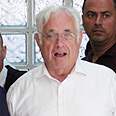
Talansky: Olmert preferred cash to checks
(Video) American businessman linked to bribery allegations against Olmert tells Jerusalem District Court he gave PM $150,000 over 15-year period. 'I gave him cash in envelopes,' Talansky says, 'I can't put into words what that friendship meant to me'
VIDEO - American businessman Morris Talansky, the key witness in the recent police investigation against Prime Minister Ehud Olmert, arrived at the Jerusalem District Court Tuesday morning for his pre-trial deposition in the case.
Talansky told the court he had passed $150,000 to the veteran politician over a 15-year period, praising Olmert as "a man who could accomplish a great deal" for Israel and who deserved his support.
"I gave (Olmert) cash in envelopes," Talansky, a New York-based fundraiser, said in preliminary testimony requested by prosecutors.

Talansky's deposition – which will be considered as trial testimony in any future legal proceeding in the case, should an indictment by filed – was given in English before a three-judge panel, presided over by District Court Chief Justice Mosia Arad and the honorable Jacob Zaban and Moshe Sobel. The hearing began at 9 am and concluded at 5 pm. Talansky testified for about seven hours.
Talansky began his testimony, at the request of State Prosecutor Moshe Lador, by recounting his relationship with Olmert since its beginning. Talansky obliged, telling the court the two first met when he was raising funds for the Jerusalem's Shaare Zedek Medical Center and ABC protective gear during the Gulf War. Olmert was serving as health minister at the time.
"We became close. I learned that he wanted to run for mayor of Jerusalem, that he believed in a strong, united city… I had a great admiration for him. We used to call him 'the prince of the Likud.' I truly loved him.
"The most important thing for me was the unity of Jerusalem. Olmert was a friend. I can't put into words what that friendship meant to me," he told the court.
In 1992, said Talansky, he asked Olmert what kind of financial assistance he would need in the mayoral bid: "I said I would help him. I asked him why I couldn't just write him a check and he said it was because of the way the money was routed. So I gave him cash. I used to cash in (donation) checks and give it to him.
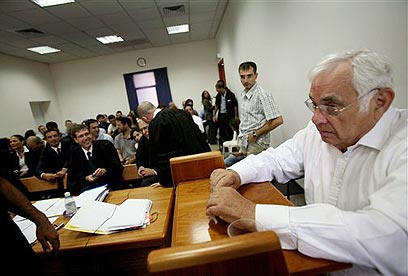
'Great admiration for Olmert'
"I never expected anything personally. I never had any personal benefits from this relationship whatsoever," he assured the court. "It never even occurred to me that I would have any personal stake. I kept funneling funds through (Olmert's former bureau chief) Shula Zaken until 2005, including when he was minister of trade, industry and labor."
Lador then asked Talansky to explain how the money changed hands.
"I gave it to Shula Zaken, but I remember he (Olmert) was with her at least once. I gave them the money in envelops, but no more than $8,000 or $9,000. Back in the States I also gave him money directly," he replied.
The state prosecutor then offered into evidence a partial log, seized from Zaken's office, which contained records of transactions amounting to $72,000.
"Olmert called and told me he needed a lot of money for the primaries. When I asked who much and he told me I was shocked," he told the court. "I got somewhere between $68,000 to $70,000 and gave it to him. I believe it was the last time I gave him money."
When asked if he had any knowledge on what Olmert was using the money for, he said: "Shula always said he had expenses… Olmert said the funds were used for the primaries. He explained that it was just like when you run for elections, that you need (to pay for) flyers, posters, campaign staff etc. When he traveled, they would only give him business class seats and not first class seats. I know some of the money was spent on that. I know some went to but cigars. He likes expensive cigars, expensive pens."
As for the now-infamous trip to the US, Talansky confirmed that he paid for Olmert's stay at the Ritz Carlton in Washington. "The bill included the stay, room service, movie rentals and so forth… the bill came to a little over $5,000," he said. When asked by Lador whether he had anything to do with the reason Olmert was visiting the US at the time, Talansky answered that he did not.
Olmert, he added, "also received a $30,000 loan for a family vacation in Italy. But never repaid it." The prime minister, he continued asked for a separate, $15,000 loan on one of his stays in New York: "I went to a bank near the hotel and made a withdrawal. I gave him the money in an envelope because it was a sizeable amount."
Tell-tale documents
Lador also offered into evidence documentation suggesting Talansky covered some of Olmert's debt to an association which backed his bid for Jerusalem mayorship in 1999. The debt ran just outside of $300,000.
More documents presented to the court told of two other money transfers made from Talansky to Uri Messer, again – for over $300,000. Talansky said he was indeed approached by Messer about yet another loan when the latter was in the States, but insisted he denied the request. He did, however, underwrote the substantial loan.
When discussing the future timetable of his testimony – which would keep him from returning to the US – the visibly upset Talansky could no longer contain himself and burst into tears. "I have to get back to my wife," he wept, "she's ill."
Talansky's deposition was set to clarify many of the questions surrounding his relationship with Olmert, especially pertaining to the alleged illegal financial transactions between the two. Sources familiar with the case said that given the complexity of the case, Talansky's deposition may take up to three days.
The difference between a pre-trial deposition – considered a rare legal maneuver used when the State demonstrates acute concern for the future testimony's integrity – and a trial testimony lies in the narrow leeway given to the defense – it can object to the prosecution's questions, but the witness still has to answer them. The court decides on the defense's objections much later, in the verdict stage.
The State Prosecutor's Office said Tuesday that despite the hustle caused by Talansky's testimony, it was too early to tell whether or not the State can use it in trial.
State Prosecutor Lador said the court will continue to hear Talansky's testimony in July. "The pre-trial deposition cannot even be evaluated before (Talansky) is cross-examined," Lador said, adding that the prosecution will decide on whether or not it will file an indictment in the case only following the conclusion of the police investigation.
Efrat Weiss contributed to this report
