


US says Iran faces cooperation or conflict
(Video) State Department says time for Iran to decide between 'negotiations or further isolation,' demands Tehran give clear answer to EU on latest nuclear proposal. Earlier Iran ruled out possibility of halting uranium enrichment as world powers convene in Geneva to discuss contested nuclear program
VIDEO - The United States said on Saturday after inconclusive talks in Geneva with Iran that Tehran had a choice between cooperation or conflict and negotiations could begin with Washington only if sensitive nuclear work ended.
Just before the talks began, Iran ruled out freezing its enrichment program. In Washington, State Department spokesman Sean McCormack said Iran has two weeks to ''give a clear answer.''
''Iran has a choice to make: negotiation or further isolation,'' McCormack said.
"We hope the Iranian people understand that their leaders need to make a choice between cooperation, which would bring benefits to all, and confrontation, which can only lead to further isolation," said McCormack after the Geneva talks, the first to be attended by the United States.
McCormack said senior US diplomat William Burns did not meet separately with any member of the Iranian delegation and EU foreign policy chief Javier Solana delivered a clear message to the Iranians but did not get a straight answer in return.
"We have not got a clear answer ... we didn't get an answer 'yes' or 'no' and we hope that it will be given soon," Solana said.
"I hope to have an answer to that and other questions in two weeks' time," he told a news conference at the end of the talks in Geneva.

Video courtesy of infolive.tv
He said the talks with Iran's chief negotiator Saeed Jalili, attended for the first time by a senior US diplomat, had been substantive and constructive.
Iran had an opportunity to get engaged with the international community, he said.
There had been a response from Tehran to the proposals in the form of a letter, but "we have not got a clear answer to the most important issue that we sent in the document called 'The Way Forward'," Solana said.
Iran rejects suspension proposal
Tehran on Saturday ruled out freezing its uranium enrichment program, casting doubt over the value of talks between Iran and six world powers less then an hour after they started.
The talks had raised expectations of possible compromise on a formula under which Iran would agree to stop expanding its enrichment activities. In exchange, the six powers - including the five permanent UN Security Council members - would hold off on passing new UN sanctions against the Islamic Republic.
But the comments from Keyvan Imani, a member of the Iranian delegation, appeared to indicate that Tehran was not prepared to budge on enrichment - at least going into the talks.
''Suspension - there is no chance for that,'' he told reporters gathered in the courtyard of Geneva's ornate City Hall, the venue of the negotiations.
There also appeared to be little progress inside the talks.
A Western diplomat in Geneva familiar with their substance said the Iranians were focusing on ''the second or third step'' of substantial negotiations without addressing what the six powers say is a prerequisite for such talks to happen - a freeze of their enrichment program.
Although the US says the Geneva talks focus only on the nuclear issue, Iranian Foreign Minister Manouchehr Mottaki said Friday they could also result in agreements to open a US interest-protection bureau and have direct flights between the two nations.
But he downplayed the presence of Burns - although the Americans had previously said they would not talk with the Iranians on nuclear issues unless Tehran was ready to stop all enrichment activity.
''He is (just) a member of the delegation'' of the six countries engaging Iran on the nuclear issue, he said.
'Freeze-for-freeze' forumula
Imani also denied that the ''freeze-for-freeze'' formula - a stop to Iranian enrichment growth in exchange for no new UN sanctions - was formally on the agenda of the Geneva talks, saying the two sides were meeting to discuss common points of their diverging plans to ease nuclear tensions.
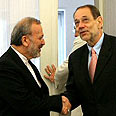
Chief EU envoy Javier Solana and Iranian negotiator Saeed Jalili left together as the talks broke for lunch, speaking earnestly with each other. Burns followed some time later, accompanied only by an aide. All three declined to answer questions.
The Western diplomat - who demanded anonymity because his information was confidential - said Solana over lunch would try to coax Jalili into agreeing to discuss the ''freeze-for-freeze'' concept instead of skirting it and focusing on the next step - substantial negotiations between the two sides.
The United States and its five partners - Britain, France, China, Russia and Germany - remain committed to getting a full halt to Iranian enrichment. Still, Burns' decision to attend the Geneva talks shows that Washington may accept ''freeze-for-freeze'' - something less than full suspension - at least as a first step.
''Freeze-for-freeze'' envisions a six-week commitment from both sides. Preliminary talks meant to lead to formal nuclear negotiations would start, Iran could continue enrichment but only at its present level, and
the US and its allies would stop pushing for new UN sanctions.
If this results in the start of formal talks, the Iranians would stop all enrichment temporarily. Those talks, in turn, are meant to secure Tehran's commitment for an indefinite ban on enrichment.
On the eve of the meeting, French Foreign Minister Bernard Kouchner said the talks themselves give hope ''that there can be a peaceful solution'' to the standoff over Tehran's nuclear program. But he also told reporters he expects no quick changes from Iran.
Reuters and the Associated Press contributed to this report
