


Dead Sea: Cooperation is the path to nomination
צילום: AP
Shrinking Dead Sea may lose 'natural wonders' bid
As seven wonders status up for vote, Dead Sea may lose chance at title if all three entities surrounding it don't form an 'Official Supporting Committee'
A red light flashes over the Dead Sea entry on a website inviting people to vote for the world's top natural wonders, warning: "this nominee is situated in more than one country."
There is no rule against that, but a chance the shrinking sea can win any votes in the election at www.new7wonders.com will vanish if all three countries involved do not each form an "Official Supporting Committee" by July 7.
Either due to bureaucracy or politics, two states are delaying -- which may jeopardize prospects for the famously buoyant lake, about the same size as Lake Geneva, whose level is dropping at nearly one meter a year.
To date, only Israel has a committee. Jordan and the Palestinian Authority have just over three months to make sure the Dead Sea is one of 77 second-round nominees selected, from which a shortlist of 21 finalists will be chosen.
"We're not sure why there's a delay," said Tia Viering, the communications chief for the contest, known as N7W. "The Dead Sea would have a very good chance if nominated, but we can't talk to a lake, and time is running out."
Jordan benefited handsomely from an election in 2007 of seven New Wonders of the World: visits to the ancient ruins of nearby Petra rose by more than 100 percent after it was chosen, said Suleiman Farajat of the Jordanian archaeological park.
Israeli organizer Seffi Hanegbi has no doubts about the reason for delay. "It's 100 percent politics," he said. "We have to have a meeting of the three official representatives. But if the Palestinians know there's a representative from Israel they won't come," he fears.
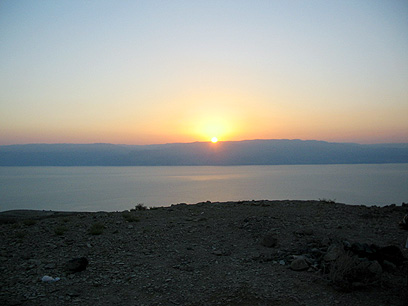
Sun setting on Dead Sea's wonder status? (Photo: Amir Peleg)
"It was a mistake to seek official approval at government level. Mayors or NGOs would have had it done by now," he said. Appreciating the Dead Sea valley should be above politics, Hanegbi says.
Potential returns
N7W expects one billion people to vote online in 2010-11 to chose the seven wonders of nature: "This is a low-involvement project for them that has great potential returns," Viering said. Letters to the Palestinians and Jordanians stressed that point and urged quick action.

Dead Sea (Photo: Kitri Maoz)
But in the West Bank, the Palestinians said they were still awaiting clarification before the government could approve. "In principle we do not have a problem," said Palestinian Authority Tourism Minister Khouloud Daibes. "We are waiting to hear the details and if they have conditions."
"Once we get that, the government should approve it ... I do not think there will be a problem. It's not a political issue."
Viering believes the delays in Amman and Ramallah are purely bureaucratic and will not prove insurmountable. "The Jordanians have been incredibly enthusiastic and supportive in the past so I expect it will go ahead," she said.
But Hanegbi says if the Palestinians balk for political reasons, Jordan too may fold its hands out of Arab solidarity.
Cross-border tourism brings peace?
Hanegbi also considers the broader implications. He believes in the power of cross-border tourism to foster peace. In the 1990s he organized camel treks on ancient routes in the region, facilitated by the fact that Petra and the Dead Seat are a mere day's drive from each other.
Exploiting the business, environmental and tourist potential of such natural assets, and getting around man-made borders is "making peace instead of just talking peace," he says.
Hanegbi is also striving to enter the Red Sea as a "wonders of nature" candidate: a task requiring endorsement from eight littoral states -- Israel, Egypt, Jordan, Saudi Arabia, Sudan, Eritrea, Yemen and Djibouti.
But if the Dead Sea nomination's delays are not merely a bureaucratic glitch as Vierring believes, it could be bad news for any broader rescue project that would require long-term commitment, investment and the approval of Red Sea states.
