


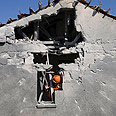
Israeli injured by rocket: I felt a ball of fire inside
Dr. Mirella Sidrer bursts into tears, tells UN commission probing Israeli offensive in Gaza, 'What was my crime? That I’m a Jew living in Ashkelon? I helped women in Gaza… The blood and the suffering has to stop'. Commission to deliver report next month
GENEVA - "I felt like a ball of fire was spinning inside me, all my teeth flew out. To this day I still have a 4cm sliver of shrapnel in the left side of my back next to my spinal chord, and it can't be removed," Dr. Mirella Sidrer, who was injured from a rocket that hit her clinic in the southern city of Ashkelon, told the United Nations commission probing Israel's offensive in the Gaza Strip on Monday.
Officially, Israel is not cooperating with what it calls the UN's "one-sided" investigation into the events of Operation Cast Lead, but Israeli presence was felt at the commission, first with an address by Noam Shalit, father of captive soldier Gilad Shalit, and then with a testimony by Sidrer.
Ashkelon Mayor Benny Vaknin, lecturers from the Sapir College and several representatives of the Sderot Information Center also appeared before the UN committee.
The doctor gave an emotional testimony, saying, "The whole peaceful life I had changed in one second, when without any warning, a rocket landed in my clinic. Within a fraction of a second the place was completely destroyed.
"I found myself seriously injured under the rubble. I still kept taking with the patient I was treating, who was also seriously injured. Her abdomen was open, her entrails were hanging out."
At the end of her testimony, Sidrer burst into tears, and posed the question to the commission: "What was my crime? That I’m a Jew living in Ashkelon? I studied medicine in order to help people from all over the world, I helped women in Gaza.
"I am a common civilian who has never had a hand in any kind of act of war. I also regret the casualties and the innocent victims on the other side. Enough with the blood and the suffering, it has to stop."
Richard Goldstone, head of the commission, told the doctor there was no need for her to apologize to the committee for her pain, which he said the committee sympathized with.
Goldstone added that it is important that the Sidrer's story be known to all parties. The commission refrained from asking the doctor any questions.
Shalit: Freeing my son will end blockade
Kidnapped soldier Gilad Shalit's father, Noam, told the commission during his testimony, "You know releasing my son is the key to advance peace and lift the blockade. A small gesture could ease the lives of many."
Shalit pleaded with the Strip's residents to pressure their leaders into releasing his son, and urged those holding him captive to make a move which would grant them the respect they crave from the international community.
"Don’t do this for any kind of profit, do it because it is the right thing to do, do it for the welfare of your people… Do not ignore the circumstances of my son's military service," continued Shalit. "He wasn’t attacking your land – he wasn’t even on your land. He was in Israel's sovereign territory, defending what was supposed to be a peaceful borderline.
"Your leaders say he is a prisoner of war. I say he is a hostage. If he is a POW, why is he being denied the conditions guaranteed by the Geneva Convention? He is being denied visits by the Red Cross, which can visit Palestinian prisoners and protest the infringement of their rights before the State of Israel.
"Many of you," he added, "understand that your leaders have committed a crime against my son. He is being held as a bargaining chip, and there is no compromise to be reached. Their demands cannot be met. My son is the chip used by your leaders to divert attention form the destruction they've brought upon you."
Pakistani committee member 'sympathetic'
Hina Jilani, a Pakistani member of the commission, thanked Shalit for his testimony. "I speak for all of us when I say we are sympathetic to your pain and to the hard times you and your family have been through," she said. "Anyone using human suffering as a tool to push an agenda is wrong. I was very impressed by your distinguished testimony."
Commission head Richard Goldstone told Shalit he hoped his son will come home soon.
Ashkelon Mayor Benny Vaknin gave the committee members a detailed picture of the targeted Qassam and Grad attacks on public sites and centers in the city, and also presented the members with photographs.
He spoke of the 3,200 residents who had to undergo anti-anxiety and anti-trauma treatment, and of the flight of investors out of fear.
Vaknin also detailed initiatives for joint projects that he tried to promote with the mayor of Gaza, that were halted when Hamas rose to power.
'Pipes and cement could turn into Qassams'
Goldstones asked whether the blockade Israel imposed on the Strip had an effect on the end of cooperation, and the mayor's advisor, Alon Marcus said in response: "It's hard to open the borders to transfer pipes and cement to Gaza, knowing they could be turned into Qassams."
The inquiry commission is slated to deliver its report next month, and its members recently visited Gaza where they also collected testimonies.
Officially, Israel has refused to cooperate with the committee, claiming lack of objectivity. Defense Minister Ehud Barak told UN Secretary-General Ban Ki-moon last month, "We view with severity the mandate given to this committee to deal with war crimes. I don’t think we will cooperate with this committee, although there is a lot of respect for Goldstone personally all around the world and in Israel as well."
Barak clarified that Israel had previous experience with similar investigation committees operating in the region.
"They won't check the other side, won't investigate the series of terror incidents throughout the years, including the firing of rockets on Israel's citizens. This is not a committee which will reach an unbiased conclusion, and therefore I don’t think we'll cooperate with this investigation."
