


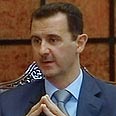
Assad celebrates 10 years in power
Aged 34, Bashar Assad took over from his father Hafez promising reforms, openness, democracy. Assassinations, bribery, continued poverty paint less promising picture
Let's take a look at the busy schedule of Syrian President Bashar Assad, who celebrated 10 years of being in power last week. He began July with a tour of four Latin American countries, then returned home and hosted a US delegation and a secret European delegate in Damascus. He then left for Tunis followed by Spain, and finally held a series of meetings in Damascus which raised suspicions, fear and envy among his Arab neighbors.
These meetings testify to Assad's new status: In one moment he has changed from an awkward and brutal dictator to a figure whose political clout cannot be ignored, for better or for worse – and all this despite the fact that the moderate Arab camp still loathes him. Thus Iraqi Shiite leader Muqtada al-Sadr dared to skip Tehran, the natural choice for a pilgrimage, and went to Damascus to sort out his affairs. Immediately after this visit, Iraqi Prime Minister Iyad Allawi arrived. He too preferred Damascus over Tehran to ensure his entry into Baghdad's most vaunted office. Assad also hosted guests from Hezbollah, who came to ensure that the equipment, arms and missiles which pass through Syria on their way from Iran to Lebanon would not be stopped as part of Assad's efforts to curry favor with the US. Suddenly the Syrian president is the top address, the main target, the mediator without whom nothing is possible. Assad will sort out what others fumble.
Assad decided to celebrate his 10-year anniversary in an original manner: He sent his deputies and advisors to give editors, academics and diplomats a series of lectures about his achievements and successes – and to explain that the key to success lies in sticking with Arab values and unity. The lecturers also announced in his name that the Syrian leader does not intend to yield anything to anyone – neither his central position in the Arab world nor a single centimeter of occupied territory: If Israel really wants peace, it must give it all back. But if Israel wants conflict, Hezbollah is equipped with missiles capable of reaching Tel Aviv.
But Assad's problems are not just with Israel. The Syrian president fears that the Iranians also want to do away with him. His advisors warn that Tehran is not ready to forgive his efforts to establish a nuclear reactor behind Iran's back. Iran also recalls the killing of "its man," senior Hezbollah figure Imad Mughniyeh, two years ago in Damascus' most secure compound. If they could, the ayatollahs would get rid of him now, immediately, as soon as possible, and replace him with a Syrian leader from the Muslim Brotherhood. The tension between Hezbollah and Syria reached new heights Tuesday, and both sides alerted the regime in Beirut. Hezbollah warned: Assad wants to destroy us in order to take over Lebanon again.
Assad is already arranging his schedule in keeping with his new role as regional mediator. He has recently hosted Turkish Foreign Minister Ahmet Davutoglu, Lebanese Prime Minister Saad al-Harari and US Senator Arlen Specter, who heard his thoughts on US President Barack Obama, Prime Minister Benjamin Netanyahu, and the chances (slim) of reaching an agreement with his southern neighbor. Next month he will receive the leaders of Qatar and Bahrain. He also faces talks with Foreign Minister Walid Mualem in preparation for the Arab League debate in Cairo on whether to give the green light to Palestinian President Mahmoud Abbas to enter direct talks with Israel. It is reasonable to suppose Assad will instruct his representative to vote against.
In the meantime, Assad has been roped in to support the flotilla to Gaza. He will not rest until he has managed to break the blockade Israel is imposing on the Gaza Strip. The funding is Iranian, the vessel Turkish, but the hands pulling the strings belong to Assad – the same young leader who, upon entering the presidential palace as his father's successor, on July 17, 2000, was expected to last just a year or two before being toppled or assassinated.
His 10 years in power are being marked elsewhere too. The International Organization for Human Rights released a damning report this week: 35 pages of accusations against Assad and his security services and intelligence agencies. Under the title "10 Wasted Years," the document paints a dark picture of a brutal regime, with arbitrary arrests, the silencing of any opposition, press censorship, the blocking of internet sites like Facebook and YouTube, wiretapping, informing, and – in particular – the disappearance of the regime's opponents. Among others, 92 human rights activists in Syria have been sentenced to 10 years behind bars, and 25 bloggers have been sent for interrogation, never to return.
When the young Assad came to power, says director of the Carnegie Middle East Center Paul Salem, he spread promises of democracy, openness and reforms. Many people hung their hopes on the young leader who was educated in the West and addicted to the internet and PlayStation. When he took over, he would go out to restaurants and theaters with his beautiful wife Asma to show his connection with the people, Salem continues. But within a year the prisons were refilled and the dream of democracy faded away.
Farid S., who worked in the information department of the presidential palace, was also optimistic when he heard the inauguration speech of the new president. In the speech, which came to be known as "Damascus spring," Assad, then 34, promised to open the "political saloons," which had operated underground in private homes. He also promised to hold open dialogue with intellectuals and cancel the state of emergency which had given the security services carte blanche to arrest whoever they felt like. Farid S. started a blog in which he praised the new leader, offered advice and recommendations, and allowed himself to include a modicum of criticism. He was arrested, tortured and sentenced to long imprisonment, but managed to escape to one of the Gulf emirates. Damascus pronounced him insane, and his parents and brothers were arrested.
Going further than his father
Assad dedicated the first five years of his rule to consolidating his position and doing away with all those perceived as representing the older generation who were close to his deceased father Hafez Assad. Thus all presidential deputies and heads of sensitive departments disappeared. For example, Foreign Minister Farouk Al-Sharaa was apparently promoted to vice-president, but his voice has been effectively silenced. When did we last see him? The same fate awaited General Assaf Shaukat, the president's brother-in-law, formerly head of the intelligence services and today holder of the empty title "deputy chief of staff." His real authority is almost nil.
Attempts to summarize these 10 years reveal a complex picture. On one hand, he opened Syria to foreign investment and recruited economists his own age to put together a program for bank privatization and easing restrictions on businessmen from the Gulf, especially from Saudi Arabia. Assad was sure that Turkish capital would flow to infrastructure and factories, and that tourism would flourish. But Turkey prefers to invest millions in Kurdistan. At the same time, the US injunction against any cooperation with Syria hinders momentum. The Obama administration, just like its predecessors, is holding Assad to account for Syria's part in sending mercenaries to Iraq to kill American soldiers. When Assad thought that the White House would change its attitude to Damascus, the mercenaries were held up at the border. Last February, when Washington appointed Robert Ford as US ambassador to Syria but decided to keep him at home for the time being, the wave of infiltration into Iraq began again.
Assad also dealt with the two million Iraqi exiles who were invited by the Presidential Palace to come to Syria. When the security services warned that the new refugees were liable to threaten internal order because of their economic straits, the regime got them back home. Only rich exiles who deposited enormous sums in banks and government projects were granted permission to remain. A large part of these deposits flowed to the private pockets of the political elite. "Corruption in the era of Assad junior has not only failed to disappear, but has been inflated to new dimensions," says Prof. Eyal Zisser, head of the Moshe Dayan Center for Middle Eastern and African Studies at Tel Aviv University. "Those of the old generation who accepted bribes have been replaced by senior figures in the new elite."
And the results? Syria continues to be a poor, agricultural country with a per capita income of $2,024. "But Assad is not really interested in developing Syria," says a figure from Israel's intelligence services. "If he takes his country forward, if he leads its 22 million citizens towards real democracy, if it becomes possible to speak without fear – the first thing they'll do is get rid of him."
That's also the reason why Assad junior, just like his father, doesn't really intend to reach an agreement with Israel, says an intelligence source. Real, full peace is dangerous to him. What he says on this subject is inconsistent: Sometimes he says in frustration that "Israel doesn't want peace," and sometimes he warns against "a war like no other wars." Two weeks ago, in an interview with the London's Observer, he suddenly talked of peace and full diplomatic relations, without which there could be no real peace. But a senior Israeli source insists that Assad junior is going even further than his father. "Hafez Assad wanted peace with Israel like peace with Ukraine, without real relations, while his son dares to speak of cooperation and normalization, on the lines of the Egyptian model," he says. "This is significant, if you take the Iranian pressure on Syria into account. He allows himself to ignore (Tehran) and demonstrate his independence."
Anarchy reigns
The president's wife, Asma Assad (35), is a central pillar of the Arab world's "first lady" club which convenes once in a while under the title "Seeking peace." Her gentle beauty and her insistence on managing an office in the palace and a staff for charity and welfare purposes soften the image of the Rais. Asma, who was born in Lebanon and earned a degree in economics, manages projects, travels widely in the country and is deeply involved. Reports from diplomats in Damascus show that her undercover representatives are heavily involved in financial deals and know how to obtain a cut from cross-border movement of goods.
"That didn't happen during the previous president's rule," says Lebanese businessman Mustafa S. who runs a haulage company operating between Beirut and Damascus. "During Assad senior's rule, army officers and establishment heads got rich but the first family took care to maintain its modest image. During Assad junior's rule, anarchy reigns. If they discover that someone has made exaggerated demands for bribery, they get rid of him."
Thus, for example, they "took care" of General Ghazi Kanaan in October 2005. Kanaan, who was considered omnipotent in Damascus, was Bashar Assad's loyal military tutor as well as head of Syria's security apparatus in Lebanon (and made millions in bribes). He soon came to be considered a threat to the new regime, and five years ago he was assassinated. Kanaan, who understood the threat with his finely-tuned senses, left his office, went home, and gave an interview to the Voice of Lebanon, saying he felt he was in danger. He then went back to his office. Half an hour later, two men entered, put a pistol to his head and issued an ultimatum: Either he "commits suicide" with dignity or they would shoot him. He chose the first option and shot himself in the mouth.
In another case of assassination, that of Lebanese Prime Minister Rafik Harari, intelligence sources believe the international tribunal will remove suspicions that Assad's police were involved – suspicions which have caused him to be shunned in the Arab world. This will be a double victory for Assad: On one hand, Syria will be back with a vengeance to manage affairs in Lebanon. On the other hand, Saad al-Harari, who has vowed to avenge his father's murder, already finds himself scuttling between Damascus and Beirut, clasping Assad's hand and declaring that the Syrian leader is his brother.
Yet with all the successes and achievements, Assad has not learned to appear in public, his speech is confused and his decision-making processes suffer under a surfeit of zigzags. "But he is far more mature and careful," says Prof. Zisser.
"He corrects mistakes and does not intend to do anything his father would not have done. I think that reality plays in his favor now. If in the past he had to consolidate his rule, now he only needs to strengthen his regime, so that problems don't arise."
Regarding peace with Israel, Prof. Zisser sees a consistent and determined line. "He isn't really keen on making peace with us," he says. "I think he wants to reach an agreement which will serve his purposes. If we offer him the Golan Heights he'll take it happily. If not, he'll insist on bringing the Turks back into the picture to get more points from them in the meantime – as he says himself, he has no real partner with us. He knows that our government cannot handle the price (for making peace with Syria). He reads us quite well – and we read him well too."
- Follow Ynetnews on Facebook
