


Photographing the everyday
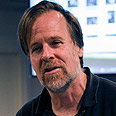
Well-known photographer Alex Webb comes to Israel after 30 years roaming the globe. His work is 'maybe reportage, maybe art… maybe neither,' he says
For more than 30 years, Alex Webb has been traveling around the world with his camera. He has been in Haiti, the Dominican Republic, Mexico, Cuba, India, Turkey and various states in Africa and South America. The well-known American photographer seeks fragments of reality, small moments that gain expression and perhaps greater significance thanks to his lens.
Last weekend, his travels brought him to Israel, where he was guest of the photography exhibition shown as part of the international World Press Photo exhibitions, being shown in the Land of Israel Museum in Tel Aviv until January 15.
"I am drawn to the everyday," Webb says in an interview with Ynet. "Even in the context of major events - the few times that I find myself at such events - it is the little everyday events at the side that intrigue me."

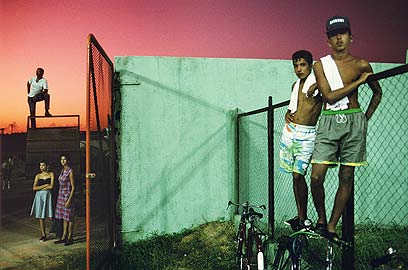
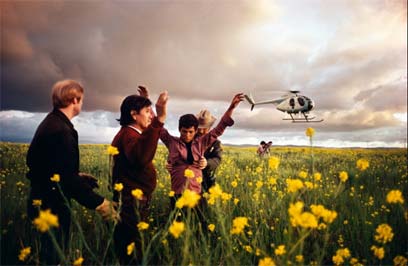
Plant City, Florida, 1989 (all photos: Alex Webb)
What ideas did you have during your visit to Israel?
"I certainly have not started anything of substance here in so short a time - but I am intrigued. Perhaps I'll return to work here someday. My ideas about what I might do are still too unformed to discuss. However, one of my photographic obsessions is borders."
Borderlands
Webb's attraction to border areas can be seen in his work at the borders of the US, and in territories bordering the US and influenced by it – for better and for worse: Mexico, Cuba, Haiti and other states. The closer they are to the American giant, the farther they are in terms of social and economic strength, and certainly in terms of life on the street. These gaps draw Webb to these states again and again.

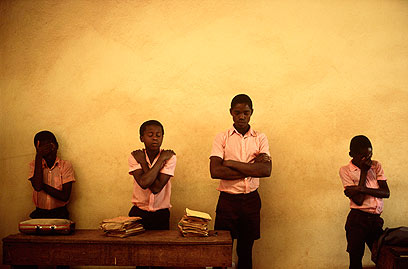
Yaviza, Panama, 2004
"It's very difficult to say just why I have chosen the particular path I have chosen as a photographer. Clearly geographic proximity to the United States has played a role. And clearly specifically not photographing in the United States has been important to me."
"In the mid-seventies I found myself at a photographic dead end. I was taking alienated pictures of the American social landscape. I read Graham Greene's The Comedians, a novel set in Papa Doc's Haiti. It fascinated and scared me. And I decided to go to Haiti, which transformed my life as a photographer and as a human being. I began exploring other worlds where, like Haiti, life seemed to be lived on the stoop and in the street - very different than the gray-brown reticence of my New England background."
Would you say you work is political?
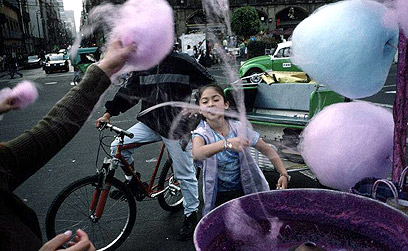
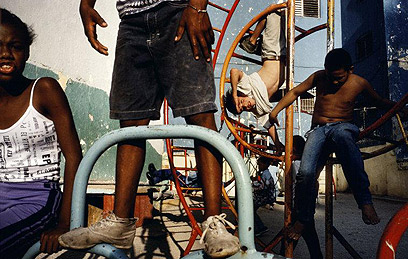
"I think there are some political elements running through my work - what I'd call sociopolitical rumblings. Not a typical documentary photographer or photojournalist, I've worked essentially as a street photographer, exploring the world with a camera, allowing the rhythm and the life of the street to guide and inform the work."
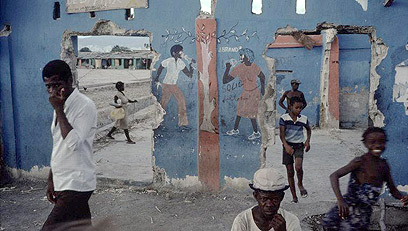
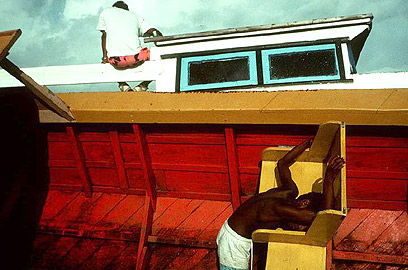
"Whatever insights - sociopolitical, cultural, aesthetic - I may have into the societies I have photographed over the years come not from preconception, but from wandering the street. At times, I feel the street can be a kind of bellwether, hinting at sociopolitical changes to come."
Truth overwhelms imagination
Webb, who has worked for publications like Time, GQ and the New York Times, exhibited in countless museums and won a string of international awards, came to Israel on Thursday and is to leave Tuesday evening after a very busy visit. In addition to wandering the streets of Tel Aviv and Jerusalem seeking an interesting angle on the Israeli experience, he also gave an open lecture and met local photographers in the framework of World Press Photo activities (which Ynet has accompanied since the beginning of the 1980s).
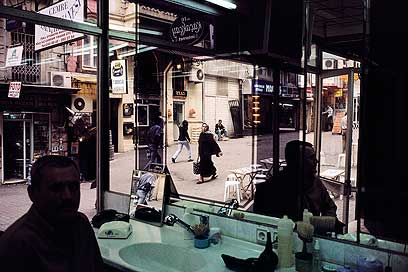
"As I am only here a few days, there are limits on what I can discover. I've only wandered around a little bit - and have talked with some local photographers and looked at their work. What I find particularly intriguing - although not startling - is being in a country confronted with issues of such weight - and of such complicated and broad ramifications - that they inform almost all journalistic discussion. For instance, I am struck by the fact that the majority of the photographers' work that I looked at the last few days deals in some way with the Palestinian issue.
"It makes me wonder about the relationship between journalism and art in places confronting such difficult issues. How can photographers try to illuminate especially thorny and complicated issues without overwhelming themselves or their viewers? Is it possible to do anything else? On some level, other issues begin to seem irrelevant."
"This question has only been reinforced by the fact that I started reading David Grossman's The Yellow Wind, in which he mentions something that JM Coetzee said upon winning the Jerusalem prize:
"Coetzee recalled the philosopher Nietsche, who said: 'We have art so that we shall not die of reality.' 'In South Africa,' Coetzee said, 'there is now too much truth for the art to hold. Truth that overwhelms and swamps every act of the imagination'."
This truth is present in every moment of Webb's life, but he is aware that even his camera cannot contain it – not as a report, and not as a work of art.
"Truth? Beauty? These words may be a little too loaded for me to use them. I'm simply responding to the world with the camera. On one level, it is a kind of reportage: But it is a highly interpretive and personal form of reportage. On another level it may be a kind of art: But it is an art that has a direct and immediate relationship with the real physical world. Perhaps the work is both reportage and art - or perhaps it's neither..."
When you are walking in the street, in your routine life, are you constantly looking for moments to capture? How obsessive do you get?
"At home in New York I rarely carry a camera unless I am specifically going out to photograph. When I photograph I need to concentrate on photographing, to remain alert to whatever is going on around me. I can't do it casually."
The world press photography exhibition is being shown in the Land of Israel Museum, Tel Aviv, until January 15.
- Follow Ynetnews on Facebook
