


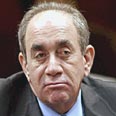
Akirov: I'll no longer invest in Israel
Although Concentration Committee's recommendations do not concern Alrov chief's business, he thinks government is being unfair. 'I wouldn't invest my money in a country that changes laws retroactively like Israel'
Although the recommendations of the committee for the reform in the economy (the Concentration Committee) do not concern any of his companies, he is disappointed with the government for making what he believes are wrong decisions because of public pressure.
"The implementation of the committee's recommendations will drive out foreign investors and lead to an abysmal recession. A case in point is Oil Refineries: If the government privatized the company (in 2007), why did it not warn the company that it would commission a concentration committee?
"You can't just go changing the rules all the time. The Sheshinski Committee was good on paper but harmful in the long run. Banks do not want to give gas companies funding to develop gas fields," Akirov says in an interview to Calcalist.
The businessman explains that he did not hire consultants to plead his case to the committee since his business does no stand in harm's way, unlike Nochi Dankner's IDB Group and Idan Ofer's Israel Corporation.
Both controlling shareholders expressly demanded the change of the committee's recommendations to separate real and financial holdings and of the restrictions and rules on pyramid companies.
Akirov, who invests his personal money in Israel through his public companies Alrov and Alrov real Estate, explains why he will no longer invest in Israel and why he refuses to invest in emerging markets.
"I invest in countries which have a sound legal system which cannot be bought. If I invest in India and there is a claim against me, the court can be bribed to rule against me.
"I will not invest in a country that changes its laws retroactively, and I hear a lot of investors saying that they will not invest in Israel because of the Concentration Committee's report. There's no problem changing the law proactively. The problem arises when you change the law retroactively. Business-wise, we have become an unenlightened country.
"Businessmen prefer certainty, which is why I invest in Switzerland. There they may raise taxes but not retroactively. The government can cut VAT – which I can accept," says Akirov, explaining the investment policy of Alrov Real Estate, which published its financial results on Monday and invests mainly in France, Holland and Switzerland.
'Makhteshim Agan workers will go home'
Akirov also touched on another major issue: "In the ChemChina deal, Dankner got the money but will not continue to invest in Israel. The factory employees will go home and no new investors will want to invest in new production facilities in Israel."
He adds that "the committee's recommendations should have been implemented proactively."
Akirov protests the government's economic policy and its refusal to boost employment. "You can't avoid encouraging the creation of more jobs and not bring in investors. According to the government statistics, unemployment is at 5% but participation rates are very low. The ultra-Orthodox don't work."
Despite his unwillingness to invest in Israel, his public company Alrov has hundreds of millions of shekels invested in Bank Leumi and Bank Hapoalim. Akirov is not planning any substantial liquidation of his bank investments in the near future if at all, in light of the crisis in the banking system.
"I believe that the crisis is not in the Israeli banking system. Even if there is a crisis in global banking, Israeli banks will continue to show profits. What's important to me is that the banks that I'm invested in continue to make profits.
"The stock market will make corrections and banks will yield a 15% return on equity", said Akirov and noted that Bank Hapoalim is traded on a valuations of 70% of its equity."
When asked why he has no investments in Mizrahi-Tefahot Bank despite its high profitability, Akirov explains: "I study the balance sheets and the companies. I don't want to spread out to investing in Mizrahi Tefahot although it's a good bank. Economy of scale works when investing in a small number of banks."
'Tourism in Israel is at a standstill'
Another issue that ruffles Akirov's feathers is the scant budget allocated for tourism.
"I met with the mayor of Paris. He said he had 26 million tourists in the country. What happened in Israel for the past 20 years? I can say that tourism is at a standstill. The government does not encourage releasing land for hotel construction and tourism.
"I'm in no position to claim the money the government owes me (money he says was promised to him as an incentive to build the Mamilla project in Jerusalem yet was withheld, which delayed the project for years)."
As for global real estate, Akirov says, "There are not many players on the market today aside from the institutional investors. We were able to increase our investments and we did so this year in Switzerland, Paris and London.
"London is very attractive for property purposes but return on the property is 2%-3%. In France we sold off property because it was going through the roof with 5% returns."
Click here to read this report in Hebrew
