


_a.jpg "צילום: ישראל ברדוגו")
The Jewish underground of Tel Aviv
Some 70 years ago, when Bialik was star of Sabbath-eve festivities, tradition and Torah were manifest in Tel Aviv's lifestyle. Some say that even today, it is just a myth that the Israeli metropolis is all secular
Speaking recently, in an interview for a book about the extinct Gymnasia Herzliya high school, former Labor MK Lova Eliav commented about his parent's home. "Father was a Zionist who raised us on the values of religion and tradition," he said. "The religious and traditional part came to me when I accompanied my father to the Great Synagogue."
In the 1930s and 1940s, the Great Synagogue on Allenby Street hosted not only Eliav and his father. Going to the synagogue was natural and obvious even for those who declared themselves secular. You did not have to don a yarmulke all week to visit shul on Shabbat. Jewish tradition was an inseparable part of Little Tel Aviv's lifestyle, which included cultural soirees on Friday nights, starring national poet Haim Nahman Bialik and featuring the weekly Torah portion.
To wit, some 500-600 synagogues dating to those days are found all over the city. Presently, most of them are inactive and some are only open on Sabbath and holydays. Many religious residents left the city, replaced by those who keep a yarmulke in the glove compartment, in case they must attend a funeral, God forbid.
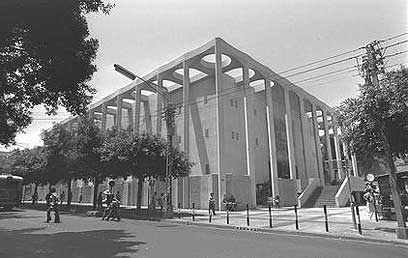
The Great Synagogue during the 1970s (Photo: Paritz Cohen, Laam)
In recent years, however, the process has started reversing. New yeshivot opened and synagogues that closed down for lack of visitors are being revived. The Siah Yitzhak Yedidya Yeshiva (named after the late Yitzhak Yedidya Frenkl, former Tel Aviv chief rabbi) took residence for a year on Trumpeldor Street, right across from the resting place of poets Bialik and Tschernihowsky, singer Shoshana Damari, and politicians such as Bugrashov. The synagogue members studied in the Nahlat Yitzhak Synagogue on the corner of Trumpeldor and Hebron Streets, which opened its locked gates with services three times a day, repainting its weary cheeks rosy.
The fickle, religious-secular nature of the city intrigued Lea Wilinger, a native and a guide at the Know Tel Aviv Center (tel: 03-5100337). Wilinger studied this issue thoroughly and now guides tours named "Synagogues: The Secular City Myth" where she relates the past and the present.
Dusty Tiles
One of the prettiest and most interesting synagogues in Tel Aviv is Moshav Zekenim on 89 Allenby Street. It was first established by Zerah Baranett, one of the founders of Petah Tikva, as an association in Jaffa in 1910, and after several stops it moved to its present location in 1921. At the time, they called a spade a spade and did not hide old age behind fancy names for senior citizens' homes. It was a Moshav Zekenim - seat of the old folks - period.
A plaque near the entrance to this old men's home carries the names of people who donated funds for its establishment, respectably mentioning the actual sum raised in Egyptian liras, old Israeli liras, or US dollars. This is the oldest parents' home in Tel Aviv.
At the time, most of the city residents were religious, which is why they laid the cornerstone for a new synagogue in 1926, despite the fact that the Great Synagogue was already standing across the street. It was designed by architect Megidovich. With time, they added respectable furniture, nicely decorated wooden benches, unique windows. Ceramic tiles with the emblems of the 12 tribes, painted by Ze'ev Raban, were placed at the front. Above the main entrance, next to the synagogue's name and in the same lettering style, they engraved the phrase, "Cast us not in our old age." In the center of the synagogue stands an elevated bima (Torah-reading platform) with fancy stairs leading to it.
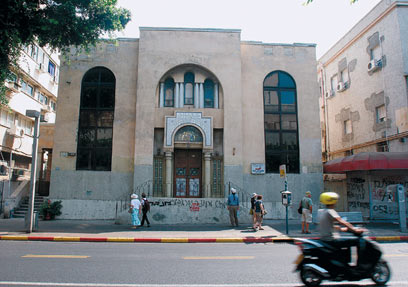
The Beit Zkenim Synagogue (Photo: Tzvika Tishler)
On the wall of the women's gallery, on the second floor, hangs this memorial plaque: "Mr Aharon Mordechay Feldstein, may his candle cast eternal light, son of Rabbi Menashe, donated 50 Palestinian liras and dedicated this synagogue window to the memory of his late wife, Mrs Tova Rachel Feldstein - daughter of Rabbi Yitzhak Moshe z"l, from Radom, Poland - who prayed here for 15 years and passed away on the Sabbath of the 'Para' Parasha in Leviticus, on 24 Adar, 5,707, and was buried on the Mount of Olives in Jerusalem." According to this plaque, Mrs Feldstein started praying in this synagogue in 1932, soon after it was built.
There is just one problem: the synagogue is closed, sealed with lock and chain. Today's local elderly are not religious and observant neighbors who pray are not to be found. Beauty and glory were abandoned and dust covers the splendid floor tiles with their wine-leaf pattern and the original furniture.
Harel Wax, the current parent's home manager who attended prayers here as a child with his grandfather, is guarding the synagogue like the apple of his eye, preventing undesirables, drunkards, and homeless from invading it and damaging the precious antiques.
"This synagogue was declared a 'building worth perseveration,' but the city does not have the budgets," Wax said. "It is up to us, and I hope and pray that we will find the necessary funds, and that we will be able to reopen it in less than two years, to mark Tel Aviv's 100th anniversary. Currently, the building is in good shape, though the roof will have to be replaced. Preservation works, to the tune of some $1 million, will follow the original rules, based on photographs taken when it was build, and remain faithful to the original down to the finest detail."
The synagogue's visitors-book carries entries by Rabbi Cook, Nahum Sokolov, and Meir Dizengoff, as well as the following lines by poet Yaacov Fichman: "Next to the Moshav Zekenim synagogue on Allenby Street, I once saw a small group of elders, sitting and talking with their heads bent toward each other, nearly touching. One of them spoke leisurely, almost whispering, and the others listened with some union of attention. To me, they seemed like a group of children, sitting and listening to fairytales… Proper elderly homes also serve as family homes that salvage a man from loneliness when his days come to a close."
Waiting for a Minyan
The Great Synagogue has been luckier than most. On Rosh Hashanah and Yom Kippur, at least, its glory days are restored when hundreds attend prayer. All year long, however, the situation is far less cheery and worship takes place on Sabbath only in the splendid central hall because there are very few worshipers.
When a wedding or a bar mitzvah takes place there, more attend, but on weekdays, the few that arrive, including many who work and not live nearby, they gather in a small side-room. One rainy winter day, I stepped in for a minha afternoon prayer. When I asked the gabbai when the prayer will start, his answer said it all: "Once we have a minyan."
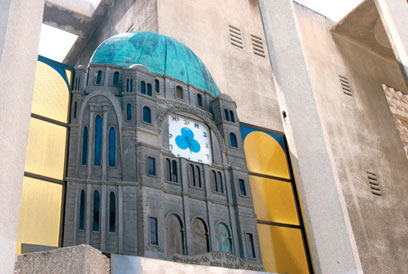
Clean, polished and shiny - The Great Synagogue
Although its glory days are in the past, the Great Synagogue survived architectural changes made in its vicinity. Pinhas, the key bearer of the synagogue ("you don’t need a last name; everyone knows me"), said that people come in during the day to observe the glory of the place. Built in 1924, the synagogue still has its original stained-glass windows and a large dome hovers above the center floor. It cannot be seen from the street level because of the arcade that was built around it in the 1960s. The place is sparkling clean as if God's very angels worked here tidying the place.
For visits on irregular hours, call: 03-5604905.
The Wedding of the Spy from Damascus
Not far from the Great Synagogue stands another still-active synagogue that came close to being closed as well: Ohel Moed on Shadal Street. This magnificent building was built in 1928 upon the initiative of then Sephardi Chief Rabbi Ben-Zion Meir Hay Uziel. Two dear Jews, Aharon Levi and Shimon Cohen from Aden, purchased the plot where it stands and donated it for the sacred cause.
With time, it became the largest Sephardi synagogue of Tel Aviv. In the center of the building stands yet another masterpiece by architect Joseph Berlin: a giant dome, made of 15 octagonal rows of stairs symbolizing the 15 elevations in the Temple. At the peak of the dome, glistens a decoration of polished diamond. Tel Aviv and Jaffa's richest used to pray here under the city's Sephardi chief rabbis, and weddings were held here, one of which was the wedding of Eli Cohen, the Israeli spy who was captured and executed in Damascus.
Presently, except for daily prayers by employees of the Electricity Company who work nearby and some 15 regular worshipers who come on Shabbat, the place is kept alive thanks to an entrepreneur who operates it as a family occasion hall. The splendid synagogue is taken care of and clean, serving as the entrance to the main hall. If you are around, do come in.
Dome and Arches Gone
Lea Wilinger's tour took us to the northern part of Tel Aviv, where we visited the unique synagogue of the Saloniki descendants near Ibn-Gvirol and Jabotinsky Streets, the pretty synagogue on Manet Street, the Hi-Tech synagogue in the Ichilov Hospital, and more.
"The synagogues of the 1920s and 1930s were built in the center of town and their magnificent buildings reflect a close tie with their location as part of a thriving secular society," Wilinger said. "They are an inseparable and significant part of the urban settings. The story is a little different in the northern part of town, where traditional architectural elements such as domes and arches are gone.
"Here, the synagogues are associated with specific communities, named after their place of origin: Saloniki, Germany, Anglo-Saxons; or known as 'uptown' community synagogues. In addition, there are the Hassidic courts and the Reform community in Bet Daniyel, located in this part of the city. Tel Aviv's diversity is reflected in its synagogues."
Returning to the Moshav Zekenim senior citizens' home and synagogue: the results of a study conducted by researchers from the Hebrew University's Geriatric Center in Jerusalem, which examined the impact of social ties on longevity, were published recently.
The researchers found that the religious sector was better off. The findings show that elderly who regularly visit synagogues live longer than their peers who do not. Mortality rate among secular elders was 75% higher than among synagogue goers. Prof Howard Litvin, who directed the study, said that this probably means that religion helps individuals to cope better with mental stress.
